

SYLLABUS
GS-3: Awareness in the fields of IT, Space, Computers, robotics, and issues relating to intellectual property rights; Science and Technology- developments and their applications and effects in everyday life.
Context: The World Development Report 2026 finds that 14.2% of jobs in high-income countries face potential automation by generative AI, compared with 4.5% in low- and middle-income countries.
About the Report
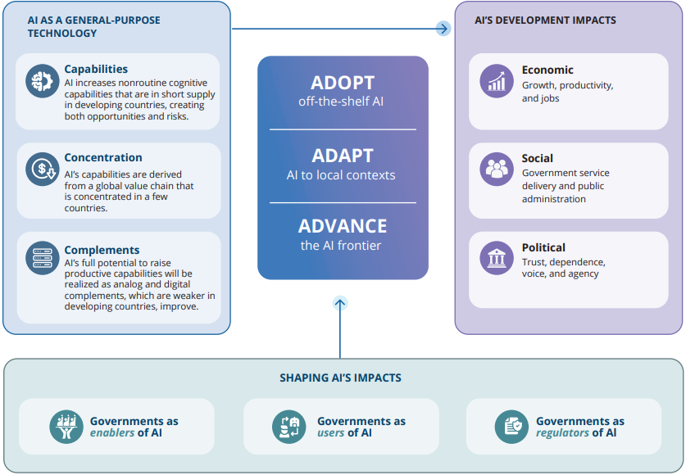
- The World Development Report 2026: The Promise of Artificial Intelligence, published by the World Bank, examines the implications of AI as a general-purpose technology for developing countries and its potential to address long-standing development challenges.
- The World Development Report (WDR) is an annual report published since 1978 by the World Bank.
- The 2026 report approaches AI through three pathways: adopt existing AI, adapt it to local conditions and eventually advance frontier AI.
Key Findings of the Report
- Unequal Exposure to Automation: About 14.2% of jobs in high-income countries are amenable to automation by generative AI, compared with 4.5% in low- and middle-income countries, while 16.2% of jobs in low- and middle-income countries can potentially be complemented by AI.
- AI Can Raise Productivity: AI can support farmers, small businesses, teachers, health workers and governments by improving decision-making, addressing shortages of specialised skills and increasing productivity.
- Nearly 90% of workers in low-income and lower-middle-income countries work in firms with fewer than 10 people, creating significant scope for AI-enabled productivity gains among small businesses.
- Rapid Global Diffusion: AI is spreading faster than earlier general-purpose technologies; within six months of ChatGPT’s launch, middle-income countries collectively accounted for half of its traffic.
- AI Can Support Economic Growth: At current adoption trends, AI’s productivity benefits are expected to be more than twice as large in advanced economies as in developing economies, largely because of wider adoption.
- In an optimistic scenario, AI could raise potential annual growth from 1.2% to 3.6% in advanced economies and from 4.1% to 4.9% in developing economies during the 2020s.
- Wider Development Impact: AI can improve public-service delivery through better forecasting, resource allocation and programme management, while also transforming education and healthcare; however, its social and political effects could reshape trust, dependence, voice and agency.
- Challenges:
- Weak Foundations: Inadequate electricity, internet, skills and digital infrastructure can limit AI adoption.
- Concentration: Advanced AI models, semiconductors, data centres and talent are concentrated in a few countries and companies.
- Inequality & Job Disruption: AI could widen productivity gaps and disrupt knowledge-intensive and entry-level jobs.
- Economic & Social Risks: AI could reshape trade, manufacturing and business-process outsourcing, increase energy costs and volatility, and enable fraud and cybercrime.
- Recommendations:
- Adopt: Use existing AI applications for agriculture, health, education, businesses and public services.
- Adapt: Customise AI to local languages, data, institutions and needs, supported by computing infrastructure and technical skills.
- Strengthen Foundations: Invest in electricity, internet, foundational skills, digital infrastructure, compute and AI-ready government data.
- Build Trustworthy AI Governance: Develop systems to procure, monitor, evaluate and scale AI applications while using standards and regulations to address harms.
- Adopt and Adapt with Care: Avoid both AI “hype” and “hysteria” and adopt and adapt AI with care but without delay, eventually advancing AI capabilities.