
SYLLABUS
GS-2: Issues relating to development and management of Social Sector/Services relating to Health, Education, Human Resources.
Context: The World Health Organization (WHO) issued its first global guidelines on the integrated management of obesity in children and adolescents, providing evidence-based recommendations for timely, people-centred and age-appropriate care.
More on the News
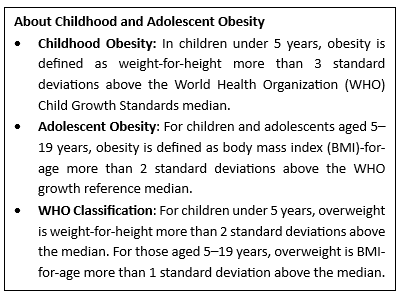
- The guidelines cover children aged 29 days to under 10 years and adolescents aged 10–19 years.
- They provide recommendations on dietary interventions, physical activity, behaviour change, digital health, medicines, bariatric surgery and weight-management devices.
- WHO emphasises a primary healthcare and people-centred approach, involving children, adolescents and caregivers.
- The guidelines also recognise the importance of mental health and psychosocial well-being, including the effects of stigma, discrimination and bullying.
Need for the Guidelines
- Rising Health Burden: Childhood obesity increases the risk of type-2 diabetes, cardiovascular disease and other non-communicable diseases, while affecting physical and mental well-being.
- Need for Age-Specific Care: Children and adolescents have distinct growth and developmental needs, requiring age-appropriate obesity management.
- Need for Evidence-Based Treatment: The growing use of medicines, digital interventions and surgery requires clear guidance on their appropriate use.
- Integrated Approach: Obesity management should address diet, physical activity, behaviour, mental health and social well-being, not just weight reduction.
- Beyond Clinical Care: Tackling obesity also requires healthier food and physical-activity environments through coordinated action across healthcare, education and food systems.
Childhood Obesity: Global and Indian Scenario
- Global Scenario: In 2024, around 170 million children and adolescents aged 5–19 years were living with obesity.
- This included 70 million children aged 5–9 years and 100 million adolescents aged 10–19 years.
- India’s Scenario: According to the World Obesity Atlas 2026, India ranks second globally after China in the number of children living with high BMI.
- In 2025, around 41 million Indian children aged 5–19 years were living with high BMI, including around 14 million with obesity.
- This included 14.9 million children aged 5–9 years and 26.4 million adolescents aged 10–19 years living with overweight or obesity.
- Around 74% of adolescents aged 11–17 years do not meet recommended physical-activity levels, highlighting sedentary behaviour as an important concern.
- India’s Initiatives
- Oil Boards: CBSE directed schools to install “Oil Boards” in common areas to raise awareness about excessive oil and high-fat food consumption.
- Sugar Boards: CBSE directed schools to establish “Sugar Boards” to create awareness about excessive sugar consumption and promote healthier eating habits.
- Eat Right School Programme: FSSAI promotes safe, healthy and sustainable eating habits among schoolchildren through awareness and experiential learning activities.
- Junk Food Regulation: FSSAI restricts the sale and marketing of foods high in fat, salt and sugar in schools and within 50 metres of school gates.
- Let’s Fix Our Food Consortium: ICMR-NIN-led consortium released a 2026 roadmap covering front-of-pack labelling, healthier school food, marketing restrictions, fiscal measures and nutrition literacy.
Key Recommendations of WHO Guidelines
- Lifestyle Interventions: WHO places structured lifestyle interventions at the foundation of obesity management.
- These include healthy dietary interventions, physical activity and behaviour-changing interventions.
- The guidelines support multimodal interventions, combining different approaches rather than relying on a single intervention.
- The focus is on improving health, functioning and well-being, rather than weight loss alone.
- Digital Health: Digital health interventions are conditionally recommended to support physical activity and behaviour change, with appropriate parent or caregiver supervision.
- Medicines: WHO does not recommend pharmacological treatment for children aged 0–9 years.
- For adolescents aged 10–19 years, approved medicines may be considered when a supervised multimodal lifestyle programme has not achieved the desired results.
- WHO also highlights that evidence on the long-term safety and effectiveness of some newer obesity medicines in children and adolescents remains limited.
- Bariatric Surgery: Bariatric surgery is not recommended for children aged 0–9 years. It may be considered under strict conditions for adolescents with severe obesity.
- Weight-Management Devices: WHO does not recommend weight-management devices for children aged 0–9 years, keeping lifestyle-based interventions at the centre of management for younger children.