SYLLABUS
GS-2: Government policies and interventions for development in various sectors and issues arising out of their design and implementation. Issues relating to development and management of Social Sector/Services relating to Education.
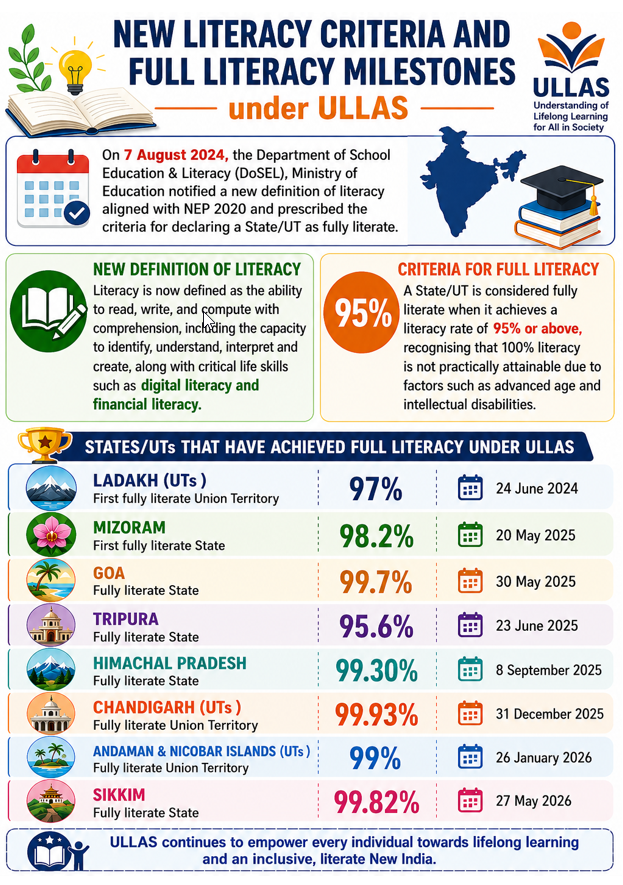
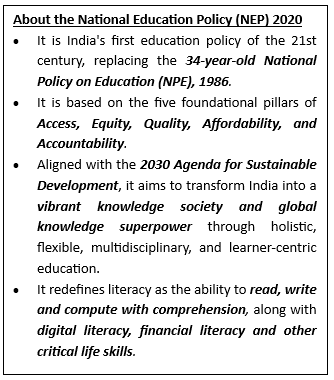
Context: Uttarakhand has become the sixth fully literate State in India after achieving the prescribed adult literacy benchmarks under the National Education Policy (NEP) 2020 and the ULLAS – New India Literacy Programme.
More on the News
- The State has a literacy rate of over 98%, exceeding the Government of India’s criterion of 95% literacy required for full literacy under the revised definition introduced in August 2024.
- With this achievement, Uttarakhand joins Mizoram, Goa, Tripura, Himachal Pradesh, and Sikkim among India’s fully literate States.
- Ladakh, Chandigarh and Andaman & Nicobar Islands have also achieved fully literate UT status.
- The achievement reflects coordinated efforts of the State Government, School Education Department, Samagra Shiksha, district administrations, volunteer teachers, local bodies and public participation under the ULLAS programme, while supporting the vision of Viksit Bharat 2047.
About the Understanding of Lifelong Learning for All in Society (ULLAS) – New India Literacy Programme
- ULLAS also known as the New India Literacy Programme (NILP), is a Centrally Sponsored Scheme implemented by the Ministry of Education.
- The scheme is being implemented during FY 2022–2027 and is aligned with NEP 2020.
- Vision: To make “Jan Jan Saakshar Bharat” through volunteerism based on the spirit of Kartavya Bodh (sense of duty).
- Target Group: Non-literate adults aged 15 years and above who missed formal schooling.
- Target: Achieve foundational literacy and numeracy for 5 crore learners during 2022–27 (1 crore learners annually).
- The scheme has a financial outlay of ₹1,037.90 crore (Central share: ₹700 crore; State share: ₹337.90 crore).
- Objectives:
- Provide Foundational Literacy and Numeracy (FLN).
- Promote critical life skills, including digital, financial, legal and health literacy.
- Support vocational skills and livelihood opportunities.
- Facilitate basic education equivalency.
- Encourage continuing and lifelong education.
- Salient Features:
- Implemented in hybrid mode (online and offline) through volunteerism.
- Learners and volunteer teachers are registered through the ULLAS Mobile App/Portal, with learning material available in 27 languages.
- Schools function as Samajik Chetna Kendras, while community halls, Panchayat offices, libraries and higher education institutions can also be used as learning centres.
- Literacy is assessed through the Foundational Literacy and Numeracy Assessment Test (FLNAT), conducted twice a year, with certificates jointly issued by NIOS and the Department of School Education & Literacy.
- Progress:
- More than 2.72 crore learners and over 43 lakh volunteer teachers have registered on the ULLAS platform.
- More than 1.7 crore learners have appeared in the FLNAT.
- ULLAS Literacy Week participation increased from 3.5 crore (2023) to 4.84 crore (2024) and 6.23 crore (2025).