
SYLLABUS
GS-2: Issues relating to development and management of Social Sector/Services relating to Health, Education, Human Resources.
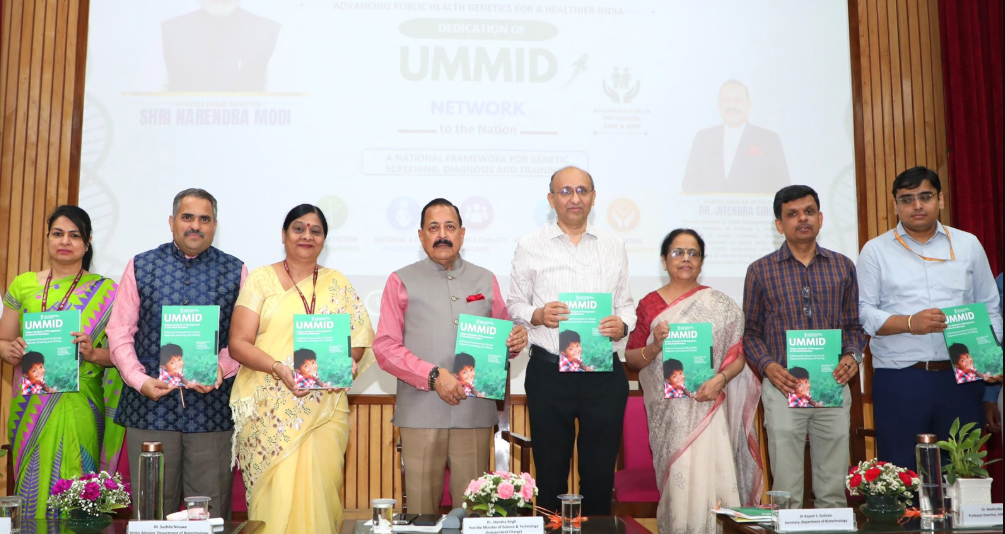
Context: The Government of India dedicated the UMMID (Unique Methods of Management of Inherited Disorders) Network to the nation to strengthen diagnosis, prevention, and management of rare genetic disorders through genome-based and precision-driven healthcare.
About the UMMID (Unique Methods of Management of Inherited Disorders)
- UMMID is a national initiative of the Department of Biotechnology under the Ministry of Science and Technology.
- It was launched in 2019 to address inherited genetic disorders through an integrated public health approach.
- The programme follows the principle of “Prevention is Better than Cure.”
- It aims to prepare India for the emerging era of molecular medicine, genomic healthcare and precision medicine.
Key Components of UMMID
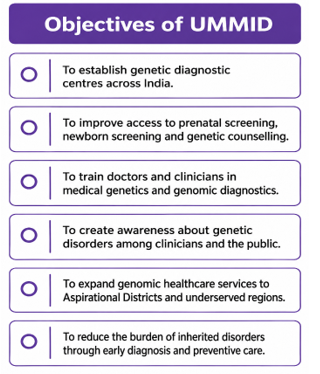
- Fellowship in Genetic Diagnostics: Doctors from government hospitals receive hands-on training in DNA-based diagnostics.
- Training is provided by advanced genetics institutions across India.
- The initiative aims to create skilled manpower in molecular genetics and clinical genetics.
- Around 96 doctors are planned to be trained over three years.
- NIDAN Kendras: NIDAN stands for National Inherited Diseases Administration Kendras.
- These centres provide advanced diagnostics, prenatal testing, counselling and multidisciplinary care.
- Nearly 30 NIDAN Kendras have been established across the country.
- They help expand genomic healthcare beyond metropolitan cities.
- Prevention of Genetic Disorders in Aspirational Districts: UMMID focuses on screening pregnant women and newborns for inherited disorders.
- Screening programmes target diseases such as beta-thalassemia and other treatable genetic conditions.
- The initiative integrates genetic services into maternal and child healthcare systems.
- It also spreads awareness among local communities and district-level healthcare workers.
Major Achievements
- Nearly three lakh individuals have benefited through screening and diagnostic services.
- A nationwide framework for genetic diagnostics and counselling has been developed.
- The programme has strengthened clinician training and community outreach.
- Genetic services have expanded to Aspirational Districts and remote regions.
- The UMMID Dashboard and UMMID Compendium were launched to improve monitoring and access to services.
Significance of UMMID
- It marks India’s first comprehensive national effort to manage inherited genetic disorders.
- It supports the transition from conventional healthcare to precision and genome-based medicine.
- It improves affordability and accessibility of genetic healthcare services.
- It strengthens preventive healthcare and early disease detection.
- It lays the foundation for future gene-based therapies and personalised treatment protocols.
- It contributes to research in genomics, pharmacogenetics and rare diseases.
About the Rare Genetic Disorders / Rare Diseases
- Rare diseases are chronic, debilitating, and often life-threatening conditions that affect a very small proportion of the population.
- Most of these diseases are genetic in origin and many begin during childhood.
- They usually require long-term treatment, continuous monitoring and specialized healthcare support.
- According to the World Health Organization, a rare disease affects one or fewer persons per 1,000 population. In India, the suggested threshold for defining a rare disease is around one person in 10,000.
- Genetic Disorders: Genetic disorders occur due to harmful changes (mutations) in genes or because of abnormalities in genetic material.
- Genes are made of DNA, which contains instructions for cell functioning and human characteristics.
- These mutations may be inherited from parents or may develop over time. Some genetic disorders are present at birth, while others appear later in life.
Types of Genetic Disorders
- Chromosomal Disorders: These disorders arise due to missing, extra or duplicated chromosome material. Since chromosomes carry genes and DNA within cells, such abnormalities can affect normal growth and development.
- Examples include Down syndrome, Turner syndrome and Klinefelter syndrome.
- Complex (Multifactorial) Disorders: These disorders result from the combined effect of genetic mutations and environmental factors such as diet, smoking, alcohol consumption, chemical exposure and medicines.
- Examples include Diabetes, Cancer, Coronary artery disease and Autism spectrum disorder.
- Single-Gene (Monogenic) Disorders: These disorders are caused by mutation in a single gene and are usually inherited within families.
- Examples include Cystic fibrosis, Sickle cell disease, Duchenne muscular dystrophy and Tay-Sachs disease.
Global and Indian Scenario
- Globally, nearly 6,000–8,000 rare diseases have been identified.
- Around 80% of them are genetic in nature, and nearly half affect children.
- In India, only a limited number of rare diseases have been systematically documented due to the lack of comprehensive epidemiological data and disease registries.
- Commonly reported rare diseases in India include Gaucher disease, Pompe disease, Cystic fibrosis, Muscular dystrophy, Spinal muscular atrophy and lysosomal storage disorders.