

SYLLABUS
GS-2: Structure, organization and functioning of the Executive and the Judiciary Ministries and Departments of the Government.
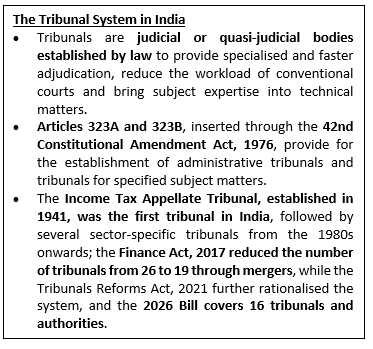
Context: The Tribunals Reforms Bill, 2026 was passed by the Lok Sabha, seeking to repeal the Tribunals Reforms Act, 2021 and establish a National Tribunals Commission (NTC) to improve the efficiency, independence, transparency and uniformity of tribunals.
Key Provisions of the Bill
- Establishment of National Tribunals Commission (NTC): The Bill establishes the NTC as an overarching body to oversee the appointment, administration and functioning of tribunals.
- Headquartered in New Delhi, with 1 Chairperson, 2 Judicial Members and 2 Technical Members.
- Chairperson: Former Supreme Court Judge or High Court Chief Justice; Judicial Members: Former High Court Chief Justices or Judges.
- Technical Members: At least 25 years of experience in public administration, finance, law, accountancy, banking, management or technology.
- Tenure: 5 years or until 70 years of age, whichever is earlier.
- Appointment: By the Central Government; Chairperson and Judicial Members appointed after consultation with the Chief Justice of India.
- Functions of the NTC:
- NTC will select tribunal members, review performance, oversee complaints against members, and maintain the National Tribunals Data Grid.
- Selection Committees: It will constitute Search-cum-Selection Committees for tribunal appointments.
- Committees will include NTC members, retired High Court judges, a government secretary, experts and the Commission Secretary.
- Recommendations: For each vacancy, one name for appointment and one for the waiting list.
- Appointment: The Central Government must appoint within 3 months of receiving the recommendation.
- Uniform Tenure and Service Conditions:
- Tenure: Chairpersons — 5 years or until 70 years; other Members — 5 years or until 67 years, whichever is earlier.
- Reappointment: Based on previous performance; Members require consultation with the concerned Tribunal Chairperson.
- Service Conditions: Central Government will prescribe rules on qualifications, selection, salaries, allowances, resignation, removal and other conditions.
- Removal and Accountability: Central Government may remove NTC or Tribunal Chairpersons/Members for insolvency, moral-turpitude conviction, incapacity, abuse of position or conflicting interests; Tribunal members may also be removed for incompetence, inefficiency or paid assignments.
- NTC will oversee inquiries into complaints against Tribunal Chairpersons and Members.
- National Tribunals Data Grid (NTDG): The Bill proposes a NTDG with tribunal case information to improve transparency and performance monitoring.
- Tribunals Covered: 16 Tribunals/Authorities: Includes Central and State Administrative Tribunals, Securities Appellate Tribunal, Debts Recovery Tribunal, Telecom Disputes Settlement and Appellate Tribunal, Armed Forces Tribunal, National Green Tribunal, National Company Law Appellate Tribunal, National Consumer Disputes Redressal Commission and Income-tax Appellate Tribunal.
- The Bill does not alter tribunal jurisdiction under their parent Acts.
- Central Government may add or alter tribunals through Gazette notification, subject to laying it before Parliament.
- Repeal and Financial Provision: Repeals the Tribunals Reforms Act, 2021 and provides a framework for appointments and service conditions in line with Supreme Court directions.
- Protects existing appointments and selection processes initiated under the 2021 Act before NTC establishment.
- NTC and its Secretariat are estimated to require ₹27.14 crore annually — ₹24.79 crore recurring and ₹2.35 crore non-recurring.
Need and Significance of the Bill
- Strengthening Judicial Independence: The Bill seeks to insulate tribunals from excessive executive interference by establishing an overarching NTC with judicial and technical expertise for appointments and oversight.
- Addressing Tribunal Vacancies: The requirement for the Central Government to make appointments within three months of receiving recommendations can help address chronic vacancies and improve the timely functioning of tribunals.
- Ensuring Uniformity and Transparency: The Bill introduces uniform standards for qualifications, selection, tenure and service conditions while creating transparent Search-cum-Selection Committees for tribunal appointments.
- Improving Tribunal Accountability: The NTC’s role in reviewing tribunal performance and overseeing inquiries into complaints against Chairpersons and Members can strengthen institutional accountability.
- Strengthening Access to Justice: The NTDG and a more efficient tribunal system can improve transparency, case monitoring and the delivery of specialised and speedy justice in areas such as taxation, company law, environment and securities.