
SYLLABUS
GS-2: Structure, organization and functioning of the Executive and the Judiciary Ministries and Departments of the Government.
Context: The e-Courts Mission Mode Project is transforming India’s paper-based judiciary into a digitally enabled, transparent, accessible and citizen-centric justice delivery system through digitisation of court records, e-filing, virtual hearings and emerging technologies.
About the e-Courts Mission Mode Project
- It was launched in 2007 to modernise India’s paper-based judicial system by digitising court proceedings and documents and making the judicial process more affordable, accessible and transparent.
- The project is being implemented in phases and is currently in its third phase (2023–2027).
- Phase I (2011–2015): Building the Digital Foundation: Phase I laid the foundation of the Mission by computerising over 14,000 courts and building the basic network infrastructure needed to support technology-enabled judicial services.
- It focused on creating the technological foundation for the subsequent expansion of digital judicial services.
- Phase II (2015–2023): Expanding Citizen-Centric Services: Phase II built on this foundation through a range of citizen-centric services, including the National Judicial Data Grid (NJDG), e-Filing and e-Sewa Kendras.
- During this phase, video conferencing infrastructure increased more than fivefold, significantly enhancing virtual access to judicial proceedings. The phase expanded digital access to case information and judicial services for citizens, lawyers and other stakeholders.
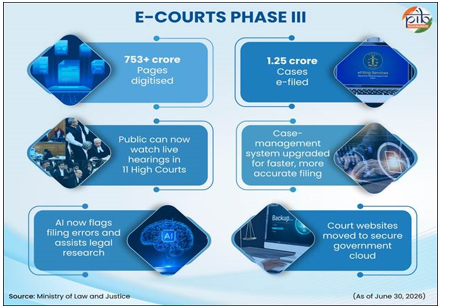
- Phase III (2023–2027): Digital, Paperless and Intelligent Courts: The ongoing Phase III aims to create digital, paperless and intelligent courts through digitisation, virtual hearings, institutional interoperability and Artificial Intelligence, Machine Learning, analytics and Optical Character Recognition.
- It has established 1,806 e-Sewa Kendras, 474 paperless courts, 538 Virtual Courts and e-filing in 4,519 courts, with video conferencing across 7,553 establishments, solar facilities in 1,626 court complexes and NSTEP in 6,895 courts.
- All High Courts have implemented ICJS, 734 court websites have migrated to S3WAAS, with 2,372 trainings, 174 SD-WAN sites, and a total outlay of ₹7,210 crore, including ₹53.57 crore for Artificial Intelligence and Machine Learning.
Major Benefits of Court Digitisation in India
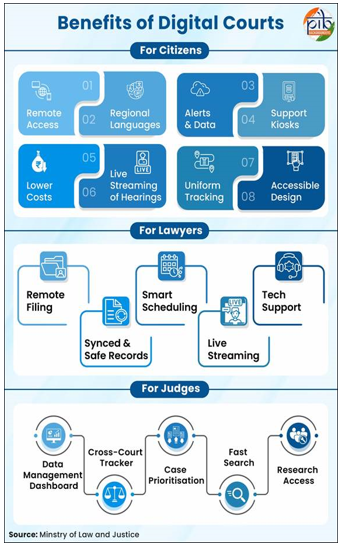
- Transparency through the National Judicial Data Grid: NJDG provides real-time public access to case data, pending/disposed cases, case stages and reasons for delays across the Supreme Court, High Courts and District Courts.
- Faster Filing and Digitisation of Court Records: e-Filing enables online filing, payments, e-signing and case tracking, with 1.25 crore+ cases filed, ₹1,404 crore court fees, ₹75 crore fines processed and 753 crore+ pages digitised.
- Affordable Access through Virtual Courts and Video Conferencing: Over 4.18 crore remote hearings have been conducted across 7,553 establishments, livestreaming operates in 11 High Courts, and 31 Virtual Courts have received 11.33 crore challans worth ₹1,135.79 crore,
- while Nyaya Shruti enables virtual participation in proceedings.
- Integrated Digital Criminal Justice System: ICJS digitally connects police, courts, prisons, forensic laboratories and prosecution agencies through platforms.
- Including CCTNS, ITSSO, e-Sakshya, e-Summons, MedLEaPR, e-Forensic, e-Prison, e-Prosecution and NAFIS, while NSTEP enables GPS-tracked electronic summons.
- Inclusive Access through e-Sewa Kendras and Digital Platforms: 2,584 e-Sewa Kendras provide case-status, certified-copy, e-filing, payment, legal-aid and virtual-hearing assistance,
- while the e-Courts portal records 35 lakh daily visits, sends 4 lakh+ SMSs and 6 lakh emails daily, and the app has 3.84 crore downloads; JustIS assists judges in monitoring judicial work.
- AI-Enabled and Multilingual Judicial Services: AI and Machine Learning tools such as LegRAA, Digital Courts 2.1, ASR-SHRUTI and PANINI support legal research, case management, transcription and translation, with 83,000+ judgments translated into 18 Indian languages.
- Including 36,000+ in Hindi, and an IIT Madras-developed AI tool being tested for e-filing defects and case-data extraction.