
SYLLABUS
GS-2: Issues Relating to Development and Management of Social Sector/Services relating to Health; Welfare Schemes for Vulnerable Sections of the Population by the Centre and States.
Context: The World Health Organization (WHO) and the International Agency for Research on Cancer (IARC) recently released the Global Status Report on Cancer 2026, providing a comprehensive assessment of global progress and gaps in cancer prevention, diagnosis, and treatment.
More on the News
- The report is jointly produced by WHO and IARC and reviews global progress in cancer control since 2010 across prevention, early detection, diagnosis, treatment, survivorship, and palliative care.
- It incorporates findings from WHO’s first-ever global survey of people affected by cancer, bringing patient and caregiver experiences into cancer policy discussions.
- The report seeks to support countries in strengthening national cancer control strategies through a more equitable and people-centred approach aligned with Universal Health Coverage (UHC).
Key Findings of the Report
- Global Cancer Burden Continues to Rise: Cancer remains the second leading cause of death globally, with 20.6 million new cases and nearly 10 million deaths annually. Annual cases are projected to rise to nearly 35 million by 2050.
- Significant Regional Disparities: In 2024, Asia accounted for 50.7% of global cancer cases and 56.5% of deaths, while Europe contributed 21% of cases and 20% of deaths despite having only 9% of the world’s population.
- Cancer Outcomes Remain Highly Unequal: Five-year breast cancer survival is 87% in high-income countries compared to 42% in low-income countries, highlighting major disparities in access to care.
- Lung Cancer Remains the Deadliest Cancer: Lung cancer is the leading cause of cancer deaths worldwide.
- Among men, lung, prostate and colorectal cancers are the most common, while among women, breast, lung and colorectal cancers account for a major share of cases.
- Policy and Research Efforts Have Expanded: Countries with National Cancer Control Plans increased from 50% in 2010 to 82% in 2026, while registered cancer clinical trials grew by 7.3% annually between 2005 and 2021.
- Limited Integration into Universal Health Coverage: Fewer than one-third of countries include comprehensive cancer care in their UHC packages, leaving many without access to essential services.
- Heavy Social and Economic Costs: 45% of affected individuals face financial hardship, more than half experience mental-health challenges, and nearly all caregivers report significant strain.
Implications for India
- Rising Cancer Burden: As Asia accounts for over half of global cancer cases and deaths, India is likely to witness a significant increase in cancer burden due to population ageing, urbanisation, and lifestyle changes.
- Strengthening Prevention Efforts: With nearly four in ten cancers being preventable, India needs to scale up tobacco control, HPV vaccination, Hepatitis-B immunisation, and healthy lifestyle interventions.
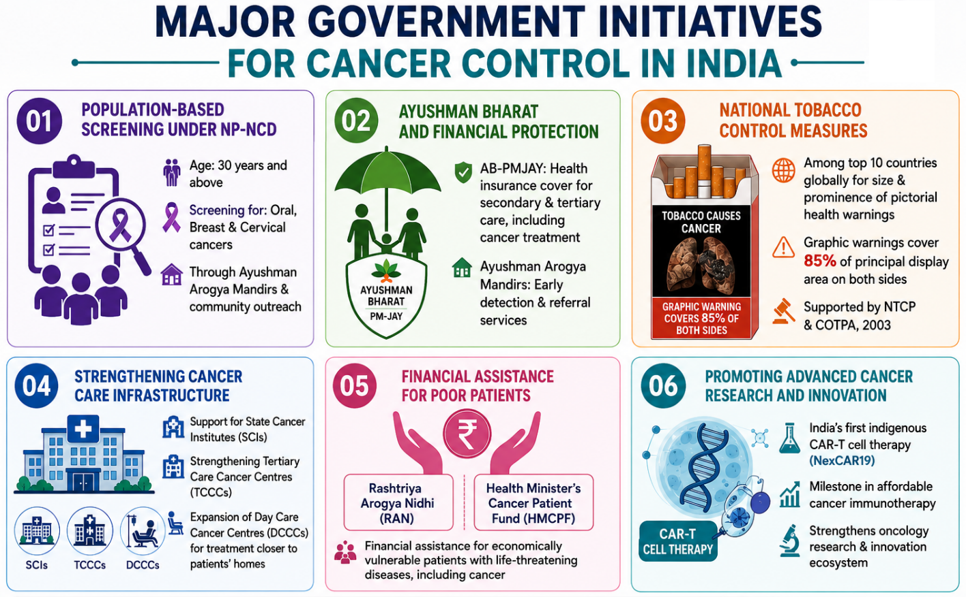
- Bridging Healthcare Inequities: Persistent gaps in access to screening, diagnostics, radiotherapy, oncology specialists, and essential medicines call for more equitable cancer-care infrastructure across regions.
- Enhancing Financial Protection: The finding that 45% of affected individuals face financial hardship underscores the need to reduce out-of-pocket expenditure and strengthen financial support for cancer patients.
Key Recommendations
- Prioritize Prevention: Scale up tobacco control, HPV and Hepatitis-B vaccination, healthy lifestyle promotion, and measures to reduce environmental risk factors.
- Strengthen Early Detection and Treatment: Expand screening, diagnostic services, radiotherapy facilities, and access to essential cancer medicines, especially in underserved areas.
- Ensure Equitable and Affordable Care: Integrate comprehensive cancer services into Universal Health Coverage frameworks and reduce financial barriers to treatment.
- Adopt a People-Centred Approach: Incorporate patient and caregiver perspectives while strengthening survivorship, rehabilitation, mental-health, and palliative-care services.
- Promote Collaboration and Innovation: Foster public-private partnerships, international cooperation, and investments in cancer research, innovation, and health-system capacity.