SYLLABUS
GS-2: Government Policies and Interventions for Development in various sectors and Issues arising out of their Design and Implementation.
GS-3: Infrastructure: Energy; Indigenization of Technology and Developing New Technology.
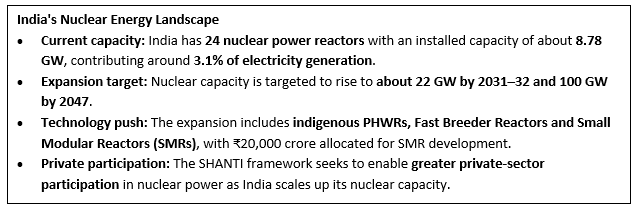
Context: The Department of Atomic Energy (DAE) has released the Draft SHANTI Rules, 2026 for public consultation to operationalise the SHANTI Act, 2025.
More on the News
- The Draft Rules seek to establish the operational regulatory framework under the SHANTI Act, 2025.
- They cover areas including nuclear liability, financial security, licensing and nuclear safety.
- The framework is intended to support the safe and regulated expansion of India’s nuclear sector.
Key Highlights of the Draft Rules
- Nuclear liability and financial security: Operators must maintain insurance, financial security or a combination of both against nuclear damage. Financial security must continue until all spent fuel is removed from the concerned storage pool.
- 1:1.33 security margin: Where financial instruments are used as security, a 1:1.33 security margin is prescribed. Any shortfall must be covered through additional financial security or insurance.
- Periodic liability review: The Central Government will constitute an expert group every five years to review the maximum limits of an operator’s civil liability for nuclear damage.
- Simplified licensing: A single composite licence is proposed for building, owning, operating and decommissioning a nuclear power plant or reactor.
- Foreign reactor technology: Foreign-designed reactors would require certification or approval by the regulatory authority in the country of origin and must be operational in the country of origin or another foreign country. The draft defines the country of origin in terms of a self-reliant reactor-design and supply-chain ecosystem with globally trusted regulatory approvals.
- Captive and emerging applications: The Rules recognise captive nuclear power for energy-intensive industries and applications such as data centres, semiconductor manufacturing and AI, subject to the regulatory framework.
Significance for India’s Nuclear Energy Sector
- Enables nuclear expansion: Clearer licensing and liability rules can support India’s ambition to scale up nuclear power as part of its long-term clean-energy mix.
- Facilitates private participation: Predictable rules can enable the wider participation of Indian private entities envisaged under the SHANTI Act. The Act permits private participation subject to Central Government licensing and regulatory authorisation.
- Strengthens regulatory governance: The SHANTI framework gives statutory status to the Atomic Energy Regulatory Board (AERB), providing an institutional foundation for regulating an expanding nuclear sector.
- Supports reliable clean power: Captive nuclear generation could provide continuous low-carbon electricity to energy-intensive industries and emerging sectors such as AI, data infrastructure and advanced manufacturing.
Key Concerns
- Liability–accountability balance: Liability limits must not weaken effective compensation and accountability after a nuclear incident.
- Supplier accountability: The SHANTI framework’s narrower operator recourse against suppliers raises concerns about responsibility for defective equipment or technology across the nuclear supply chain.
- Regulatory capacity: Wider private participation and more nuclear activities will increase demands on AERB’s technical expertise, independence and enforcement capacity.
- Technology dependence: Greater access to foreign reactor technology should not create excessive dependence on external suppliers, critical components or long-term technology support.
Way Forward
- Risk-based financial safeguards: Periodically review liability limits, insurance requirements and the 1:1.33 security margin against project scale, inflation and evolving nuclear risks.
- Strengthen AERB: Enhance its technical expertise, institutional capacity and enforcement capability before large-scale private participation expands.
- Build domestic capability: Combine access to foreign reactor technologies with indigenisation of components, skilled manpower and resilient nuclear supply chains.
- Safety-led expansion: Ensure faster nuclear deployment is accompanied by robust radiation protection, radioactive-waste management, emergency preparedness and compensation mechanisms.