
SYLLABUS
GS-2: Structure, organization and functioning of the Executive and the Judiciary Ministries and Departments of the Government.
Context: The Supreme Court held that the nearly half-century-old expansive interpretation of “industry” in the 1978 Bangalore Water Supply and Sewerage Board v. A. Rajappa case will continue for pending disputes under the Industrial Disputes Act, 1947, but will not automatically apply to the Industrial Relations Code (IRC), 2020.
Key Highlights of the Judgement
- The nine-judge Constitution Bench held that the 1978 interpretation of “industry” under Section 2(j) of the Industrial Disputes Act will not act as the “sheet anchor” for interpreting “industry” under Section 2(p) of the IRC.
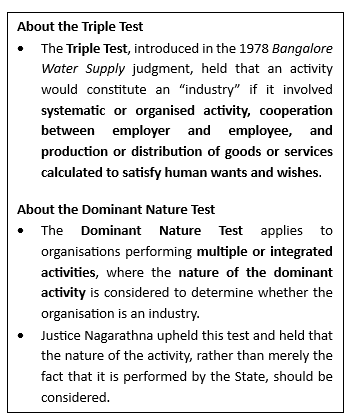
- The 1978 Triple Test will continue to govern pending proceedings under the Industrial Disputes Act, 1947, and the Court did not retrospectively replace it with a new test.
- The future meaning of “industry” under the IRC will be interpreted independently, based on its own statutory text and scheme.
- CJI Surya Kant observed that the elements of the 1978 Triple Test could have been articulated differently and suggested a possible refinement, including a discernible commercial character analogous to trade or business.
- The suggested refinement is only a considered opinion and cannot be used to alter the governing legal position in pending proceedings under the 1947 Act.
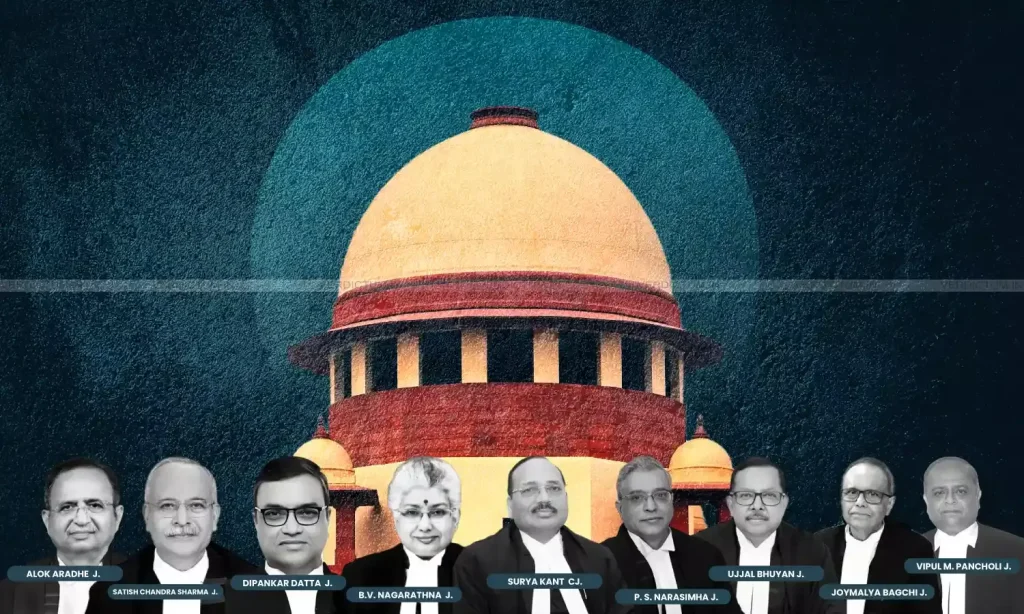
- Justice B.V. Nagarathna, supported by Justices Dipankar Datta and Ujjal Bhuyan, held that reconsideration of the 1978 judgment was unwarranted and that its broad interpretation remained important for safeguarding workers.
- Justice Joymalya Bagchi agreed that the 1978 judgment correctly determined the scope of “industry” but disagreed with reformulating the Triple Test; however, he agreed with the majority that the IRC should not be encumbered by the 1978 verdict in future disputes.
Industrial Relations Code, 2020
- The Industrial Relations Code, 2020 replaced the Industrial Disputes Act framework and contains its own definition of “industry” under Section 2(p).
- It covers systematic activity involving cooperation between employers and workers for the production, supply or distribution of goods or services, irrespective of capital investment or profit motive.
- The Code excludes charitable and philanthropic institutions, domestic service and sovereign government functions, among specified exclusions.
- The Supreme Court held that the meaning of “industry” under the IRC must therefore be interpreted independently, rather than by automatically importing the 1978 interpretation of Section 2(j).
Significance / Implications
- Future IRC disputes: The meaning of “industry” under the IRC will develop through interpretation of the new Code itself.
- Worker protection: The decision may affect the future scope of labour-law protection because the 1978 interpretation had brought a wide range of workers and establishments within its ambit.
- Sovereign functions: Government involvement alone does not automatically make an activity sovereign; the nature of the activity remains relevant.
- Legal certainty: By retaining the 1978 position for pending cases, the Court avoided disturbing the legal basis of existing proceedings.
- New phase of labour jurisprudence: The judgment separates the jurisprudence governing legacy disputes under the Industrial Disputes Act, 1947 from the future interpretation of the Industrial Relations Code, 2020.