SYLLABUS
GS-3: Issues related to direct and indirect farm subsidies and minimum support prices; Public Distribution System (PDS) – Objectives, Functioning, Limitations; Major crops-cropping patterns in various parts of the country.
Context: The Cabinet Committee on Economic Affairs (CCEA) has approved higher Minimum Support Prices (MSPs) for all six mandated Rabi crops for the 2027–28 Marketing Season, with the government estimating an MSP procurement payout of ₹90,962 crore for around 324 lakh tonnes of these crops.
More on the News
- Revised MSPs:
- Wheat: ₹2,610/quintal — increase of ₹25
- Barley: ₹2,286/quintal — increase of ₹136
- Gram: ₹5,958/quintal — increase of ₹83
- Lentil (Masur): ₹7,390/quintal — increase of ₹390
- Rapeseed & Mustard: ₹6,613/quintal — increase of ₹413
- Safflower: ₹7,215/quintal — increase of ₹675, the highest absolute increase.
- Return over cost: The expected margin over the all-India weighted average cost of production is 106% for wheat, 96% for rapeseed & mustard, 92% for lentil, 59% for gram, 58% for barley and 50% for safflower.
- Policy Focus: The relatively higher increases for pulses and oilseeds are intended to encourage crop diversification beyond cereals, while strengthening domestic production of these crops.
Understanding Minimum Support Price (MSP)
- MSP is a government-announced price support mechanism intended to protect agricultural producers against sharp falls in market prices and provide remunerative returns.
- MSPs are announced by the Cabinet Committee on Economic Affairs (CCEA) on the recommendations of the Commission for Agricultural Costs and Prices (CACP).
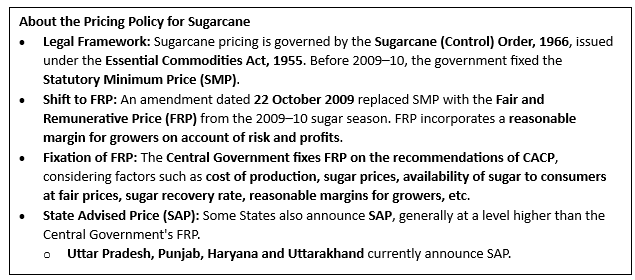
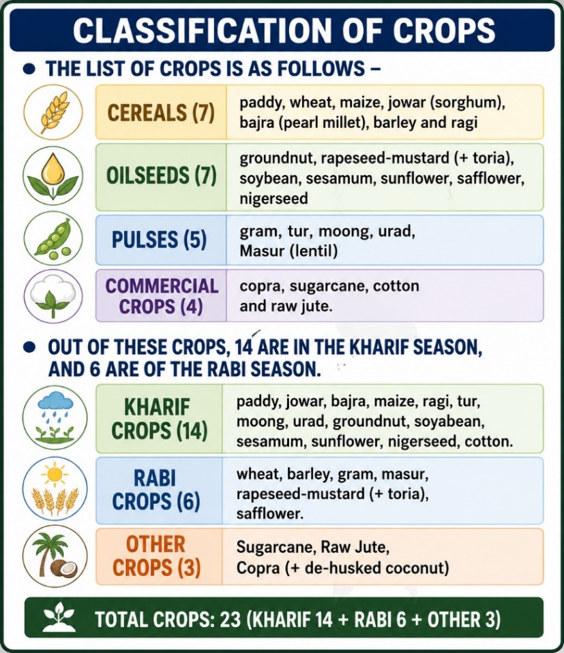
- India currently announces MSPs for 22 mandated crops, while sugarcane is covered under the separate Fair and Remunerative Price (FRP) system.
- The CACP considers factors such as cost of production (A2+FL method), demand and supply, inter-crop price parity, effect on the general price level, and domestic and international prices while recommending MSPs.
- The cost framework includes:
- A2: Actual paid-out costs such as seeds, fertilisers, labour, fuel and irrigation.
- A2+FL: A2 plus the imputed value of unpaid family labour.
- C2: A2+FL along with imputed rent on owned land and interest on fixed capital.
- Since the Union Budget 2018–19, the government has followed the policy of fixing MSP at least 1.5 times the all-India weighted average cost of production, implying a minimum 50% margin over the relevant cost.
- Announcement of MSP does not mean automatic procurement of the entire crop. Government agencies procure crops under applicable procurement arrangements, and farmers may also sell in the open market.
- Thus, the effectiveness of MSP as a price-support mechanism depends significantly on the availability and scale of actual procurement.
Significance of MSP Increase
- Farmer price assurance: Higher MSPs strengthen the administered price-support framework and seek to provide remunerative returns to farmers.
- Crop diversification: Larger increases for oilseeds and pulses, particularly safflower, rapeseed-mustard and lentil, strengthen incentives to diversify beyond cereal-dominated cropping patterns.
- Pulses and edible-oil security: Greater support for pulses and oilseeds can encourage domestic production, with implications for reducing dependence on imports.
- Scale of government intervention: For 2027–28, the government estimates procurement of about 324 lakh tonnes of the six Rabi crops, involving an estimated ₹90,962 crore payment to farmers.