
SYLLABUS
GS-2: Structure, Organization, and Functioning of the Executive and the Judiciary; Government Policies and Interventions for Development in various sectors and issues arising out of their Design and Implementation.
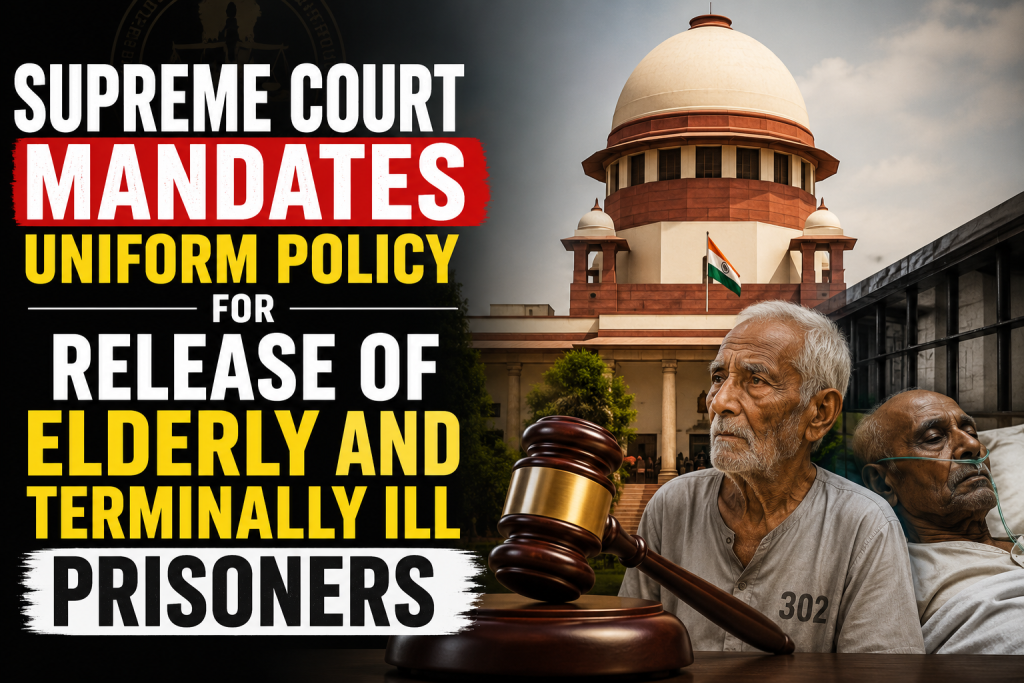
Context: The Supreme Court has directed all States and Union Territories to formulate, within three months, a uniform policy for the premature release of elderly and terminally ill prisoners.
More on the News
- The directions were issued by a division bench while deciding a Public Interest Litigation (PIL) filed by the National Legal Services Authority (NALSA) seeking a uniform mechanism for the release of elderly, infirm, and terminally ill prisoners.
- Invoking its extraordinary powers under Article 142, the Supreme Court stepped in due to the absence of a uniform national framework governing the premature release of such vulnerable prisoners across States and UTs.
- The Court observed that prisoners do not lose their fundamental rights upon incarceration and emphasised that the constitutional guarantee of dignity and humane treatment under Article 21 extends even to elderly and terminally ill inmates.
Key Directives of the Supreme Court
- Formulation of a Comprehensive Policy: All States and UTs have been directed to formulate and notify, within three months, a comprehensive policy for the premature release of elderly, infirm, and terminally ill prisoners.
- Uniform Definition of Terminal Illness: The Supreme Court directed States and UTs to adopt a clear and uniform definition of “terminal illness” and allowed them to draw upon the definition contained in the UNODC Handbook on Prisoners with Special Needs, 2009.
- It defines terminal illness as a medical condition with no reasonable possibility of improvement, leading to continuous degeneration and eventual death.
- Objective Eligibility Criteria: The policy must prescribe transparent and objective eligibility criteria, including age, medical condition, nature of illness, and other relevant humanitarian considerations.
- Consultation with Legal Services Authorities: States and UTs have been directed to frame the policy in consultation with the State Legal Services Authorities (SLSAs) to facilitate identification of eligible prisoners and ensure effective implementation.
- Independent Medical Boards: States and UTs must constitute independent medical boards at divisional and State levels to assess the health condition of prisoners and provide objective recommendations regarding eligibility for premature release.
- Technology-Driven Processing: Applications for premature release are to be processed through the e-Prisons portal, with the National Informatics Centre (NIC) and the Union Government providing technological support to ensure effective monitoring and timely processing of cases.
Understanding the Premature Release of Prisoners in India
- Premature release refers to the release of a convicted prisoner before the completion of the full sentence on grounds such as age, health condition, good conduct, humanitarian considerations, or public interest.
- Unlike parole and furlough, which provide temporary release from prison, premature release permanently shortens the period of incarceration through remission, commutation, or government release policies.
- Constitutional and Statutory Framework
- The President and Governors exercise clemency powers under Articles 72 and 161 of the Constitution, respectively.
- In addition, Sections 473–475 of the Bharatiya Nagarik Suraksha Sanhita (BNSS), 2023 deal with suspension, remission, and commutation of sentences and provide the statutory basis for premature release policies implemented by State Governments.
Significance of the Judgment
- Strengthening the Right to Dignity: The judgment reinforces the principle that the right to life and dignity survives incarceration, particularly for elderly and terminally ill prisoners.
- Advancing Reformative Justice: It promotes a shift from a purely punitive approach towards a more humane and reformative criminal justice system.
- Humane Treatment of Vulnerable Prisoners: The decision recognises the special healthcare, palliative care, and end-of-life needs of elderly, infirm, and terminally ill inmates.
- Promoting Uniformity Across States: A common policy framework can reduce disparities in premature-release practices and ensure more consistent treatment of similarly placed prisoners.
- Addressing Prison Overcrowding: The release of prisoners who pose minimal security risks and require specialised medical care can contribute to broader prison-reform efforts and help ease overcrowding in prisons.
SOURCES :
The Hindu
Verdictum
New Indian Express