

SYLLABUS
GS-3: Indian Economy and issues relating to Planning, Mobilisation of Resources, Growth, Development and Employment; Investment Models; Inclusive Growth.
Context: NITI Aayog has released the first-ever Investment Friendliness Index (IFI) 2026 to assess how effectively States and Union Territories create an enabling environment for attracting and sustaining investments in line with the vision of Viksit Bharat @2047.
About the Investment Friendliness Index (IFI)
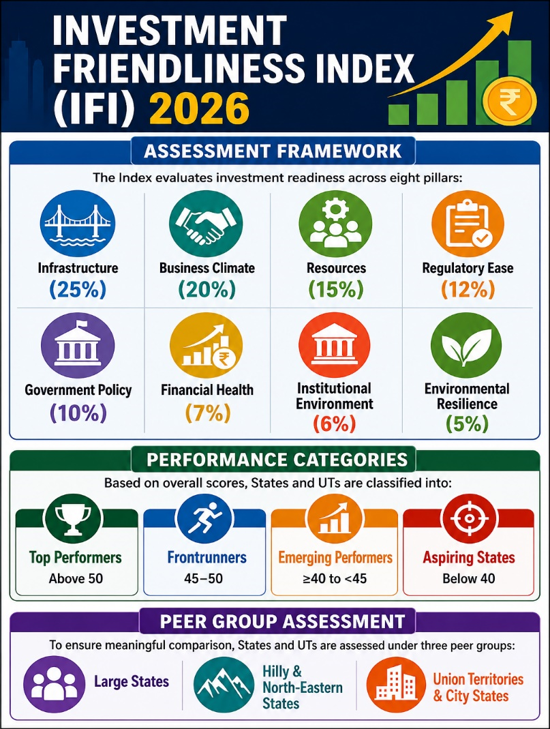
- It is a data-driven framework developed by NITI Aayog to assess the investment ecosystem across all 28 States and 8 Union Territories.
- The Index evaluates investment readiness using 84 indicators across eight assessment pillars.
- The Index benchmarks how effectively States create an environment conducive to domestic and foreign investments.
- Objective: To promote competitive and cooperative federalism by enabling States to benchmark performance, identify policy gaps, adopt best practices and undertake continuous reforms.
- The Index was conceptualised following the Prime Minister’s direction during the 9th Governing Council Meeting of NITI Aayog (July 2024) to prepare an Investment-Friendly Charter.
- The Union Budget 2025–26 subsequently announced the development of the Investment Friendliness Index.
Key Findings
- Overall Performance: Gujarat emerged as India’s most investment-friendly State, followed by Maharashtra, Tamil Nadu, Goa and Odisha.
- Top Performers: Gujarat scored 56.6, Maharashtra 53.7, and Tamil Nadu 53.3, reflecting their strong infrastructure, business climate and policy support.
- Performance Categories: The Index classified States and UTs into:
- 5 Top Performers
- 15 Frontrunners
- 8 Emerging Performers
- 8 Aspiring States/UTs
- Peer Group Rankings: Gujarat topped among Large States; Uttarakhand ranked first among Hilly & North-Eastern States; Goa led the Union Territories & City States category, followed by Delhi and Chandigarh.
- Drivers of Performance:
- Gujarat: Efficient ports, competitive power sector and favourable business climate.
- Maharashtra: Strong private equity & venture capital ecosystem, innovation and robust economic indicators.
- Tamil Nadu: High-quality infrastructure, efficient ports, strong exports and nearly 100% Memorandum of Understanding (MoU) conversion rate.
- State Profiles: The report provides detailed profiles covering macroeconomic indicators, sectoral strengths, investor perceptions, pillar-wise performance and peer-group comparisons to identify reform priorities.
- India’s Investment Imperative: India recorded an average real GDP growth of 6.1% during FY1992–FY2025.
- According to the World Bank, India needs to achieve 7.8% average real GDP growth over the next two decades to become a high-income economy by 2047.
- The report highlights that investments have contributed to over half of India’s economic growth since FY1992, underscoring the need for sustained investment-led growth.
Significance of the Report
- Benchmark for Reforms: Provides an objective framework for States to assess investment readiness and identify reform priorities.
- Promotes Federalism: Encourages healthy competition, peer learning and the adoption of best practices among States.
- Improves Investment Climate: Supports better infrastructure, regulatory efficiency, institutional quality and policy predictability.
- Supports Evidence-based Policymaking: Combines objective data with investor feedback to guide targeted governance reforms.
- Enhances Investor Confidence: Improves transparency by providing comprehensive State Profiles and comparative performance assessments.
- Supports Viksit Bharat @2047: Encourages higher private investment, employment generation and long-term sustainable economic growth.