SYLLABUS
GS-3:Conservation, Environmental Pollution and Degradation, Environmental Impact Assessment.
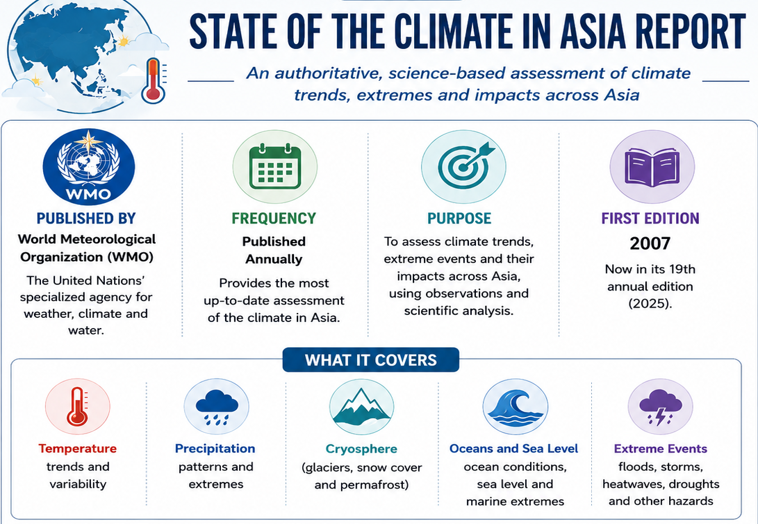
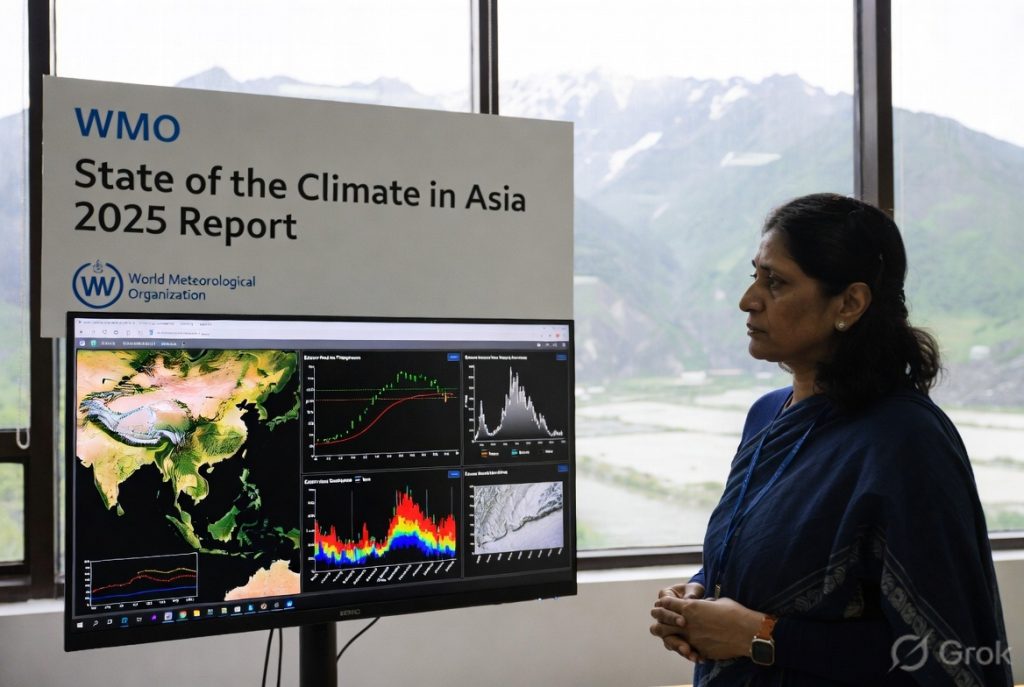
Context: According to the recently released World Meteorological Organization (WMO)’s State of the Climate in Asia 2025 report, Asia is warming nearly twice as fast as during the 1961–1990 period, with 2025 ranking among the warmest years on record for the continent.
Key Findings of the Report
- Accelerating Temperature Rise
- Asia’s warming rate during 1991–2025 was nearly twice that observed during 1961–1990, highlighting the accelerating pace of climate change across the continent.
- Temperatures over the Asian landmass in 2025 were 0.96°C above the 1991–2020 average and about 1.9°C above the 1961–1990 baseline.
- Depending on the dataset used, 2025 was the second or third-warmest year on record in Asia.
- While temperatures were above average across most of Asia, parts of South Asia, including the Indian subcontinent, experienced relatively cooler conditions due to favourable monsoon rainfall.
- Extreme Weather Becoming the New Normal
- Weather-, climate- and water-related hazards continued to cause widespread human and economic losses across the continent.
- Floods and storms accounted for the largest share of casualties and economic losses, while heatwaves and droughts affected several regions.
- Rapid Glacier Retreat in High Mountain Asia
- Glaciers across the High Mountain Asia region continued to shrink, threatening long-term water security.
- The report warns of increasing risks from glacial lake outburst floods (GLOFs) and other mountain hazards.
- Record Ocean Warming and Sea-Level Rise
- Asia recorded its highest ocean heat content since observations began in 1960, reflecting unprecedented heat accumulation in surrounding oceans.
- Marine heatwaves affected large parts of the northwestern Pacific Ocean and northern Indian Ocean.
Why is Asia Particularly Vulnerable?
- Large Population Exposure: Home to nearly 60% of the world’s population, Asia faces disproportionately high exposure to climate-related hazards.
- Dependence on Climate-Sensitive Sectors: Agriculture, fisheries and water resources remain highly vulnerable to changes in temperature and precipitation patterns.
- Glacier-Dependent River Systems: Major river systems such as the Indus, Ganga, Brahmaputra, Mekong and Yangtze depend significantly on snow and glacier melt, making millions vulnerable to cryospheric changes.
- Rapid Urbanisation and Coastal Concentration: Expanding cities and densely populated coastal regions face growing risks from heatwaves, flooding, sea-level rise and extreme weather events.
- Arctic Amplification Effects: Rapid warming in Northern Asia and the Arctic is influencing regional weather patterns and contributing to more frequent climate extremes across the continent.
Key Implications for India and Asia
- Water and Food Security: Glacier retreat, erratic rainfall and increasing drought frequency could adversely affect agricultural productivity and long-term water availability.
- Rising Disaster Risks: More frequent and intense floods, cyclones, heatwaves and droughts are likely to increase disaster-related losses and humanitarian challenges.
- Threat to Mountain and River Ecosystems: Continued glacier loss threatens the long-term sustainability of glacier-fed rivers, affecting irrigation, hydropower generation and drinking-water supplies.
- Economic and Infrastructure Losses: Climate-induced disruptions pose growing risks to infrastructure, supply chains, public health systems and economic growth.
- Need for Climate Adaptation: The findings highlight the need for stronger early-warning systems, climate-resilient infrastructure, disaster preparedness and adaptive water-resource management.