
SYLLABUS
GS-3: Indian Economy and issues relating to planning, mobilization of resources, growth, development and employment.
Context: The Union Cabinet has approved the Scheme for Enhancement of Construction and Infrastructure Equipment (CIE) Manufacturing Ecosystem, with an outlay of ₹11,000 crore, to promote domestic manufacturing, reduce import dependence and strengthen India’s construction equipment industry.
About the Scheme for Enhancement of Construction and Infrastructure Equipment (CIE)
- Nodal Ministry: Ministry of Heavy Industries (MHI).
- Financial Outlay: ₹11,000 crore.
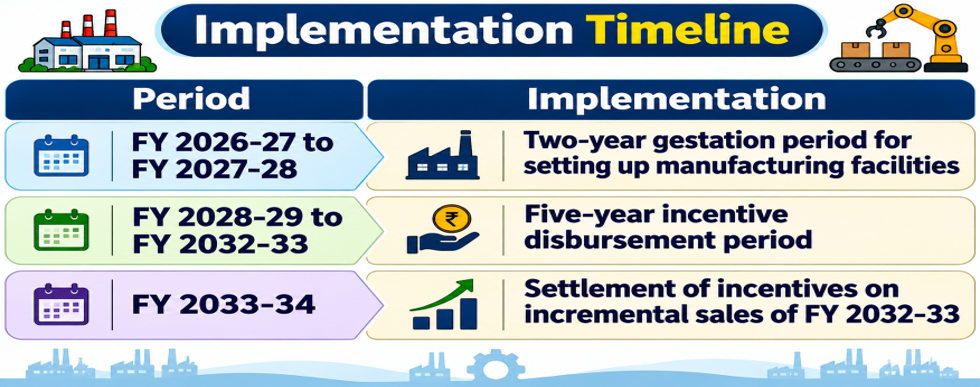
- Duration: Eight years (FY 2026-27 to FY 2033-34).
- Objective: Incentivise domestic manufacturing of construction and infrastructure equipment and their components, and establish a dedicated CIE testing facility in India.
Key Components
- Sales-Linked Incentive: Incentives on incremental sales of eligible CIE equipment and components for approved applicants under two categories:
- Original Equipment Manufacturers (OEMs).
- Component Manufacturers.
- Graded incentive rates range from 13% to 8% over five years.
- Grant for CIE Testing Facility: Grant of up to ₹375 crore in the form of Viability Gap Funding (VGF) for establishing a dedicated, state-of-the-art CIE testing facility.
Equipment Categories Covered
- The scheme covers seven categories of equipment that are fully or largely imported:
- Tunnel Boring Machines
- Off-Highway Trucks
- Excavators
- Cranes
- Loaders
- Piling Rigs
- Drilling Machines
- Examples include ship-to-shore cranes, hydraulic excavators and other technologically advanced construction equipment.
India’s CIE Industry
- India has the world’s third-largest CIE industry, after China and the United States.
- Market Size (FY 2024-25): Approximately ₹97,500 crore.
- Projected Market Size (FY 2029-30): Approximately ₹2,28,100 crore.
- Approximately 45% of domestic demand is reportedly met through imports, highlighting the need to strengthen domestic manufacturing.
- Major growth drivers include infrastructure development, particularly roads, ports and housing.
Need and Significance of the Scheme
- Reducing Import Dependence: Promotes indigenous manufacturing of technologically advanced equipment and reduces reliance on imported machinery.
- Strengthening Supply Chain Security: Develops domestic manufacturing capabilities for equipment and components, reducing vulnerabilities arising from external supply disruptions.
- Promoting Technological Development: Encourages domestic production of advanced machinery such as tunnel boring machines, cranes and hydraulic excavators.
- Employment Generation and Industrial Growth: Expands manufacturing activities, creates employment opportunities and strengthens the domestic component manufacturing ecosystem.
- Enhancing Global Competitiveness: Improves India’s position in the global CIE market and supports the objectives of Atmanirbhar Bharat and Viksit Bharat @2047.