SYLLABUS
GS-1: Population and Associated Issues.
GS-2: Statutory, Regulatory and various Quasi-judicial Bodies; Issues relating to development and management of Social Sector/Services relating to Health, Education, Human Resources.
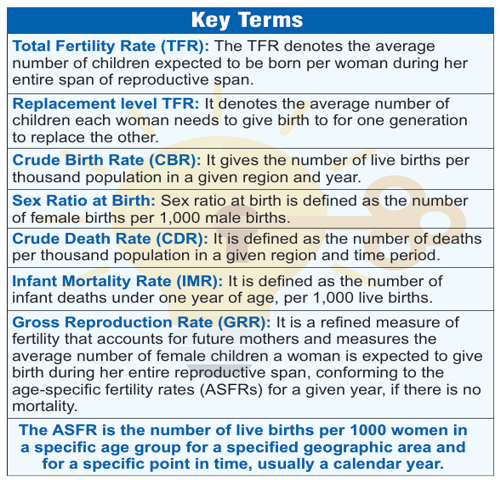
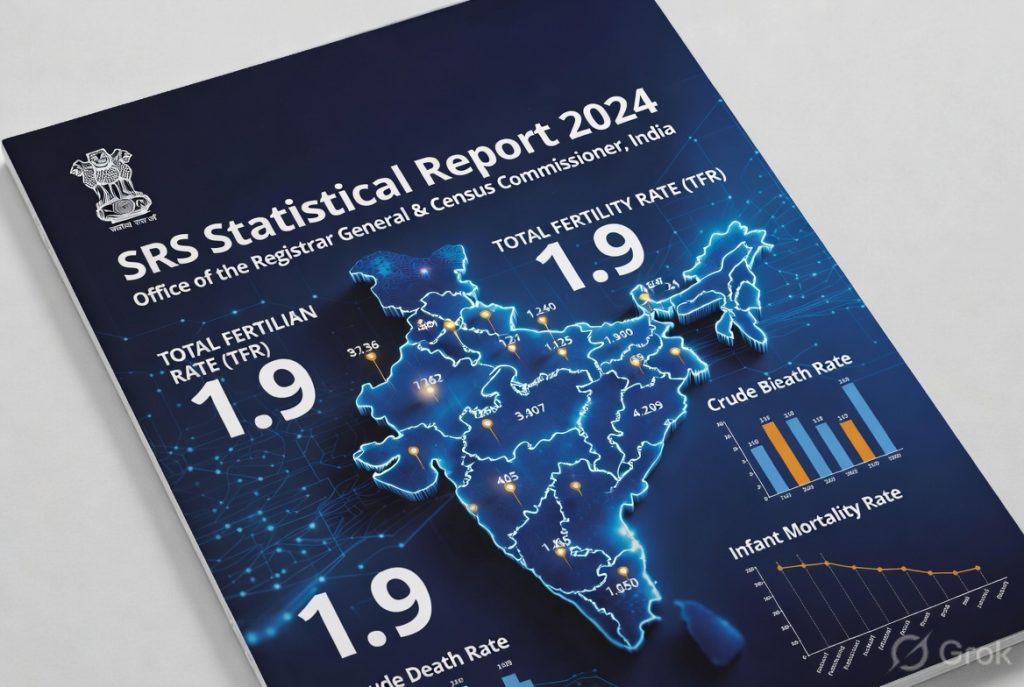
Context: The Office of the Registrar General of India (ORGI) recently released the Sample Registration System (SRS) Statistical Report 2024, highlighting important demographic trends relating to fertility, mortality, sex ratio, and population dynamics in India.
More on the News
- The Sample Registration System (SRS) is India’s largest demographic survey system for generating annual estimates of fertility and mortality indicators at the national and state levels.
- The report indicates that India’s demographic transition is continuing, with fertility levels remaining below the replacement rate and gradual improvements in mortality and child survival indicators.
- The findings assume significance for policy areas such as:
- population stabilisation,
- ageing population,
- healthcare planning,
- women and child development,
- and labour-force dynamics.
Key Findings of the SRS Statistical Report 2024
Decline in Fertility Levels
- India’s Total Fertility Rate (TFR) remained at 1.9, below the replacement-level fertility of 2.1 for the fifth consecutive year.
- The Urban TFR remained low at 1.5, while rural TFR stayed at replacement level (2.1).
- Bihar recorded the highest TFR in the country at 2.9, followed by Uttar Pradesh (2.6), while Delhi reported the lowest fertility level at 1.2.
- Only six states — Bihar, Uttar Pradesh, Madhya Pradesh, Rajasthan, Jharkhand, and Chhattisgarh — continue to record fertility levels above the replacement rate.
Trends in Birth and Death Rates
- India’s Crude Birth Rate (CBR) continued its long-term decline, reflecting slowing population growth and changing demographic patterns.
- The national CBR stood at 18.3 per 1,000 population, with rural areas recording a higher CBR (20.2) compared to urban areas (14.7).
- Bihar reported the highest CBR at 26.8, while Kerala recorded the lowest at 11.1.
- The national Crude Death Rate (CDR) stood at 6.4 per 1,000 population, with rural areas recording a higher CDR (6.8) compared to urban areas (5.6).
- Chhattisgarh reported the highest CDR at 8.4, while Delhi recorded the lowest at 4.5.
Improvement in Infant and Child Mortality
- India’s Infant Mortality Rate (IMR) declined to 24 infant deaths per 1,000 live births, with rural IMR (27) remaining significantly higher than urban IMR (17).
- Chhattisgarh recorded the highest IMR at 36, while Kerala reported the lowest IMR at 8.
- The Under-Five Mortality Rate (U5MR) declined to 28 per 1,000 live births, indicating improvements in maternal and child healthcare outcomes.
Sex Ratio at Birth and Still Birth Rate
- India’s Sex Ratio at Birth (SRB) improved to 918 females per 1,000 males, although several states continue to exhibit adverse child sex ratios.
- The national Still Birth Rate (SBR) stood at 5 per 1,000 total births, reflecting gradual improvements in maternal and neonatal healthcare services.
Significance of the Findings
- Demographic Transition: The report reflects India’s ongoing demographic transition from high fertility and mortality rates toward lower fertility, lower mortality, and higher life expectancy.
- Population Stabilisation: Sustained sub-replacement fertility indicates that India is gradually approaching long-term population stabilisation.
- Improving Health Outcomes: Declining IMR and U5MR reflect improvements in maternal healthcare, institutional deliveries, immunisation, nutrition, and public health interventions.
- Emerging Ageing Challenge: Continued fertility decline could eventually increase the proportion of the elderly population, creating future pressures on pensions, healthcare, and social security systems.
- Regional Imbalances: Significant inter-state variations in fertility, mortality, and sex ratio indicators highlight uneven socio-economic and healthcare development across India.
About the Sample Registration System (SRS)
- It is a large-scale demographic survey conducted every year by the Office of the Registrar General & Census Commissioner of India (ORGI) in all States/Union Territories.
- Background of SRS:
- The Registration of Births & Deaths Act, 1969, was enacted to unify civil registration in India.
- Despite making birth and death registration mandatory, under-reporting persists in some States/UTs.
- To address data gaps, the Sample Registration System (SRS) was launched in 1964–65 on a pilot basis and on a full scale from 1969–70.
- The SRS follows a dual-record system, involving:
- continuous enumeration by local part-time enumerators,
- and independent six-monthly retrospective surveys by supervisors.
About the Office of the Registrar General & Census Commissioner (ORGI)
- The Office of the Registrar General & Census Commissioner, India (ORGI) functions under the Ministry of Home Affairs and is headed by the Registrar General and Census Commissioner of India.
- It was established in 1949 primarily for conducting the decennial Population Census and administering the Registration of Births and Deaths Act, 1969.
- ORGI is responsible for conducting major demographic and socio-economic surveys, including the Population Census, Sample Registration System (SRS), Civil Registration System (CRS), and various fertility and mortality studies.