
SYLLABUS
GS-3: Conservation, environmental pollution and degradation; Science and Technology- developments and their applications and effects in everyday life.
Context: India is rapidly accelerating its transition towards electric mobility to strengthen energy security, reduce carbon emissions, promote sustainable transportation and emerge as a global hub for electric vehicle manufacturing.
About Electric Vehicles (EVs)
- An Electric Vehicle (EV) is a vehicle powered by an electric motor using energy stored in rechargeable batteries or produced through fuel cells instead of relying solely on conventional fossil fuels.
- Types of EVs:
- Battery Electric Vehicles (BEVs): Fully electric vehicles powered only by rechargeable batteries.
- Hybrid Electric Vehicles (HEVs): Use both an internal combustion engine and an electric motor.
- Plug-in Hybrid Electric Vehicles (PHEVs): Hybrid vehicles with externally rechargeable batteries for extended electric-only operation.
- Fuel Cell Electric Vehicles (FCEVs): Produce electricity from hydrogen through fuel cells to power the electric motor.
Evolution of India’s Electric Mobility Policy
- Beginning of India’s EV Journey (2015): India began its transition towards electric mobility with the launch of the National Electric Mobility Mission Plan (NEMMP 2020) and the FAME India Scheme to promote clean mobility, reduce petroleum imports and strengthen energy security.
- Expansion of the EV Ecosystem: Post-FAME, Government policy expanded beyond vehicle adoption to battery manufacturing, charging infrastructure, public transport electrification, localisation and innovation.
- Manufacturing-led Growth: Recent initiatives such as the National Mission on Manufacturing (2025), PM E-DRIVE, SPMEPCI and PLI Schemes have strengthened India’s position as an emerging global EV manufacturing hub.
Rise of India’s Electric Vehicles Ecosystem
- Rapid Growth in EV Adoption: Annual EV sales increased from around 50,000 units in 2016 to 2.3 million units in 2025, representing nearly 46-fold growth.
- EV adoption increased from 0.08% in FY 2015-16 to 8.26% in FY 2025-26.
- Electric two-wheelers and three-wheelers have emerged as the fastest-growing segments.
- Growing Export Competitiveness: EV exports increased from USD 1.2 million in 2020 to USD 84 million in 2024, with major export destinations including Nepal, Indonesia and Japan.
- Expanding Charging Infrastructure: As of July 2026, India had 52,718 public charging stations, including 16,561 fast charging stations, while industry players continue to expand ultra-fast charging networks across cities and highways.
- India Electric Mobility Index (IEMI): NITI Aayog launched the index in August 2025 to evaluate States and Union Territories on transport electrification, charging infrastructure readiness, and EV research & innovation, with Delhi, Maharashtra and Chandigarh emerging as frontrunners.
- Manufacturing and Innovation: Domestic manufacturing now includes battery packs, motors, drivetrains, power electronics, charging equipment and related components.
- Around 400 EV startups are driving innovation in battery technology, charging infrastructure and AI-enabled mobility.
- Rising Investments: India’s EV ecosystem attracted over USD 1.4 billion in investments during FY 2025, around 27% higher than the previous year.
- The EV market is projected to grow from USD 3.71 billion in 2025 to USD 191.04 billion by 2034.
Need for Electric Mobility
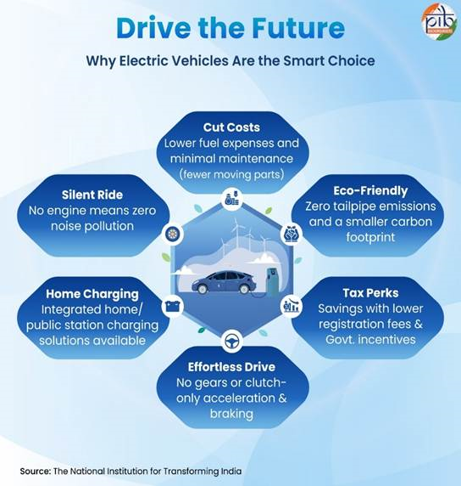
- Energy Security: Reduces dependence on imported petroleum and strengthens India’s long-term energy security.
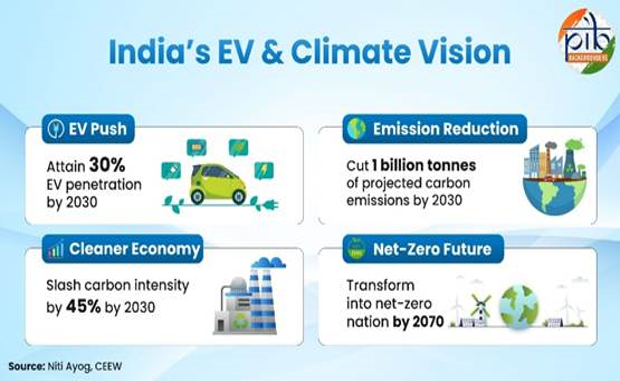
- Cleaner Environment: Helps lower greenhouse gas emissions from the transport sector, which contributes around 9% of India’s total emissions, while improving urban air quality.
- Economic Growth: Promotes domestic manufacturing, attracts investments and strengthens India’s position in global EV value chains.
- Employment and Innovation: Generates employment through manufacturing, battery production, research & development and startup-led innovation.
- Renewable Energy Integration: Supports better utilisation of renewable energy through battery storage and grid integration.
- Climate Commitments: Contributes towards sustainable development and India’s long-term vision of Viksit Bharat 2047.
Government Initiatives to Promote Electric Mobility
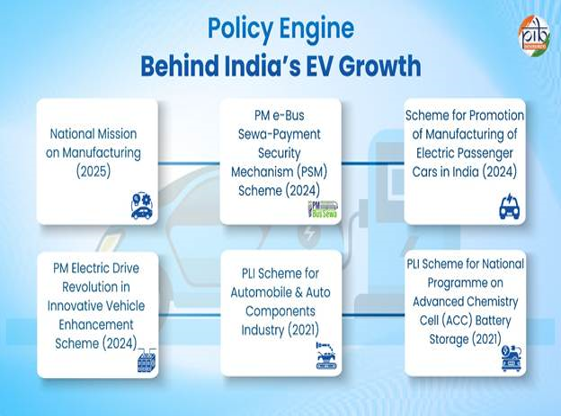
- National Electric Mobility Mission Plan (NEMMP 2020): Laid the strategic roadmap for accelerating EV adoption and domestic manufacturing.
- FAME India Scheme (2015): Introduced demand incentives, charging infrastructure support and domestic manufacturing through Phase I (2015–2019) and Phase II (2019–2024).
- PM Electric Drive Revolution in Innovative Vehicle Enhancement (PM E-DRIVE) Scheme: Supports EV adoption, charging infrastructure, domestic manufacturing and public transport electrification with an outlay of ₹10,900 crore.
- National Mission on Manufacturing (NMM), 2025: Identifies electric vehicles as a priority sector to promote advanced manufacturing, employment and global competitiveness.
- PLI Scheme for Advanced Chemistry Cell (ACC) Battery Storage: Promotes domestic battery manufacturing with an outlay of ₹18,100 crore to establish 50 GWh of Advanced Chemistry Cell capacity.
- State EV Policies: By December 2025, 29 States and Union Territories had notified EV policies offering incentives such as capital subsidies, land allotments, tax reimbursements and investment support to promote EV manufacturing and adoption
Future Outlook
- 30% EV Target: India aims to achieve a 30% share of electric vehicles in total vehicle sales by 2030 under the global EV30@30 initiative.
- Charging Infrastructure: The country plans to establish 1.32 million public charging stations by 2030 to support large-scale EV adoption.
- Stricter Emission Norms: The proposed CAFE III (2027–2032) and CAFE IV (2033–2037) norms will introduce stricter CO₂ emission standards to accelerate the transition to electric mobility.
- Towards Viksit Bharat 2047: Expanding manufacturing, battery localisation, investments and charging infrastructure are positioning India as a global hub for electric mobility while strengthening energy security and sustainable development.