

SYLLABUS
GS-3: Indian Economy and issues relating to planning, mobilization of resources, growth, development, and employment; Effects of liberalization on the economy, changes in industrial policy and their effects on industrial growth.
Context: The Office of the Economic Adviser (OEA), under the Department for Promotion of Industry and Internal Trade (DPIIT), has released the revised Index of Core Industries (ICI) with 2022–23 as the new base year, replacing the 2011–12 series.
Key Findings
- For the first time, Iron Ore has been included as the 9th core industry, increasing the number of core sectors from eight to nine.
- The ICI grew by 5.0% (YoY) in June 2026, improving from 3.2% in May 2026, marking the fastest growth in five months.
- Iron Ore (43.9%), Electricity (9.8%), Cement (9.8%), Steel (4.6%), and Coal (1.4%) recorded positive growth.
- Natural Gas (-7.4%), Crude Oil (-4.2%), Refinery Products (-4.7%), and Fertilisers (-3.3%) recorded negative growth.
- Iron Ore and Electricity emerged as the major contributors to the overall growth of the ICI.
- The cumulative growth of the ICI during April–June 2026 stood at 3.6%, compared with 1.0% in the corresponding period of the previous year.
Key Changes in the Revised ICI
- The base year has been revised from 2011–12 to 2022–23.
- Iron Ore has been included as a new core industry owing to its intensive use in industrial production and contribution to industrial development.
- The Steel Index is now compiled using gross production data instead of net production data to align with the revised Index of Industrial Production (IIP) methodology.
- Only Raw Coal has been retained in the Coal category, while Coal Middling and Washed Coal have been excluded to eliminate double counting.
- The sectoral weights have been derived from the revised IIP (2022–23) and proportionately adjusted to 100.
- A Linking Factor of 1.47 has been introduced to facilitate comparison between the old and revised ICI series.
About the Index of Core Industries (ICI)
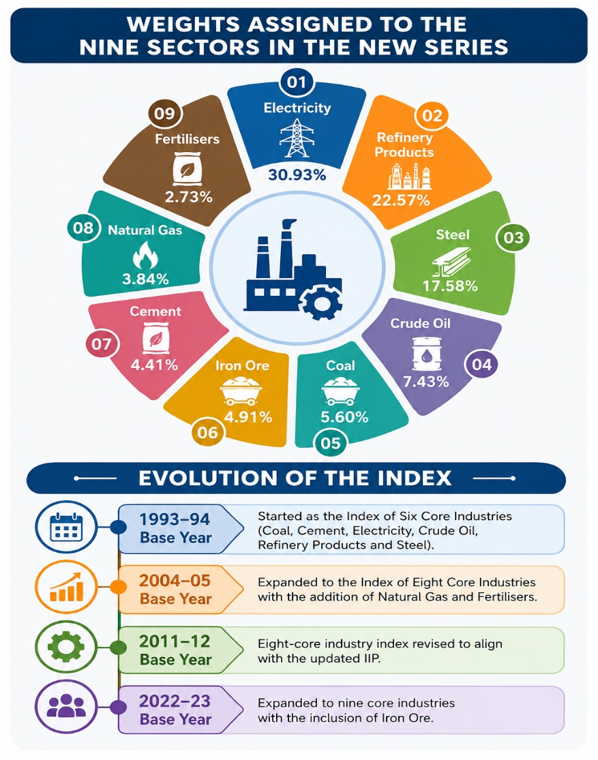
- The ICI is a monthly production volume index compiled by the Office of the Economic Adviser (OEA), DPIIT, Ministry of Commerce & Industry.
- It measures the production performance of nine core industries, providing an advance indication of
- industrial growth before the release of the Index of Industrial Production (IIP).
- The ICI accounts for 40.27% of the weight of the Index of Industrial Production (IIP).
- The provisional ICI is released on the 20th of every month (or the next working day if the 20th is a holiday).
- The ICI is a Laspeyres-type weighted production volume index, measuring changes in production relative to the base year.
Importance of the ICI
- Serves as an early indicator of industrial activity before the release of the IIP.
- Helps policymakers assess the performance of infrastructure and manufacturing sectors.
- Widely used by the Ministry of Finance, Reserve Bank of India (RBI), NITI Aayog, banks, and infrastructure planners for economic analysis and policy formulation.
- Reflects the health of sectors that have a significant impact on overall economic and industrial growth.
Need for Changing the Base Year
- Reflects Structural Changes: Captures changes in India’s industrial structure, production patterns and economic composition since 2011–12.
- Improves Representativeness: Updates sectoral weights using the latest industrial output data, making the index more representative of the present economy.
- Aligns with Revised IIP: Harmonises the methodology and weights with the revised Index of Industrial Production (2022–23).
- Improves Accuracy: Uses gross steel production and removes double counting in coal data by excluding washed coal and coal middlings.
- Includes Emerging Industrial Importance: Recognises the growing role of Iron Ore in industrial production by including it as a core industry.
- Enhances Data Comparability: The linking factor (1.47) enables comparison between the old and revised ICI series.
- Supports Better Policymaking: Provides a more accurate and contemporary measure of industrial performance for economic planning, forecasting and policy decisions.