SYLLABUS:
GS-2: Bilateral, regional and global groupings and agreements involving India and/or affecting India’s interests.
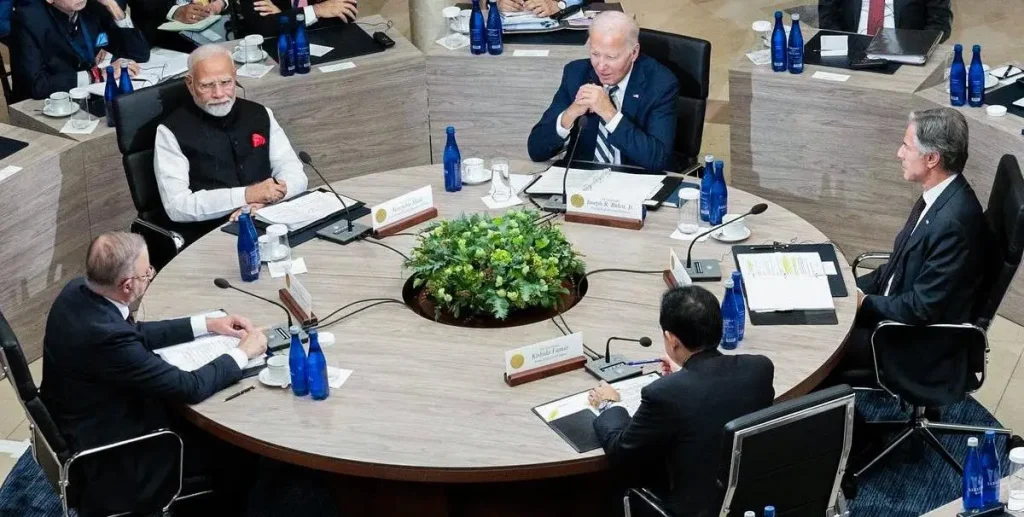
Context: Recently, the 7th Quad Leaders’ Summit was held in Manila, Philippines, under the participation of India, the United States, Japan and Australia, marking the first leaders’ meeting since September 2024.
Key Outcomes of the Quad Summit
- Quad Business Leaders’ Forum: The first-ever Quad Business Leaders’ Forum will be hosted by India in Mumbai in early 2027 to strengthen private-sector partnerships, promote commercial deals and enhance economic cooperation.
- AI (Super Intelligence) Accelerator: The leaders reaffirmed the AI Accelerator, announced by Quad Foreign Ministers in Atlanta, to support trusted AI access, deployment and technical assistance across the Indo-Pacific.
- The Quad countries pledged over US$85 million for trusted AI access across the Indo-Pacific.
- Indo-Pacific Maritime Surveillance Collaboration: A new initiative was launched to strengthen information sharing and maritime domain awareness, with P-8 and P-3C patrol aircraft scheduled to participate in their first joint maritime exercise under the Quad framework in 2027.
- Cable Connectivity and Resilience: Under the Quad Partnership for Cable Connectivity and Resilience, Australia expanded its support for electricity cables, alongside upcoming undersea cable projects in the Indian Ocean.
- Cybersecurity Cooperation: Enhanced Quad Cybersecurity Cooperation was announced to address rising cyber incidents and ensure an open and secure cyberspace.
- Counterterrorism Cooperation: The leaders condemned terrorism, violent extremism and cross-border terrorism and pledged to strengthen the Quad’s counterterrorism cooperation.
- Regional Security and Economic Cooperation: The leaders opposed unilateral changes to the status quo through force or coercion and committed to securing critical supply chains and freedom of navigation and overflight.
About the Quad
- The Quadrilateral Security Dialogue is a diplomatic partnership comprising India, Australia, Japan and the United States, committed to promoting a free, open, inclusive, peaceful and prosperous Indo-Pacific.
- Origin (2004): The grouping traces its origins to the coordinated humanitarian assistance and disaster relief operations undertaken by the four countries following the Indian Ocean tsunami in December 2004.
- First Meeting (2007): The first meeting of Quad officials took place on the sidelines of the ASEAN Regional Forum in the Philippines in May 2007, following an initiative by Japanese Prime Minister Shinzo Abe.
- Revival (2017): After a decade-long gap, the four countries revived the Quad through consultations held in Manila in November 2017 on the sidelines of the East Asia Summit.
- Leaders’ Level (2021): The grouping was elevated to the leaders’ level, with its first virtual summit held in March 2021 and its first in-person summit held in September 2021 in Washington, D.C.
- Nature: The Quad is an informal diplomatic partnership without a permanent secretariat, treaty-based framework or collective defence mechanism similar to NATO.
- Key Areas of Cooperation: Maritime security, economic security, critical and emerging technologies, cybersecurity, health security, climate change, infrastructure and humanitarian assistance and disaster relief.
- ASEAN Centrality: The Quad consistently supports ASEAN centrality and unity and promotes cooperation with regional institutions, including ASEAN and the Pacific Islands Forum.
Significance of the Quad
- Indo-Pacific Security: The Quad strengthens maritime security, maritime domain awareness and freedom of navigation and overflight in the strategically important Indo-Pacific region.
- Countering China’s Influence: The grouping provides a platform for coordinating responses to China’s growing military presence, unilateral actions and economic coercion in the Indo-Pacific.
- Economic and Technological Resilience: Cooperation in critical minerals, resilient supply chains, artificial intelligence, cybersecurity and undersea cables strengthens regional economic and technological security.
- India’s Strategic Interests: The Quad enhances India’s strategic partnerships, strengthens its role as an Indo-Pacific security provider and supports its vision of a free, open and rules-based regional order.
Challenges Faced by the Quad
- Divergent Strategic Priorities: Differences in the foreign policy objectives, security priorities and strategic interests of the four members can limit collective decision-making.
- China’s Economic Interdependence: Extensive economic and trade relations with China create difficulties for Quad members in adopting a common approach towards Beijing.
- Lack of Institutional Framework: The absence of a permanent secretariat, binding commitments and collective decision-making mechanisms can affect policy continuity and implementation.
- Uncertainty in US Engagement: Changes in US foreign policy priorities, leadership and commitment to the Indo-Pacific can create uncertainty regarding the long-term cohesion of the grouping.
Way Forward
- Strengthening Institutional Cooperation: Strengthen coordination, regular consultations and implementation of Quad initiatives.
- Deepening Maritime Cooperation: Expand joint exercises, intelligence sharing and maritime surveillance with regional partners.
- Promoting Economic and Technological Resilience: Diversify critical mineral supply chains and strengthen cooperation in infrastructure, AI and cybersecurity.
- Ensuring ASEAN Centrality and Inclusiveness: Deepen engagement with ASEAN and Indo-Pacific partners while respecting their sovereignty and strategic autonomy.