SYLLABUS
GS-2: Welfare schemes for vulnerable sections of the population by the Centre and States
GS-3: Indian Economy and issues relating to planning, mobilization of resources, growth, development and employment.
Context: The Ministry of Rural Development has issued guidelines for Ombudspersons and Appellate Authorities to strengthen transparency, accountability, citizen participation and grievance redressal under the Viksit Bharat – Guarantee for Rozgar and Ajeevika Mission (Gramin) (VB-G RAM G) Act, 2025.
Key Guidelines for Ombudsperson and Appellate Authority
- District-level Ombudsperson: A dedicated Ombudsperson will address grievances relating to job cards, employment, wage payments, delay compensation, worksite facilities, muster rolls and denial of statutory entitlements.
- Protection of Workers’ Rights: The mechanism will cover discrimination, harassment and violations of workers’ rights, particularly those involving women and vulnerable groups.
- Expanded Eligibility: Eligible candidates will include individuals with experience in rural development, public administration, law, academics, social work and management. Provisions relating to tenure and remuneration have also been revised.
- Digital Grievance Redressal: A dedicated digital platform will facilitate online complaint registration and tracking, recording of proceedings, uploading of awards and monitoring of action taken.
- Field-level Monitoring: Geo-tagged and time-stamped photographs during field visits will strengthen documentation, traceability and transparency.
- Social Audit Participation: Ombudspersons must attend at least three Social Audit public hearings or Gram Sabhas every month to hear grievances and facilitate follow-up action.
- Community Accountability: Social audit findings, community feedback and individual complaints will help identify discrepancies and initiate corrective action.
About the VB-G RAM G Act, 2025
- The VB-G RAM G Act, 2025 is a comprehensive statutory overhaul of the Mahatma Gandhi National Rural Employment Guarantee Act (MGNREGA), aligned with the vision of Viksit Bharat @2047.
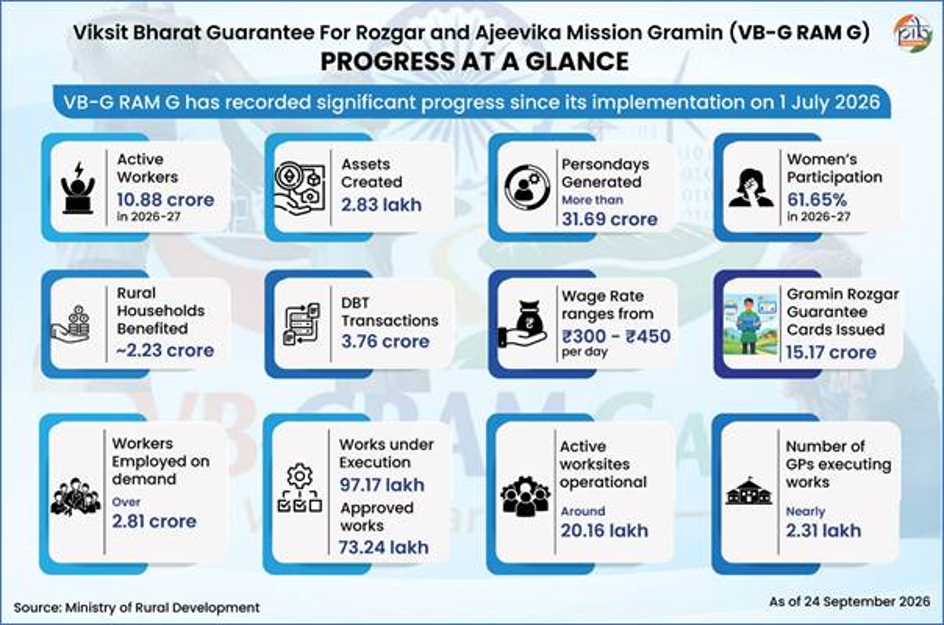
- It came into force on 1 July 2026, replacing MGNREGA.
- The Act links wage employment with productive asset creation, livelihood security and sustainable rural infrastructure through a convergence-driven approach.
Key Features of VB-G RAM G
- Enhanced Employment Guarantee: Provides 125 days of wage employment per financial year to every rural household whose adult members volunteer for unskilled manual work, compared with 100 days under MGNREGA.
- Agricultural Labour Availability: Introduces an aggregated 60-day no-work period during peak sowing and harvesting seasons. Workers remain entitled to 125 days of employment during the remaining 305 days.
- Timely Wage Payments: Wages must be paid weekly or, in any case, within a fortnight of completion of work.
- Four Priority Thematic Areas:
- Water security.
- Core rural infrastructure.
- Livelihood-related infrastructure.
- Special works to mitigate extreme weather events.
- Decentralised Planning through VGPPs:
- Viksit Gram Panchayat Plans (VGPPs) are prepared through Gram Panchayat planning and Gram Sabha participation, recommendations and approval.
- GIS-based planning uses Yuktdhara and PM Gati Shakti for asset mapping, spatial planning and identification of infrastructure gaps.
- Plans are consolidated at Block, District, State and National levels into the Viksit Bharat National Rural Infrastructure Stack.
- Technology-enabled Governance:
- Digital Verification: e-KYC, face authentication and biometric authentication.
- Work Monitoring: Geo-tagging, digital measurement, electronic Measurement Books (e-MB) and mobile-based monitoring.
- Digital Payments: Direct Benefit Transfer (DBT).
- Technology-enabled Oversight: Real-time dashboards, AI-enabled analytics and spatial technology-based planning.