
SYLLABUS
GS-2: Government policies and interventions for development in various sectors and issues arising out of their design and implementation.
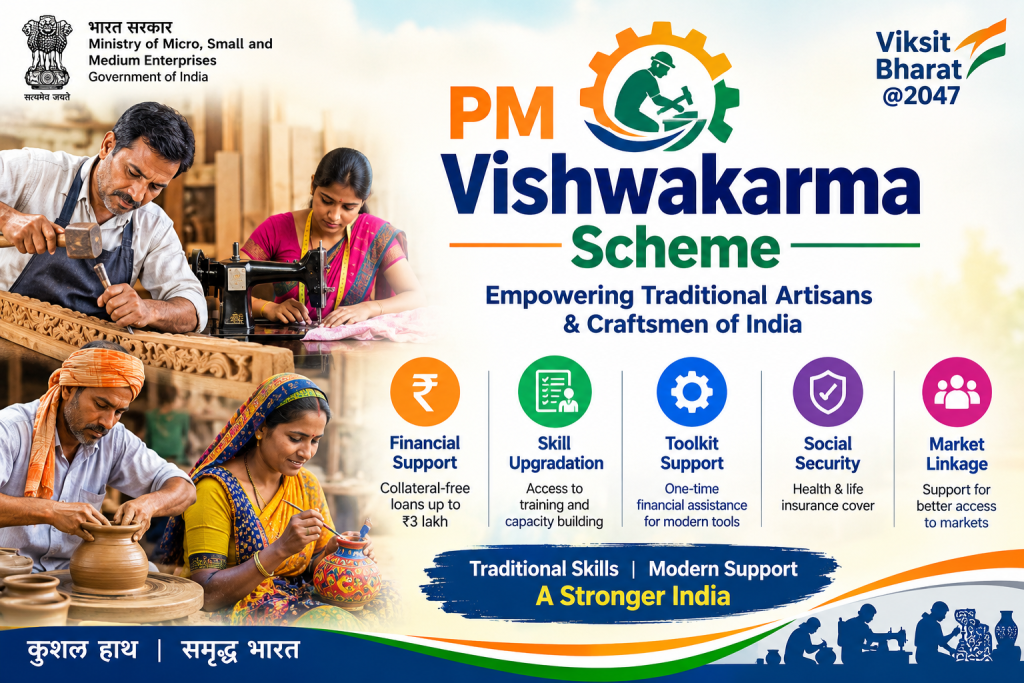
Context: The PM Vishwakarma Scheme, launched on 17 September 2023 to support traditional artisans and craftspeople, has completed three years of implementation.
About the PM Vishwakarma Scheme
• It was launched on 17 September 2023 by the Ministry of Micro, Small and Medium Enterprises (MSME).
• It is a Central Sector Scheme with an outlay of ₹13,000 crore for 2023–24 to 2027–28.

• The scheme covers 18 traditional trades and aims to provide end-to-end support to artisans working with their hands and tools in the unorganised sector.
• It seeks to improve artisans’ productivity, income, access to institutional credit and integration into domestic and global markets.
• The scheme is built around three pillars:
- Samman: Recognition and dignity.
- Samarthya: Skill development and capability enhancement.
- Samriddhi: Sustainable livelihoods and prosperity.
• It also seeks to strengthen the Guru-Shishya parampara and the family-based transmission of traditional skills.
Key Features of the Scheme
• Recognition and Skill Development: Beneficiaries receive a PM Vishwakarma Certificate and Identity Card after completing the verification process.
- Basic training is provided for 5–7 days, while advanced training lasts 15 days or more.
- Trainees receive a stipend of ₹500 per day.
- Training focuses on modern tools, improved techniques, digital transactions, marketing and entrepreneurship.
• Toolkit and Credit Support: Eligible beneficiaries receive modern toolkits worth up to ₹15,000.
- Collateral-free Enterprise Development Loans of up to ₹3 lakh are provided in two tranches.
- The first tranche offers up to ₹1 lakh for 18 months, while the second provides up to ₹2 lakh for 30 months.
- Loans are available at a concessional interest rate of 5% per annum, with government interest subvention of up to 8%.
• Digital and Marketing Support: Beneficiaries receive ₹1 per eligible digital transaction, subject to a maximum of 100 transactions per month.
- Marketing assistance includes trade fairs, exhibitions, branding, publicity and access to e-commerce platforms such as the Government e-Marketplace and Open Network for Digital Commerce.
• Eligibility and Registration: Applicants must be at least 18 years old and self-employed in one of the 18 notified traditional trades.
- Registration is generally restricted to one member of a family.
- Government employees and their family members are excluded.
- Applications are submitted through Common Service Centres and undergo a three-tier verification process involving local bodies, the District Implementation Committee and the Screening Committee.
- Beneficiaries are also onboarded onto the Udyam Assist Platform to facilitate the formalisation of informal enterprises.
Need and Significance

• Preservation of Traditional Skills: Strengthens the Guru-Shishya tradition and supports the continuity of family-based occupations.
• Economic Empowerment: Access to modern tools, skill training and affordable credit can improve productivity, incomes and entrepreneurial opportunities.
• Achievement of Targets: By September 2026, the scheme had registered 30 lakh beneficiaries. Over 24.37 lakh artisans had received basic skill training, while more than 18.16 lakh had received toolkits.
• Evidence of Economic Impact: An IIM Mumbai evaluation covering 11,591 beneficiaries found that 93% of surveyed beneficiaries reported a moderate to significant increase in income following training.
• Financial and Market Inclusion: More than 6.19 lakh loans worth approximately ₹5,316 crore had been sanctioned. Over 30,000 beneficiaries had been onboarded onto e-commerce platforms, while the first national exhibition at Dilli Haat recorded sales exceeding ₹2 crore.
Challenges
• Limited Formalisation: Informal operations and limited awareness may restrict access to institutional finance and government support.
• Inadequate Market Linkages: Weak branding, packaging and marketing capabilities can limit access to wider markets.
• Technology Adoption: Artisans may face difficulties adopting modern tools, digital payments and emerging technologies.
• Sustainability of Traditional Occupations: Competition from mass-produced goods and changing consumer preferences may discourage younger generations from continuing traditional crafts.