
SYLLABUS
GS-2: Government Policies and Interventions for Development in various sectors and Issues arising out of their Design and Implementation; Issues Relating to Development and Management of Social Sector/Services relating to Health, Education, Human Resources.
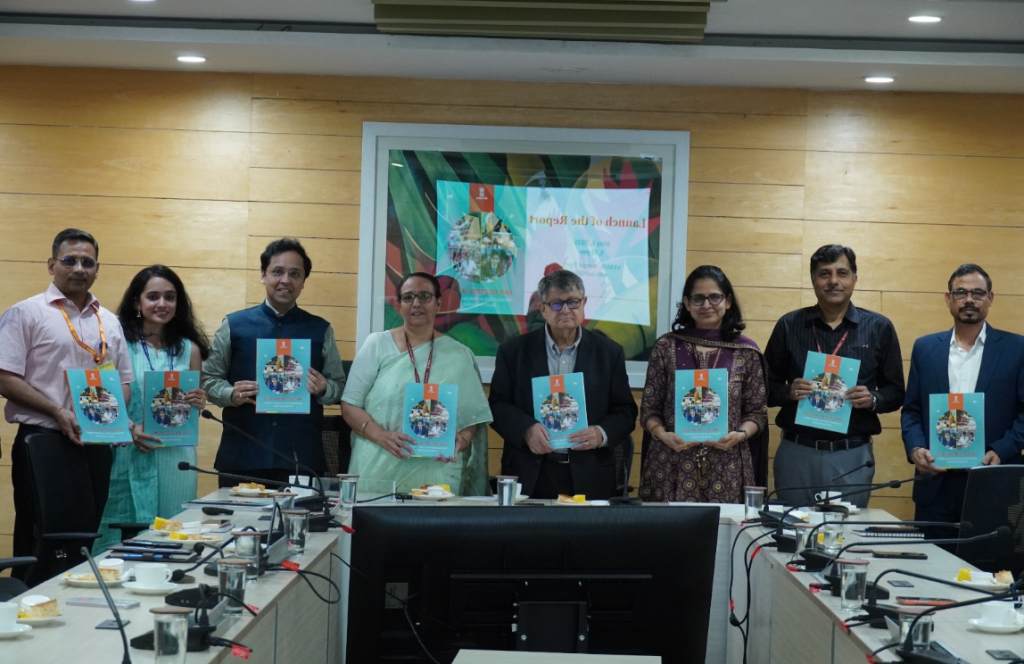
Context: NITI Aayog has released a comprehensive report titled “School Education System in India: Temporal Analysis and Policy Roadmap for Quality Enhancement”.
More on the News
• The report undertakes a longitudinal assessment of India’s school education system over a decade and proposes a policy roadmap aligned with the objectives of the National Education Policy (NEP), 2020.
• It examines the performance of school education across key parameters such as access and enrolment, infrastructure, equity and inclusion, and learning outcomes.
• It draws on secondary data from UDISE+ 2024-25, PARAKH Rashtriya Sarvekshan 2024, NAS 2017 and 2021, and ASER 2024.
• This Report reviews the present state of the system, identifies the challenges that must be addressed, and recommends policy interventions and an implementation roadmap to achieve the vision of achieving universal access, raising learning standards, and ensuring equity across all stages of schooling.
Present State of School Education in India
Scale and Access
• India’s school education system today spans 14.71 lakh schools, serving over 24.69 crore students, making it the largest system in the world.
• Gross Enrolment Ratio (GER) at the elementary stage remains high (90.9%), but participation drops at the secondary (78.7%) and higher secondary (58.4%) levels.
Improvement in Infrastructure
• Significant improvements have been recorded in basic school infrastructure:
- over 97% schools have drinking water facilities,
- more than 96% schools have separate toilets for girls, and
- Electricity access has improved substantially across government schools.
• Availability of ICT infrastructure, internet connectivity, and smart classrooms has also improved over the past decade, though regional disparities remain significant.
Equity and Inclusion
• Gender Parity Index (GPI) has improved across most stages of education, indicating greater participation of girls in schooling.
• Enrolment of Scheduled Castes (SCs), Scheduled Tribes (STs), and Other Backward Classes (OBCs) has increased steadily, particularly at elementary levels.
Government vs Private Schooling Trends
• The report notes a gradual decline in enrolment in government schools and an increasing preference for private institutions in many states.
• Government school enrolment declined from around 71% in 2005 to nearly 49% in 2024–25.
Learning Outcomes Remain Weak
• Despite progress in access and infrastructure, learning outcomes remain a major concern:
- ASER 2024 found that only about 27% of Grade 3 students could read a Grade 2-level text.
- Only around 31% of Grade 5 students could solve a basic division problem.
- Performance in mathematics and higher-order reasoning remains particularly weak across several states.

Key Recommendations of the Report
A. Systemic Recommendations
1. Reform School System and Ensure Structural Continuity: Expansion of integrated/composite schools and seamless stage-wise transition
2. Strengthen School Infrastructure: Universal access to classrooms, electricity, ICT, labs, libraries, and inclusive facilities
3. Reform Governance and Enhance Administrative Capacity: Data-driven governance, institutional leadership, and administrative efficiency
4. Institutionalise a “Whole-of-Society” Approach through State and District Task Forces on School Quality: Multi-stakeholder coordination and decentralised reform monitoring
5. Strengthen School Management Committees (SMCs/SDMCs) and Institutionalise Bottom-Up Planning: Community participation, decentralised planning, and local accountability
6. Elevate Teacher Deployment, Professional Capacity, and Career Progression: Rational teacher deployment, continuous training, and merit-based progression
7. Strengthen and Expand Digital and Broadcast-Based Learning for Inclusive Education: Expansion of digital learning platforms, connectivity, and broadcast education
8. Promote Equity and Inclusion: Targeted support for disadvantaged groups and reduction of regional disparities
A. Academic Recommendations
1. Transform Pedagogy, Assessment, and Foundational Learning: Competency-based learning, FLN strengthening, and assessment reforms
2. Promote Holistic Education and Student Wellbeing: Mental health, socio-emotional learning, arts, sports, and life skills
3. Strengthen Vocational Education and Skill Integration in Schooling: Mainstreaming vocational education and industry-linked skilling
4. Strengthen ECCE: Anganwadi-school integration and improved school readiness programmes
5. Integrate Artificial Intelligence for Pedagogical Innovation and System Readiness: AI-enabled personalised learning and future-ready education systems