

SYLLABUS:
GS-3: Conservation, environmental pollution and degradation, environmental impact assessment.
Context: India has slipped five positions to 28th rank in the Climate Change Performance Index (CCPI) 2027, scoring 60.85 points, while retaining its overall ‘medium’ performance rating.
About the Climate Change Performance Index (CCPI)
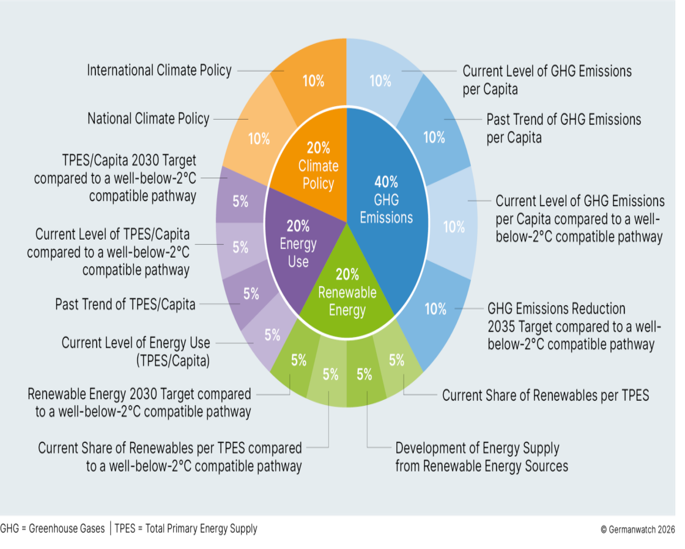
- Published by: Germanwatch and NewClimate Institute, Germany.
- Launched: 2005; published annually, usually alongside the United Nations Climate Change Conference (COP).
- Purpose: To monitor and compare countries’ climate mitigation efforts and promote transparency in national and international climate policies.
- Coverage: Assesses 64 countries and the European Union (EU), collectively accounting for over 90% of global greenhouse gas (GHG) emissions.
- Expert Participation: Around 500 climate and energy experts contribute to the assessment of countries’ national and international climate policies.
- Assessment Methodology: The CCPI uses a standardised framework comprising 14 indicators across four categories.
- Performance Ratings: Very High, High, Medium, Low and Very Low.
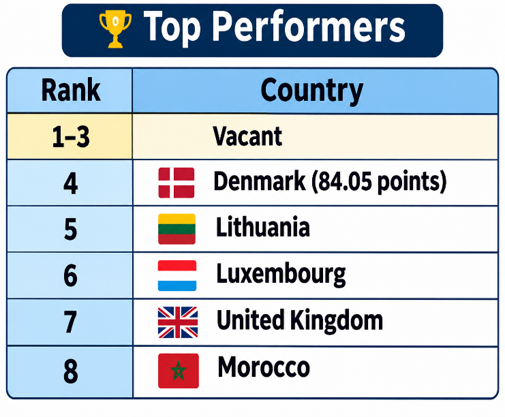
- Ranking Convention: The first three positions remain vacant because no country has demonstrated sufficiently strong performance across all categories to be aligned with the Paris Agreement’s climate goals.
Key Findings of CCPI 2027
- India’s Performance:
- Overall Rank: India secured 28th position with 60.85 points.
- Ranking Decline: Slipped five positions from 23rd in CCPI 2026 and 18 positions from 10th in CCPI 2025.
- Overall Rating: Medium.
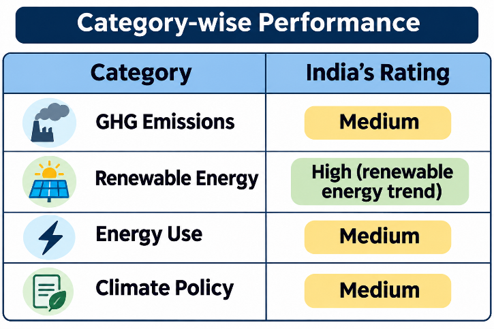
- Progress in Renewable Energy:
- Early Achievement: Non-fossil fuel sources accounted for 50% of India’s installed electricity capacity by June 2025, achieving its earlier 2030 target five years ahead of schedule.
- This includes nuclear energy and does not represent the share of non-fossil sources in actual electricity generation.
- Government Support: Competitive procurement, rooftop solar support and incentives for domestic manufacturing have accelerated renewable energy expansion.
- India’s Updated Nationally Determined Contributions (NDCs) for 2035:
- Reduce emissions intensity of GDP by 47% from 2005 levels.
- Increase the share of non-fossil fuel sources to approximately 60% of installed electricity capacity.
- Create an additional forest and tree-cover carbon sink of 3.5–4 billion tonnes of CO₂ equivalent.
- Major Challenges for India:
- Grid Infrastructure: Electricity grids and storage facilities are not expanding at the same pace as renewable energy capacity.
- Solar Energy Curtailment: India curtailed 2.3 terawatt-hours (TWh) of solar electricity generation between late May and December 2025 to maintain grid stability, according to estimates by Ember.
- Coal Dependence: Coal continues to play a central role in India’s electricity generation.
- Fossil Fuel Imports: Dependence on imported crude oil, natural gas and some coal creates additional vulnerabilities.
- Rising Emissions: Increasing per-capita emissions and energy consumption have affected India’s performance in the GHG emissions and energy use categories.
- Policy Gap: India’s net-zero target of 2070 does not provide a comprehensive, time-bound roadmap for transitioning away from fossil fuels.
- Global Performance:
- Denmark: Remained the highest-ranked country for the sixth consecutive year.
- Top Three Vacant: No country achieved sufficiently strong performance across all categories to receive an overall ‘very high’ rating.
- European Union: Ranked 19th, improving by one position and retaining its ‘medium’ rating.
- China: Ranked 56th.
- Pakistan: Ranked 26th, ahead of India.
- G20 Performance:
- G20 members account for over 75% of global GHG emissions.
- The United Kingdom was the only G20 member to receive an overall ‘high’ rating.
- Ten G20 countries received an overall ‘very low’ rating.
- Türkiye (53rd) and Australia (54th), associated with the COP31 presidencies, also received very low ratings.
- Saudi Arabia, Russia, the United States and Iran were among the lowest-ranked performers.
Recommendations / Way Forward
- Strengthen Grid Infrastructure: Expand electricity transmission networks and energy storage facilities to improve the utilisation of renewable energy.
- Improve Energy Efficiency: Reduce energy consumption through greater efficiency across sectors.
- Accelerate Clean Energy Deployment: Convert installed renewable energy capacity into actual electricity generation.
- Reduce Coal Dependence: Establish a clearer and time-bound roadmap for reducing fossil fuel dependence.
- Strengthen Climate Action: Translate climate commitments and announced targets into faster implementation across the economy.