SYLLABUS
GS-3: Indian Economy and issues relating to Planning, Mobilization of Resources, Growth, Development and Employment; Effects of Liberalization on the Economy.
Context: NITI Aayog has released the report India’s Services Sector: Insights on Regulatory Regime in Professional Services, examining regulatory barriers in professional services and suggesting reforms to strengthen their domestic competitiveness, global mobility and services exports.
Key Findings of the Report
- Services-led Growth: Services contributed around 55% of India’s GDP/GVA in FY24 and nearly 30% of total employment, growing at about 7% CAGR during 2011-12 to 2023-24.
- Strong Global Position: India became the 7th-largest services exporter globally in 2024, with its share of global services exports rising to 4.3%, from about 2% in 2005.
- Professional Services Expansion: Professional services accounted for 19.7% of India’s services exports in 2023 and recorded an 18% CAGR during FY15-FY25, indicating their growing role in India’s services trade.
- Rising Comparative Advantage: India’s Revealed Comparative Advantage (RCA) in professional and management consulting services increased from 0.95 in 2005 to 3.0 in 2024, reflecting strengthening global competitiveness.
- Engineering Services: Engineering-services exports increased from US$1.77 billion in FY15 to US$13.77 billion in FY25, registering a 22.8% CAGR.
Key Regulatory Challenges
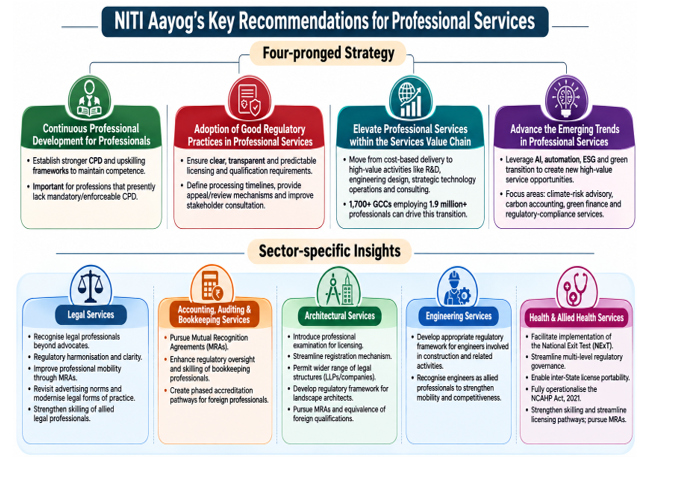
- Legal Services: Limited recognition of legal professionals beyond advocates, restrictions on advertising and forms of establishment, and limited mechanisms for professional mobility and mutual recognition constrain global integration.
- Accounting & Bookkeeping: Limited mutual-recognition arrangements, restrictions on foreign professional practice and the absence of uniform qualification and ethical standards for bookkeepers create regulatory gaps.
- Architecture & Engineering: Architects face restrictions on permissible forms of establishment and limited mechanisms for recognising foreign qualifications, while India lacks a comprehensive statutory framework governing engineering as a profession.
- Healthcare & Allied Healthcare: Multi-layered regulation, limited inter-State licence portability and incomplete implementation of the NCAHP Act, 2021 create barriers to professional mobility and consistent regulation. As of 2025, only 26 States/UTs had constituted State Allied and Healthcare Councils.
- High Regulatory Restrictiveness: OECD’s Services Trade Restrictiveness Index places India among the more restrictive economies in architecture, legal and accounting services, highlighting scope for regulatory reform.
Significance for India’s Services Sector
- Boosts Export Competitiveness: A more predictable regulatory environment can reduce regulatory friction and strengthen the ability of Indian professional-service firms to compete in global markets.
- Facilitates Professional Mobility: Better recognition of qualifications and greater portability of licences can expand opportunities for Indian professionals across States and international markets.
- Promotes Higher-Value Services: Regulatory reform can help India transition from a predominantly cost-competitive services model towards knowledge-intensive, high-value activities, improving its position in global value chains.
- Supports Trade Negotiations: Mapping domestic regulatory gaps can support India’s bilateral and multilateral services-trade negotiations and inform discussions on reciprocal market access.
- Strengthens Services-Led Growth: With services already contributing around 55% of GDP/GVA, improving the regulatory ecosystem for professional services can deepen India’s services-led growth and support the broader objective of Viksit Bharat@2047.