
SYLLABUS
GS-3: Conservation, environmental pollution and degradation, environmental impact assessment.
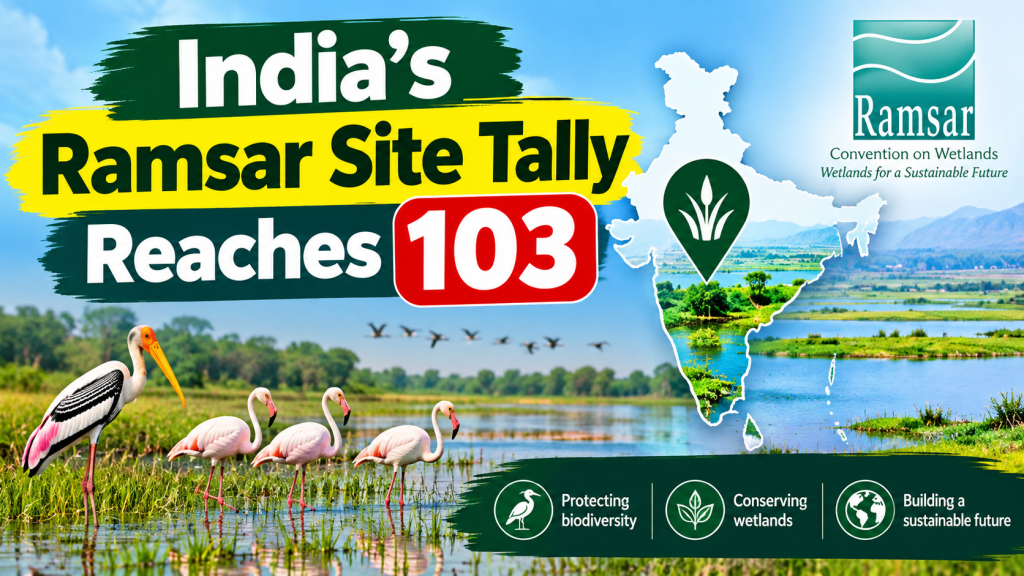
Context: India’s Ramsar site tally has reached 103 with the addition of Sukhna Wetland in Chandigarh and Sauj Jheel in Uttar Pradesh, with Sukhna Wetland becoming Chandigarh’s first Ramsar site.
About the Sukhna Wetland
- Location: Situated on the outskirts of Chandigarh, at the foothills of the Outer Himalayas.
- Nature: A peri-urban reservoir that helps regulate sediment and water flows from its surrounding catchment.
- Ecological Significance:
- Supports diverse habitats, including open water, littoral vegetation, scrub and forest.
- Provides feeding, breeding, roosting and wintering habitats for resident and migratory waterbirds along the Central Asian Flyway.
- Supports vulnerable Common Pochard (Aythya ferina), endangered Pallas’s Fish Eagle (Haliaeetus leucoryphus) and endangered Black Pond Turtle (Geoclemys hamiltonii).
- Other Importance: Serves as a recreational and educational resource for Chandigarh’s residents.
- Conservation Challenges: Sediment inflow, siltation and invasive species; management measures include soil and moisture conservation and periodic removal of invasive plants.
About the Sauj Jheel
- Location: Situated in Mainpuri district, Uttar Pradesh, in the floodplain of the Ganga River.
- Nature: A shallow lake surrounded by farmland and part of a wider network of wetlands.
- Ecological Significance:
- Contributes to ecological connectivity and supports wetland-associated vegetation, including sacred lotus (Nelumbo nucifera) and wild sugarcane (Saccharum spontaneum).
- Regularly supports more than 30,000 waterbirds and is designated an Important Bird and Biodiversity Area (IBA) by BirdLife International.
- Provides habitat for vulnerable Sarus Crane (Grus antigone) and Greater Spotted Eagle (Clanga clanga).
- Proximity: Located near Saman Bird Sanctuary, another Ramsar site in Mainpuri district.
- Conservation Measures: Proposed measures include seasonal fishing restrictions, restrictions on fine-mesh fishing nets and control of cattle access.
About the Ramsar Convention
- The Ramsar Convention is an international treaty established in 1971 in Ramsar (Iran).
- Its aim is the conservation and sustainable use of wetlands to preserve biodiversity and maintain ecological balance.
- The convention promotes the concept of “wise use” of wetlands, balancing conservation with sustainable development.
- According to the Convention, Wetlands are defined as areas of marsh, fen, peatland or water, whether natural or artificial, permanent or temporary, with water that is static or flowing, fresh, brackish or salt, including areas of marine water the depth of which at low tide does not exceed six metres.
- World Wetlands Day is celebrated annually on 2nd February since 1997.
Ramsar Sites in India
- India acceded to the Ramsar Convention on Wetlands on February 1, 1982.
- India has the highest number of Ramsar sites in Asia (103) and the third highest in the world, after the United Kingdom (176) and Mexico (144).
- Tamil Nadu has the highest number of Ramsar Sites in India, with 20 designated wetlands, followed by Uttar Pradesh at 14.
- The Sundarban Wetland in West Bengal, covering 4,230 square kilometres, is India’s largest Ramsar site, while Renuka Lake in Himachal Pradesh, with an area of 0.2 square kilometres, is the smallest.
- These wetlands are protected under various national laws, including the Forest (Conservation) Act (1980), the Environment (Protection) Act, 1986, the Indian Wildlife (Protection) Act (1972), and Wetlands (Conservation and Management) Rules, 2017.