
SYLLABUS
GS-3: Indian Economy and issues relating to Planning, Mobilization of Resources, Growth, Development and Employment.
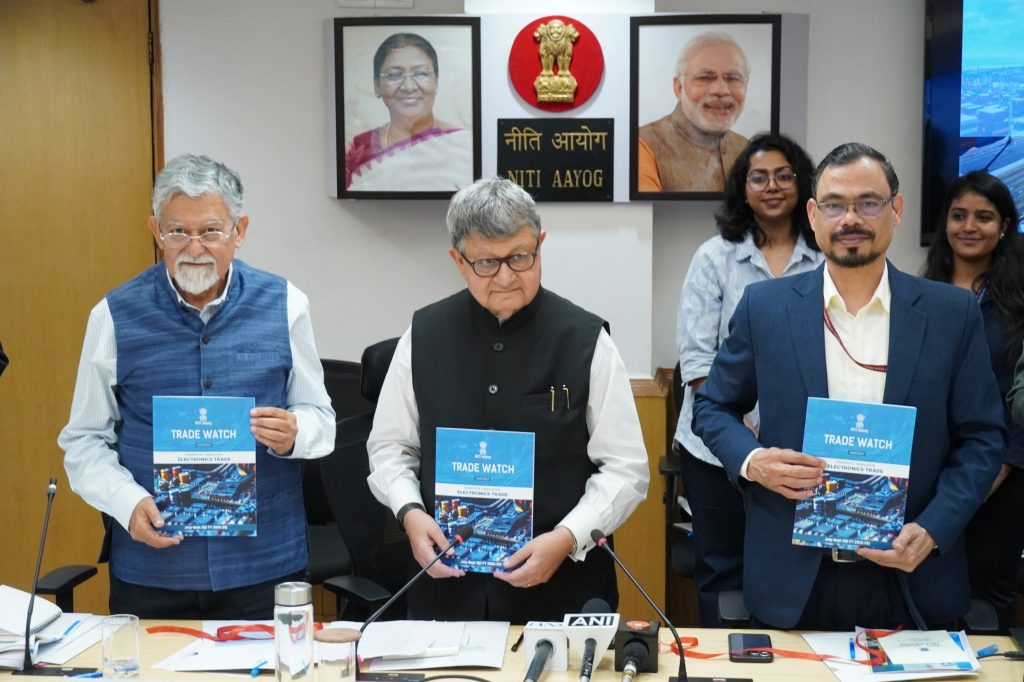
Context: Recently, NITI Aayog released the 7th edition of the Trade Watch Quarterly for Quarter 3 of FY26 (October-December 2025), providing a comprehensive assessment of global and domestic trade trends amid evolving global conditions.
About Trade Watch Quarterly
- Trade Watch Quarterly is a periodic analytical report that evaluates India’s merchandise and services trade performance across quarters.
- It provides insights into sectoral trends, global demand patterns, and India’s positioning in international trade and global value chains.
- The report also includes thematic analyses of key sectors, offering policy-relevant recommendations to enhance competitiveness.
- It serves as an important tool for evidence-based policymaking and trade strategy formulation.
Key Highlights and Trends
- Resilient but Mixed Trade Performance
- India’s trade performance in Q3 FY 2025–26 reflects a mixed yet resilient trend, with merchandise exports growing modestly by 1.6% (to $110.48 bn), while imports increased at a faster pace of 7.9% (to $202.33 bn), leading to a widening trade deficit.
- In contrast, services exports recorded strong growth of around 7.8% (to $111.2 bn), maintaining a significant trade surplus that supports overall external stability.
- Overall trade (goods + services) recorded positive growth of about 5.6% year-on-year, indicating sustained external sector activity.
- Sectoral Focus: Gems and Jewellery
- The report highlights the gems and jewellery sector as a key pillar of India’s labour-intensive manufacturing ecosystem.
- The global market size (excluding raw gold) is estimated at around $378 billion, with India contributing about $29.5 billion (7.8% share) in exports.
- India continues to play a dominant role as a global processing hub, particularly in diamond cutting and polishing.
- Evolving Trade Structure
- India’s trade patterns indicate stable export composition and changing import dynamics, reflecting deeper integration with global production networks.
- Herfindahl-Hirschman Index (HHI) trends indicate India’s exports have become more geographically and product-wise diversified, with Asia’s share moderating from ~49% to ~40% alongside rising shares of Europe (~22%) and America (over 25%) during 2017-18 to 2024-25.
Challenges Highlighted
- Persistent Merchandise Trade Deficit: The faster growth of imports relative to exports has resulted in a large merchandise trade deficit (~$91.85 bn in Q3), posing concerns for external sustainability.
- Global Uncertainties: Ongoing geopolitical tensions and macroeconomic volatility pose risks to trade flows and global demand.
- Structural Constraints: The report identifies issues such as limited value addition, dependence on imported inputs, and sectoral concentration as barriers to competitiveness.
- Constraints in Trade Policy and FTA Utilisation: Misalignment of FTAs with sector-specific needs, along with delays in duty refunds and unclear export incentives, constrain liquidity and limit effective use of preferential market access.
- High Cost of Finance and Limited Credit Access: High capital costs and restricted formal credit for MSMEs increase reliance on informal financing, raising production costs and reducing global competitiveness.
Policy Recommendations
- Strengthening Domestic Capabilities: Emphasis is placed on enhancing domestic manufacturing and value addition, particularly in key export sectors.
- Export Diversification: India needs to diversify its export basket and markets to reduce vulnerability to global shocks and demand fluctuations.
- Integration with Global Value Chains (GVCs): The report calls for deeper integration into global value chains to improve competitiveness and expand market access.
- Invest in Skills, Technology, and Cluster Infrastructure: Enhancing productivity and moving up the value chain requires simultaneous investments in skills, technology, and infrastructure.