

Coal Gasification
Context:
The Union Ministry of Coal is accelerating coal gasification through policy incentives and private investment to reduce import dependence, enhance energy security, and achieve the target of gasifying 100 million tonnes of coal by 2030.
About Coal Gasification
- Coal gasification is the process of converting coal into synthetic gas (syngas) by reacting it with a controlled amount of oxygen, steam, and heat under high temperatures.
- Syngas mainly consists of carbon monoxide (CO), hydrogen (H₂), carbon dioxide (CO₂), and methane (CH₄).
- The produced syngas can be used to manufacture methanol, ammonia, urea, hydrogen, ammonium nitrate, synthetic natural gas (SNG), fertilisers, chemicals, and petrochemicals.
- Coal gasification can be carried out through Surface Coal Gasification and Underground Coal Gasification (UCG), the latter enabling the utilisation of deep or unmineable coal reserves.
- It is considered a value-added use of coal as it converts coal into cleaner fuels and industrial feedstocks rather than directly burning it.
- For India, coal gasification is important because the country imports a large share of its crude oil, natural gas, ammonia, methanol, and fertiliser requirements.
Status of Coal Gasification in India
- India possesses about 401 billion tonnes of coal and 47 billion tonnes of lignite, and has set a target of gasifying 100 million tonnes of coal by 2030.
- The government has announced incentive packages worth ₹46,500 crore (including earlier support schemes), allocated 100 million tonnes of coal for gasification, and is targeting ₹4 lakh crore of investmentswith potential import substitution of ₹3 lakh crore over the next five years.
Zojila Tunnel Project
Context:
The strategically important Zojila Tunnel project achieved a breakthrough with the successful completion of tunnel excavation, marking a significant step toward establishing all-weather connectivity between the Kashmir Valley and Ladakh.
About the Zojila Tunnel Project
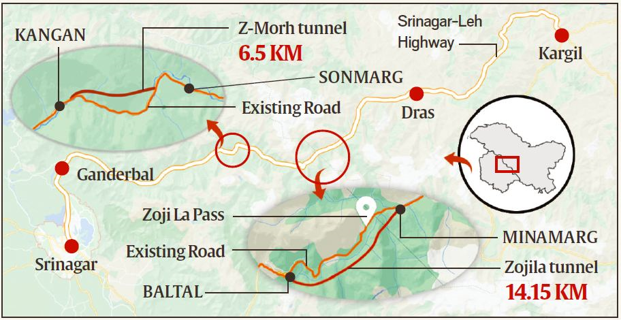
- The Zojila Tunnel is a 13.153-km-long, single-tube, bi-directional road tunnel being constructed between Baltal in Jammu & Kashmir and Minimarg in Ladakh at an altitude of about 11,578 feet.
- Built at a cost of over ₹6,500 crore, it will be India’s longest road tunnel and the world’s longest single-tube bi-directional tunnel at such a height.
- The project includes an 18-km approach road and supporting infrastructure, forming a 31-km corridor.
- It is expected to become operational in February 2028.
About Zojila Pass
- Zojila Pass is a high-altitude mountain pass on the Srinagar–Leh National Highway that serves as the primary link between the Kashmir Valley and Ladakh.
- Heavy snowfall, avalanches, and landslides often force its closure during the winter months, isolating Ladakh from the rest of the country.
- The difficult terrain also makes travel hazardous and accident-prone.
Significance of the Tunnel
- The tunnel will provide year-round, weather-proof connectivity between Kashmir and Ladakh and reduce travel time across the Zojila sector from about 1–1.5 hours to nearly 15 minutes.
- It will improve civilian and military mobility, enhance road safety, and strengthen strategic connectivity in the border region.
- The project is also expected to boost tourism, trade, employment opportunities, and regional development in Jammu & Kashmir and Ladakh.
SIPRI Yearbook 2026
Context:
The SIPRI Yearbook 2026 reported an increase in India’s nuclear arsenal, highlighted the 2025 India-Pakistan military crisis, and assessed global trends in military expenditure and nuclear weapons.
Key Findings of the Report
- India’s nuclear stockpile increased to an estimated 190 warheads by early 2026, while Pakistan possessed around 170 warheads.
- India’s nuclear modernisation programme is increasingly focused on developing long-range delivery systemscapable of reaching targets across China.
- SIPRI described the May 2025 India-Pakistan confrontation (Operation Sindoor) as an “unusually severe military crisis“ between two nuclear-armed states.
- India and Pakistan integrated cyber operations into active military conflict for the first time, indicating an evolving nature of warfare.
- India remained the world’s fifth-largest military spender in 2025, with defence expenditure reaching $92.1 billion, an increase of 8.9% over 2024.
- India ranked behind only the United States, China, Russia and Germany.
- India was also the second-largest importer of major arms during 2021–25, accounting for 8.2% of global arms imports.
- Globally, the nine nuclear-armed states possessed an estimated 12,187 nuclear warheads in 2026 and continued to modernise their arsenals, reflecting a growing reliance on nuclear deterrence.
- Global military expenditure reached a record $2.9 trillion in 2025, accounting for about 2.5% of global GDP.
About Stockholm International Peace Research Institute (SIPRI)
- SIPRI is an independent international research institute established in 1966and headquartered in Stockholm, Sweden.
- It researches conflict, armaments, arms control, disarmament, and international security.
- SIPRI is globally recognised for its authoritative databases and annual reports on military expenditure, arms transfers, and nuclear forces.
Land Port Management System (LPMS– ‘VINIMAY’)
Context:
Recently, the Union Home Minister inaugurated VINIMAY (Land Port Management System – LPMS), a digital platform developed by the Land Ports Authority of India (LPAI) for integrated, paperless and technology-driven management of cargo and passenger movement across India’s land borders.
More on the News
- VINIMAY has been developed as a unified digital ecosystem to streamline operations at India’s Integrated Check Posts (ICPs) and facilitate seamless cross-border movement of goods and passengers.
- The platform is a key component of LPAI’s broader Digital Transformation Programme, aimed at modernising border infrastructure through digital governance, automation and stakeholder integration.
- It integrates multiple stakeholders, including customs, immigration, security agencies, traders, transporters and other border-management authorities, onto a single digital platform.
- The initiative aligns with the Government’s vision of creating smart, secure and efficient borders while enhancing trade facilitation and ease of doing business.
Key Features of VINIMAY
- End-to-End Digital Processing: Provides integrated digital workflows for cargo and passenger processing, reducing dependence on manual procedures.
- Paperless and Faceless Operations: Enables digital submission, processing and approval of documents, significantly reducing physical paperwork and human interface.
- Unified Stakeholder Platform: Facilitates real-time coordination among customs, immigration, security agencies, logistics operators, traders and transporters.
- Improved Operational Efficiency: Expected to reduce paperwork by nearly 90%, truck waiting time by 40–60%, and gate-processing time by 22–35%.
- Enhanced Transparency and Monitoring: Enables digital tracking, better accountability and improved visibility across border operations.
Significance
- Boosting Border Trade: Faster cargo clearance and reduced logistics costs can improve cross-border trade competitiveness and regional economic integration.
- Ease of Doing Business: Simplified procedures and digital documentation reduce transaction costs for exporters, importers and logistics operators.
- Smart Border Management: Supports the transition towards technology-enabled, secure and efficient border infrastructure.
- Improved Security and Governance: Digital workflows and integrated stakeholder coordination enhance transparency, monitoring and regulatory compliance.
About Land Ports Authority of India (LPAI)
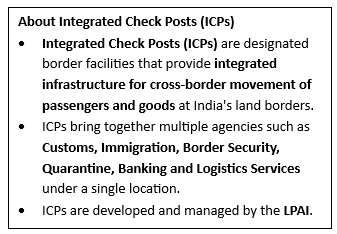
- Established under the Land Ports Authority of India Act, 2010, LPAI functions under the Ministry of Home Affairs.
- It is responsible for developing, operating and maintaining Integrated Check Posts (ICPs) along India’s international land borders.
- LPAI currently manages 15 Integrated Check Posts (ICPs) that facilitate secure and efficient movement of passengers and cargo.
- The Authority plays a key role in promoting cross-border trade, connectivity, border security and regional economic integration with neighbouring countries.
Russia Offers Sukhoi Su-57 Stealth Aircraft and Joint Production in India
Context:
Russian President Vladimir Putin has offered India the Su-57E fifth-generation stealth fighter aircraft, along with joint production, co-development and unrestricted technology transfer, signalling Russia’s intent to deepen defence-industrial cooperation with India.
More on the News
- The offer revives discussions around advanced fighter collaboration after India exited the FGFA (Fifth Generation Fighter Aircraft) programme with Russia in 2018.
- The proposal also comes at a time when the Indian Air Force (IAF) faces a decline in squadron strength and is exploring options to strengthen its future combat capabilities while pursuing the indigenous Advanced Medium Combat Aircraft (AMCA) programme.
About Su-57
- The Su-57 is Russia’s first operational fifth-generation multirole stealth fighter aircraft, developed under the PAK FA programme.
- Key features include:
- Stealth technology and reduced radar signature.
- Supercruise capability.
- Advanced avionics and electronic warfare systems.
- Multirole air-superiority and strike capabilities.
- The export version offered to India is designated Su-57E.
Significance for India
- Defence Indigenisation: Joint production and technology transfer could strengthen India’s domestic aerospace manufacturing ecosystem.
- Capability Enhancement: The aircraft could help address the Indian Air Force’s future requirements for fifth-generation combat capabilities.
- Technology Access: The offer includes access to advanced fighter technologies, an area where India is simultaneously pursuing the indigenous Advanced Medium Combat Aircraft (AMCA) programme.
French Open 2026
Context:
The 2026 French Open (Roland Garros), the second Grand Slam tournament of the year, was held in Paris, France, from 24 May to 7 June 2026.
About the French Open (Roland Garros)
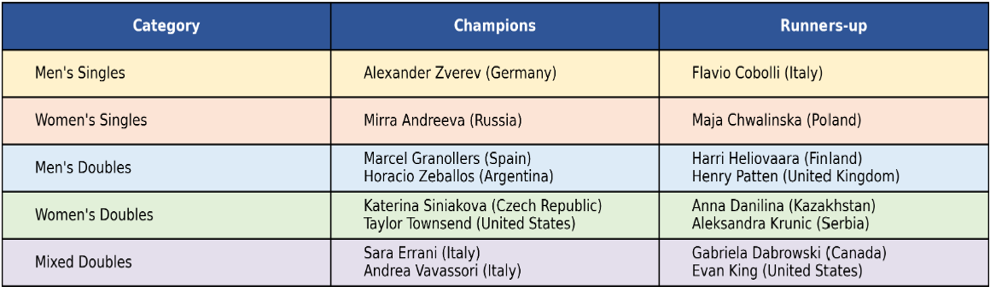
- The French Open, popularly known as Roland Garros, is one of the four Grand Slam tournaments alongside the Australian Open, Wimbledon and the US Open.
- It is conducted annually in Paris, France, by the French Tennis Federation (FFT).
- It is the only Grand Slam tournament played on outdoor clay courts, making it renowned for slower playing conditions, longer rallies and greater physical endurance requirements.
- The tournament is named after Roland Garros, a pioneering French aviator and World War I fighter pilot.
- The 2026 edition was the 125th French Open and the 96th Grand Slam tournament of the Open Era.
- Unlike the other three Grand Slam tournaments, the French Open continues to use human line judges, making it the only Grand Slam yet to fully adopt electronic line-calling technology.