

Nagaland Study Reveals Anti-Cancer Properties of Konyak Tribal Herbal Formulation
Context: Researchers from Nagaland University, in collaboration with Berhampur University and Saveetha Medical College, have identified the anti-cancer potential of a traditional herbal formulation used by the Konyak Naga tribe.
About the Konyak tribe
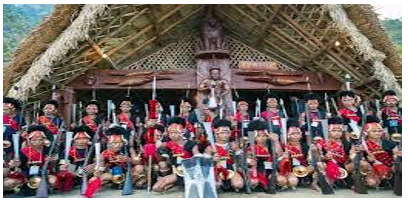
- The Konyaks are the largest Naga tribe, primarily inhabiting the Mon district of Nagaland, with settlements extending into Myanmar and parts of Arunachal Pradesh.
- The term “Konyak” is believed to be derived from Whao (head) and Nyak (black), meaning “men with black hair.”
- They are divided into two groups:
- Thendu – “Tattooed face” (mainly central Mon region).
- Thentho – “White face” (upper and lower regions, especially Wakching area)
- Political System (Angh System): The Konyaks are unique for their hereditary monarchical system, headed by chiefs known as Anghs.
- Two types of Anghs exist: Pongyin Angh (Great Chief/King) and Anghha (Village Chief).
- In villages without a Pongyin Angh, an Anghha is appointed under a chief lineage.
- Governance is supported by a village council of clan elders (nokphong).
- Language: Linguistically, Konyaks belong to the Naga-Kuki group of the Tibeto-Burman family.
- Each village has its own dialect; the Wakching dialect is commonly used for communication.
- Social & Cultural Institutions:
- Baan (Morung-like institution): Training centre for young men in warfare, crafts, hunting, dances, and social life.
- Ywo: Traditional learning space for women.
- Both institutions are now almost non-existent.
- Festivals are central to Konyak life and linked to agriculture:
- Aoling / Aolingmonyu (April): Marks the New Year and sowing season.
- Aonyimo (July/August): Celebrated after the first harvest.
- Laoun-ongmo: Thanksgiving festival after completion of agricultural activities
- Religion and Beliefs: Traditionally animistic, believing in nature spirits and a supreme deity (Kahwang). Today, the majority of Konyaks are Christians.
- Common traditional drink: Khalap (black tea).
9th Indian Ocean Conference (IOC 2026)
Context: Recently, the 9th Indian Ocean Conference (IOC 2026) was held in Mauritius from April 10–12, 2026, organised by India Foundation in association with the Government of Mauritius and India’s Ministry of External Affairs.
Key Highlights of the Conference
- Indian Ocean as a Strategic Ecosystem: External Affairs Minister Jaishankar highlighted that the ocean underpins resources, connectivity, and cultural exchanges, warning that disruptions in this ecosystem can have far-reaching global consequences.
- Rising Concern over “Choke Points”: Beyond traditional maritime choke points, new constraints are emerging in finance, technology, resources, and knowledge systems, necessitating open and resilient global flows.
- Call for Collective Resilience (Global South Focus): Describing the region as a “Global South Ocean,” he called for stronger cooperation to tackle shared challenges such as Food, fuel, and fertiliser shortages, Disaster response and spillover effects of global conflicts.
- Maritime Stability & Global Conflicts: Referring to tensions in West Asia, he underlined the need to protect civilian lives, ensure uninterrupted maritime navigation and address impacts on energy prices, trade flows, and food security.
- India’s Approach: India’s vision was linked to the Neighbourhood First policy and Maritime outlook based on collective resilience and cooperation.
About the Indian Ocean Conference (IOC)
- It was launched in 2016 by the India Foundation in collaboration with regional think tanks and institutions.
- It has evolved into a flagship platform for dialogue among Indian Ocean countries on regional cooperation, maritime security, and development under the vision of Security and Growth for All in the Region (SAGAR).
- Theme (9th edition): “Collective Stewardship for Indian Ocean Governance,” brought together leaders, policymakers, and experts from across the Indian Ocean Region to deliberate on regional cooperation, maritime governance, and shared challenges.
- The 8th IOC 2025 was held in Muscat, Oman, in February 2025.
- Theme: “Voyages to New Horizons of Maritime Partnership.”
- Since its inception in 2016, the Indian Ocean Conference (IOC) has been hosted across key countries—Singapore (2016), Sri Lanka (2017), Vietnam (2018), Maldives (2019), UAE (2021), Bangladesh (2023), Australia (2024), Oman (2025), and Mauritius (2026).
Significance
- Strengthens the Indian Ocean as a geopolitical and economic hub connecting Asia, Africa, and Europe.
- Promotes rules-based maritime order and cooperation in line with global norms.
- Enhances regional resilience amid rising geopolitical tensions and economic fragmentation.
- Provides a platform for addressing non-traditional security challenges such as climate change, supply chain disruptions, and maritime insecurity.
- Reinforces the importance of collective stewardship in managing shared ocean resources and ensuring sustainable development.
7th edition of the India-Uzbekistan joint military exercise, Exercise DUSTLIK
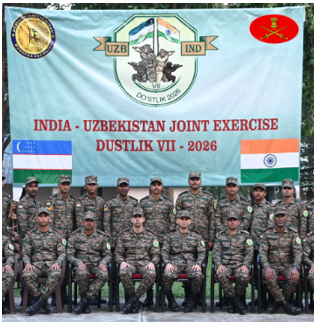
Context: An Indian Army contingent of 60 personnel has departed for the 7th edition of Exercise DUSTLIK, a joint India–Uzbekistan military exercise being held from April 12 to 25, 2026, at the Gurumsaray Field Training Area in Namangan, Uzbekistan.
More on the News
- The Indian contingent includes 45 personnel from the Indian Army (mainly the Mahar Regiment) and 15 personnel from the Indian Air Force, while Uzbekistan has deployed a similar strength from its Army and Air Force.
- The joint training will culminate in a 48-hour validation exercise focusing on special operations to neutralise unlawful armed groups.
About Exercise DUSTLIK
- Exercise DUSTLIK is an annual bilateral military exercise, conducted alternatively in India and Uzbekistan.
- The previous edition (2025) was held at Aundh, Pune.
- Objective: To strengthen military cooperation and enhance the ability of both forces to conduct joint operations in semi-mountainous terrain.
- Key Focus Areas: The exercise emphasizes joint planning and execution of operations, along with enhancing tactical drills, special arms skills, and high standards of physical fitness.
- It also focuses on establishing a unified command-and-control framework while improving interoperability and operational synergy.
- Operational Activities: The activities include land navigation exercises, strike missions on enemy bases, and the seizure of enemy-held areas.
- It also involves training for special operations against unlawful armed groups.
- Strategic Significance:
- Promotes sharing of best practices in Tactics, Techniques, and Procedures (TTPs).
- Enhances interoperability and coordination between the armed forces.
- Builds camaraderie and mutual trust among troops.
- Strengthens defence cooperation and bilateral relations between India and Uzbekistan.
Project Cheetah Achieves First Wild Birth in India
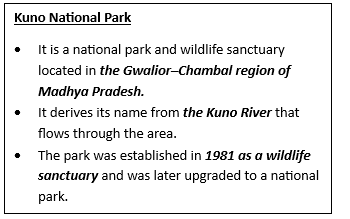
Context: India’s ambitious cheetah reintroduction programme, known as Project Cheetah, marked a historic milestone, when an Indian-born female cheetah gave birth to four cubs in the wild at Kuno National Park—the first such recorded instance since the project began in 2022.
About the Project Cheetah
- It is a landmark wildlife conservation initiative launched on 17 September 2022 at Kuno National Park.
- It marks the world’s first inter-continental translocation of a large carnivore, aiming to reintroduce cheetahs to India after their extinction in 1952.
- The project is implemented by the National Tiger Conservation Authority under the Ministry of Environment, Forest, and Climate Change.
- Key Phases of the Project:
- September 2022: Introduction of 8 cheetahs from Namibia (first-ever translocation)
- February 2023: Arrival of 12 cheetahs from South Africa, including Gamini
- February 2026: Third phase involving the translocation of 9 cheetahs from Botswana.
- Objectives:
- To establish breeding cheetah populations in safe habitats across their historical range and manage them as a metapopulation.
- To use the cheetah as a charismatic flagship and umbrella species to mobilise resources for restoring open forest and savanna ecosystems, benefiting biodiversity and ecosystem services.
- To enhance India’s capacity for carbon sequestration through ecosystem restoration in cheetah conservation areas, contributing to global climate change mitigation goals.
- To promote ecodevelopment and ecotourism, thereby improving local community livelihoods.
- To manage human-wildlife conflict through compensation, awareness, and timely management actions to ensure community support.
- Long-Term Vision:
- Develop a connected Kuno–Gandhi Sagar landscape capable of supporting 60–70 cheetahs.
- Expand cheetah habitats to other suitable regions across India.
- Create a model for global wildlife reintroduction and conservation practices.