

7th AgriVoltaics World Conference 2026
Context: The 7th AgriVoltaics World Conference 2026 was held in New Delhi from 21–23 October under the theme “Powering the Global South”.
About the AgriVoltaics World Conference 2026
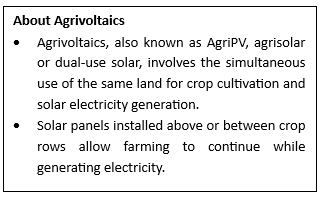
- The conference was hosted by the Ministry of New and Renewable Energy (MNRE), Government of India, with support from Germany’s Federal Ministry for the Environment, Climate Action, Nature Conservation and Nuclear Safety (BMUV).
- It was the first edition hosted in the Global South and brought together farmers, policymakers, researchers, industry leaders and international experts.
- Key Outcomes:
- Policy Development: Odisha announced that it is finalising its dedicated Agrivoltaics Policy 2026, targeting 1 GW by 2030, with provisions to protect cultivable land, farmer consent and crop insurance.
- Farmer-Centric Implementation: Discussions emphasised agro-climatic zoning, crop selection, water-use efficiency, farmer training, land ownership protection and commercially viable business models.
- Technology and Finance: Participants explored advanced solar technologies, innovative financing, concessional lending, blended finance and risk-mitigation mechanisms to accelerate deployment.
- Knowledge Resources: Three resources were launched: the AgriPV Policy Handbook by MNRE, the India Agrivoltaics Alliance’s Decision-Making Tool and the International Water Management Institute’s Book of Abstracts.
- Recognition and Cooperation: Excellence Awards, the National Agrivoltaics Pitch-Hub Award and Best Paper Awards across six scientific themes recognised contributions to the sector. France will host the 8th conference in 2027.
Kashipur Excavation and Painted Grey Ware Culture
Context: The Archaeological Survey of India (ASI) has resumed excavations at a 90-acre mound in Kashipur, Uttarakhand, to establish its cultural sequence and investigate its historical significance and possible links with the Mahabharata traditions.
Key Findings
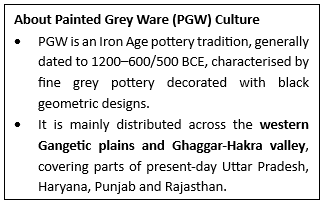
- Historical Identification: Alexander Cunningham identified Kashipur with Kiu-pi-shwang-na, or Govisana, described by Chinese traveller Xuanzang (Hiuen Tsang), who visited the region in the 7th century CE.
- Cunningham also traced a large structure at Bhim-Gaja, the site’s highest point.
- Earlier Excavations: The ASI excavated the site in 1939–40, 1965–66 and 1970–71, revealing a temple constructed in three phases.
- It began as a raised soil-brick platform, possibly supporting a sanctum, during the Gupta period, followed by two enclosing walls, probably in the 6th–7th centuries CE.
- Recent Excavations: The ASI’s Dehradun Circle has uncovered brick structures and a circular formation.
- The current excavation aims to scientifically examine earlier findings and establish the site’s cultural sequence, which earlier excavations did not fully investigate.
- Archaeological Evidence: Pottery from the Painted Grey Ware, Kushan, Gupta and medieval periods indicates human activity across multiple historical periods.
- Local traditions associate the site with sage Dronacharya and the Pandavas, but these connections require archaeological corroboration.
About the Hastinapur Site
- Location and Excavation: Located in Meerut district, Uttar Pradesh, Hastinapur was excavated by B. B. Lal in 1950–52 under the ASI.
- Lal associated Painted Grey Ware sites, including Hastinapur, Mathura, Kurukshetra and Barnawa, with places mentioned in the Mahabharata.
- Hastinapur was announced in 2026 as one of 15 archaeological sites for development as an experiential cultural destination. It is also an important Jain pilgrimage centre.
Khajuraho Temples
Context: The Archaeological Survey of India (ASI) has found the missing sandstone head of an 11th-century Vishnu idol at Khajuraho’s Javari Temple in Madhya Pradesh and plans to reattach it after expert examination.
More on the News
- The seven-foot idol’s restoration became controversial after a petition seeking its restoration, replacement or reconstruction reached the Supreme Court.
- ASI Director General Yadubir Singh Rawat stated that experts are examining the recovered head before reattaching it to the idol.
About the Khajuraho Temples
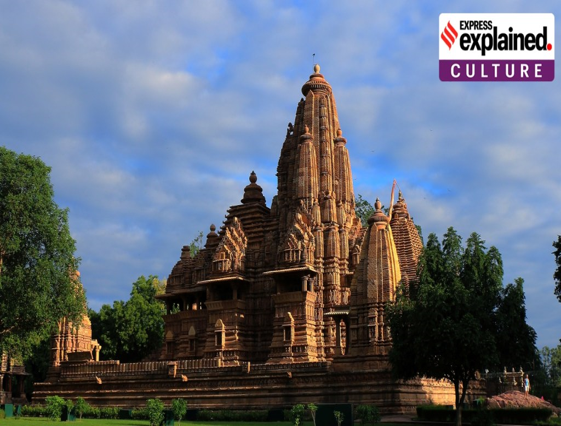
- Location: Chhatarpur district, Madhya Pradesh.
- Builders: The Chandela dynasty, which patronised temple construction mainly between the 10th and 11th centuries.
- Historical background: Khajuraho reportedly once had around 85 temples spread across approximately 13 square kilometres, of which about 20–23 survive today.
- Religious significance: The temples represent Hindu and Jain traditions and reflect religious devotion, royal patronage, political legitimacy and cultural achievement.
- Architecture: They exemplify the Nagara style of temple architecture, characterised by soaring shikharas, intricate carvings and harmonious proportions.
- The Lakshmana and Vishvanatha temples follow the Panchayatana style, featuring four subsidiary shrines around the main shrine.
- Three temple groups: The Western Group includes Kandariya Mahadeva and Lakshmana temples; the Eastern Group includes the Javari Temple and Jain temples; and the Southern Group includes the Duladeva and Chaturbhuja temples.
- Sculptures: Depictions include deities, celestial figures, dancers, musicians, warriors, domestic life and amorous couples, reflecting religious beliefs and contemporary society.
- Rediscovery and conservation: Captain T. S. Burt documented the temples in 1838. Alexander Cunningham subsequently surveyed them, and Maharaja Pratap Singh of Chhatarpur undertook repairs between 1843 and 1847.
- UNESCO recognition: The Khajuraho Group of Monuments was designated a UNESCO World Heritage Site in 1986.
PHP2Shell Vulnerabilities
Context: The PHP development team released emergency security updates on October 21, 2026, for two critical vulnerabilities, collectively called PHP2Shell, which could allow attackers to execute malicious code remotely without authentication.
Understanding PHP

- PHP (PHP: Hypertext Preprocessor) is a free, open-source, server-side programming language used to develop dynamic websites and applications.
- It processes user requests, interacts with databases and generates web pages.
- According to cybersecurity firm Wiz, PHP powers around 70% of websites whose server-side language is identifiable. WordPress, which powers over 40% of websites worldwide, relies on PHP.
- The PHP Foundation supports its long-term development.
Key Vulnerabilities
- The two vulnerabilities are identified as CVE-2026-109618 and CVE-2026-109619, with a reported severity rating of 9.2 out of 10. They may be triggered before website-level authentication checks.
- Memory corruption: PHP may mishandle incomplete or invalid data during memory-related errors.
- Stale memory references: PHP may attempt to access memory that has already been cleared, potentially corrupting data.
Bodhana Sivanandan: Youngest Female International Master in Chess
Context: Eleven-year-old Bodhana Sivanandan became the youngest female International Master (IM) in chess history, breaking Judit Polgár’s record that had stood since 1988.
About the Difference Between Grandmaster (GM), International Master (IM), Woman Grandmaster (WGM) and Woman International Master (WIM)
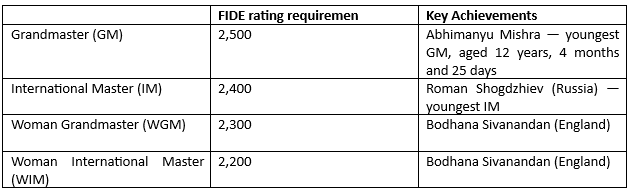
Firsts and Youngest Achievers in Indian Chess
- First Indian Grandmaster: Viswanathan Anand (1988).
- First Indian International Master: Manuel Aaron (1961).
- First Indian woman Grandmaster: Koneru Humpy (2002).
- Youngest World Chess Champion: Gukesh D (18 years, 2024).
- Youngest Grandmaster: Abhimanyu Mishra (12 years, 2021).
- Youngest female International Master: Bodhana Sivanandan (11 years, 2026).
- World No. 1 (highest peak rating): Magnus Carlsen (Norway) — 2,882 Elo.
Narcotics Control Bureau (NCB) launched Operation Trident
Context: The Narcotics Control Bureau (NCB), in coordination with Mizoram Police and the Enforcement Directorate (ED), launched Operation Trident to dismantle a transnational drug trafficking network operating across Assam, Mizoram and Manipur.
About Operation Trident
- Execution: 38 multi-agency teams conducted simultaneous searches at 38 identified locations across the three states, targeting the operational and financial networks of the cartel.
- Key Outcomes: The operation resulted in 18 arrests, identification of nearly ₹100 crore in hawala transactions, freezing of 1,424 bank accounts, and attachment of properties worth ₹17.82 crore. Authorities also seized 500 detonators and ₹12 lakh in cash.
- Drug Trafficking Network: Investigations linked the network to the trafficking of methamphetamine and heroin through routes connecting Myanmar, Mizoram, Manipur, Assam and Tripura, with onward movement into mainland India and Bangladesh.
- Investigation: Intelligence-sharing, financial profiling and digital forensics exposed alleged facilitators, shell entities and money mules associated with the syndicate.
- Significance: The operation reflects a shift from a seizure-centric approach to a network-centric and financial disruption strategy, targeting both drug trafficking logistics and illicit financial flows.
- Policy Linkage: It aligns with the Vision Document on Narcotics Control (2026–2029) and the government’s target of eliminating every drug network by 31 December 2029.
Kamala Hydroelectric Project
Context: State-run NHPC has sought forest clearance to divert 3,278 hectares of forest land in Arunachal Pradesh for its proposed 1,720 MW Kamala Hydroelectric Project.
Kamala Hydroelectric Project
- Location: On the Kamala River, a right-bank tributary of the Subansiri River, upstream of Tamen village in Arunachal Pradesh.
- Former Name: Subansiri Middle Hydroelectric Project.
- Implementing Agency: National Hydroelectric Power Corporation (NHPC).
- Installed Capacity: Approximately 1,720 MW, comprising an underground powerhouse and a surface powerhouse.
- Project Cost: Approximately ₹24,000 crore.
- Key Features: A 216-metre-high concrete gravity dam designed for power generation and flood moderation, with a storage reservoir.
- Land Requirement: 3,278 hectares of forest land proposed for diversion, including 439 hectares of very dense forest and 1,119 hectares of moderately dense forest.
- Biodiversity: Field surveys recorded 155 plant species belonging to 69 families. The project may affect wildlife habitats and animal movement between riverbanks.
- Compensatory Afforestation: Plantation over 7,018 hectares has been proposed across several districts of Madhya Pradesh.
- Social Impact: Approximately 5,440 families across 126 villages are expected to be affected.
- Environmental Clearance: The project received a recommendation for environmental clearance in January, subject to obtaining in-principle forest clearance before final approval.