

Anti-Submarine Warfare Shallow Water Craft INS Mangrol Inducted into Navy
Context: The Indian Navy commissioned INS Mangrol (P82), the third Mahe-class Anti-Submarine Warfare Shallow Water Craft (ASW-SWC), at the Naval Dockyard, Mumbai, on 12 October 2026.
Key Features of INS Mangrol
- Indigenous construction: Designed and built by Cochin Shipyard Limited (CSL), Kochi, with over 80% indigenous content.
- It is named after the coastal town and fishing harbour of Mangrol in Gujarat’s Junagadh district and carries forward the legacy of the erstwhile INS Mangrol (M85), a minesweeper that served until April 2004.
- Weapons and sensors: Equipped with the Abhay hull-mounted sonar, lightweight torpedoes, an indigenous anti-submarine rocket launcher and the Maareech Advanced Torpedo Decoy System.
- Propulsion and operational roles: Three diesel engine-driven waterjet propulsion units provide high manoeuvrability in shallow and confined waters. The vessel is designed for anti-submarine warfare (ASW), underwater surveillance, Low-Intensity Maritime Operations (LIMO) and mine warfare-related tasks.
Significance
- Strengthening coastal defence: Enhances the Navy’s ability to detect, track and counter submarine threats in shallow coastal waters, protecting ports, harbours and coastal approaches.
- Replacing ageing platforms: The Mahe-class programme is intended to replace the Navy’s ageing Abhay-class ASW corvettes. The broader ASW-SWC programme comprises 16 vessels—eight Mahe-class vessels being built by CSL and eight Arnala-class vessels by Garden Reach Shipbuilders & Engineers (GRSE).
- Defence indigenisation: With over 80% indigenous content, INS Mangrol strengthens domestic warship design, construction and systems integration, supporting Aatmanirbhar Bharat and Make in India.
India and France to launch Trishna satellite in 2027
Context: India and France are developing the TRISHNA satellite, a joint Earth-observation mission scheduled for launch in 2027, to improve monitoring of land-surface temperature, agricultural water stress and natural resources.
About TRISHNA (Thermal Infra-Red Imaging Satellite for High-resolution Natural Resource Assessment)
- Agencies and cooperation: The third joint satellite mission of the Indian Space Research Organisation (ISRO) and France’s National Centre for Space Studies (CNES), following Megha-Tropiques (2011) and SARAL (2013).
- Payloads: CNES provides the four-channel Thermal Infrared (TIR) instrument, while ISRO develops the Visible–Near Infrared–Short Wave Infrared (VNIR–SWIR) instrument with seven spectral bands.
- Launch and orbit: Planned to be launched by India’s Polar Satellite Launch Vehicle (PSLV) from Sriharikota. It will operate in a 761-km Sun-synchronous orbit, with a planned mission life of five years.
- Resolution and revisit: Provides products at approximately 60-metre resolution and revisits the same location about every three days near the equator.
- Data access: Scientific data will be processed through ground segments in India and France and made freely accessible through India’s BHOONIDHI and France’s GEODES portals.
Objectives and Significance
- Agriculture and water management: Measures evapotranspiration, vegetation conditions and crop-water stress to improve irrigation planning, water-use efficiency and crop productivity.
- Climate and ecosystem monitoring: Tracks land-surface temperature, urban heat islands, droughts, snowmelt and glacier dynamics; also supports monitoring of coastal and inland water quality and dynamics.
- Natural-resource assessment: Helps identify subsurface fires, assess geothermal resources and improve understanding of surface energy and water budgets.
- Scientific cooperation: Combines complementary Indian and French satellite technologies and expertise to provide high-resolution, frequent Earth observations for research and resource-management decisions.
10th Edition of India Mobile Congress
Context: ThePrime Minister inaugurated the 10th India Mobile Congress (IMC) 2026 on 8 October at Yashobhoomi, New Delhi. Held from 7–10 October, it carried the theme “Scale Without Boundaries.”
About India Mobile Congress
- Nature: IMC is a major platform for telecommunications and emerging digital technologies. PIB describes it as Asia’s largest digital technology forum, while its official website calls it Asia’s Largest Tech Fest.
- Organisers: Department of Telecommunications (DoT), Ministry of Communications, and the Cellular Operators Association of India (COAI).
- Evolution: Launched in 2017 with the theme “Connecting the Next Billion,” IMC has evolved into an international platform for technology demonstrations, product launches, policy dialogue, investment and industry collaboration. The 2022 edition hosted the launch of 5G services in India.
Key Features of IMC 2026
- Four pillars: Srishti (Building the Future), Samvardhan (Fueling Growth), Sashakt (Expanding Opportunities) and Suraksha (Strengthening Trust).
- Technology focus: 5G and 6G, AI networks, semiconductors, non-terrestrial networks, cybersecurity, quantum communication and electronics manufacturing.
- New focus areas: Smart mobility, stadium experiences, industrial robotics and transport technology.
World Cotton Day 2026
Context: World Cotton Day was observed on 7 October 2026 under the global theme “Cotton for Good: Building Prosperity Through Trade, Transformation and Partnership”.
About World Cotton Day
- Origin: Proposed by the Cotton-4 countries—Benin, Burkina Faso, Chad and Mali. The first global celebration was held in Geneva on 7 October 2019.
- UN recognition: The UN General Assembly proclaimed 7 October as World Cotton Day through Resolution 75/318 in August 2021.
- Significance: It highlights cotton’s contribution to livelihoods, international trade, economic development and poverty alleviation. According to FAO, cotton is the world’s second-most-used fibre after polyester, accounting for approximately 20% of total fibre demand.
Cotton Cultivation in India
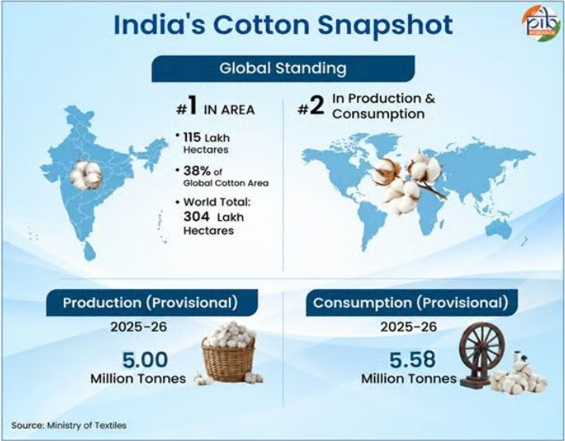
- Economic importance: Popularly known as white gold, cotton supports around 60 lakh farmers and provides employment to an estimated 40–50 million people in associated activities across the value chain.
- Cotton species: India is the only country cultivating all four recognised species: Gossypium arboreum, G. herbaceum, G. hirsutum and G. barbadense.
- India ranks first globally in cotton cultivation area and second in production and consumption.
- Bt cotton: Commercially introduced in India in 2002, it incorporates genes from the soil bacterium Bacillus thuringiensis (Bt) to provide resistance against bollworms, reducing infestation and the need for insecticide sprays.
- Major growing zones: The Northern Zone comprises Punjab, Haryana and Rajasthan; the Central Zone comprises Gujarat, Maharashtra and Madhya Pradesh; and the Southern Zone comprises Telangana, Andhra Pradesh and Karnataka. Cotton is also grown in Odisha and Tamil Nadu.
- Exports and trade: In 2024–25, India exported 18 lakh bales (0.31 million tonnes) of raw cotton, accounting for 3.37% of global exports. Separately, India’s cotton fabrics and made-ups exports were led by the United States (26.3%), followed by Bangladesh (19.8%).
- Recent initiatives: The Mission for Cotton Productivity aims to improve productivity, quality and climate resilience, while Kasturi Cotton Bharat promotes Indian cotton through certification, traceability and branding.
Air Force Day 2026
Context: Air Force Day is observed annually on 8 October to commemorate the establishment of the Indian Air Force (IAF) in 1932. The IAF marked its 94th anniversary in 2026 under the theme “Indian Air Force: Infallible, Impervious and Precise”.
About the Indian Air Force (IAF)
- Establishment: Established on 8 October 1932 as the Indian Air Force. The prefix “Royal” was added in March 1945, and it was dropped in January 1950 when India became a republic. Its first squadron, No. 1 Squadron, was formed on 1 April 1933.
- Role: The IAF safeguards Indian airspace and conducts aerial operations in support of national security. It also undertakes humanitarian assistance and disaster-relief operations.
- Motto: “Nabhaḥ Sparśam Dīptam”—“Touch the Sky with Glory”—is derived from Chapter 11, Verse 24 of the Bhagavad Gita.
EXERCISE INDRA-2026
Context: INS Sahyadri arrived at Vladivostok, Russia, on 10 October 2026 to participate in the bilateral naval exercise INDRA-2026, scheduled from 13–18 October 2026.
About Exercise INDRA
- Nature and origin: A bilateral military exercise between India and Russia, initiated in 2003 to strengthen defence cooperation and interoperability. The name INDRA is derived from INDia and RussiA.
- Edition: The 2026 naval exercise is the 15th edition, following the 14th naval edition held off the coast of Chennai, India, in March–April 2025.
- Formats: The series has included service-specific exercises involving the respective armies, navies and air forces. INDRA-2017 was the first joint tri-services exercise between the two countries.
- 2026 conduct: The exercise comprises a harbour phase at Vladivostok, followed by coordinated operational activities at sea in the adjacent waters of the Sea of Japan. It aims to enhance mutual understanding, operational coordination and interoperability between the two navies.
- Strategic significance: The exercise strengthens India–Russia defence and maritime cooperation and aligns with India’s MAHASAGAR vision—Mutual and Holistic Advancement for Security and Growth Across Regions.