SYLLABUS
GS-2: Bilateral, regional and global groupings and agreements involving India and/or affecting India’s interests.
Context: The first Shanghai Cooperation Organisation (SCO) Civilisational Dialogue Forum was held from November 20–22, 2026, at Purana Qila, New Delhi, to celebrate shared civilisational heritage, strengthen people-to-people connections and promote cultural cooperation among SCO countries.
Key Outcomes of the Forum
- Adoption of Indraprastha Communiqué: The Forum adopted the Indraprastha Communiqué, outlining areas of consensus and a roadmap for continued civilisational dialogue among SCO countries. Key provisions include:
- Recognising every civilisation as an equal voice and respecting its identity and contribution to humanity.
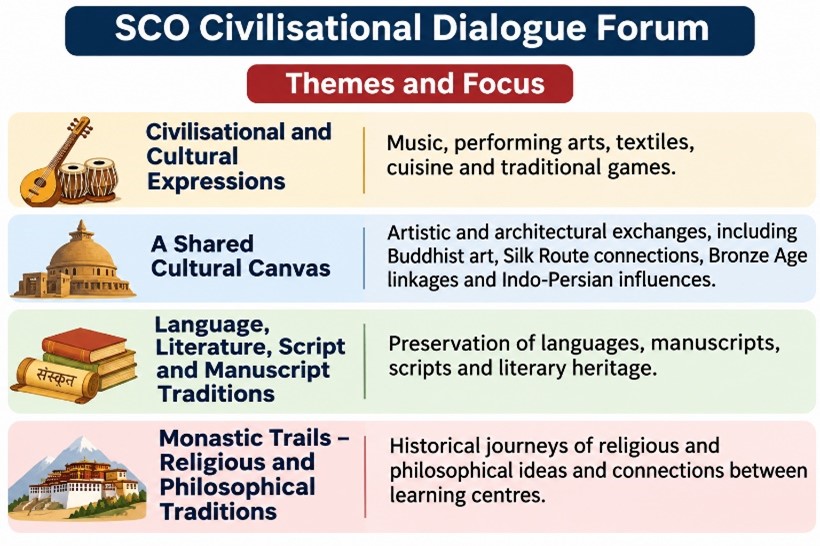
- Recognising cultural heritage in its broader form, including monuments, manuscripts, literature, artworks, living traditions, cuisine, performing arts and traditional knowledge systems.
- Promoting the responsible use of Artificial Intelligence (AI) and other technologies for the preservation, accessibility, translation and documentation of cultural heritage.
- Strengthening cooperation against illegal trafficking of cultural property, environmental damage and natural disasters affecting heritage.
- Digital Preservation of Heritage: Encouraging cooperation in digitising and translating ancient manuscripts, historical documents and literary works, alongside joint research projects.
- Strengthening Cultural Exchanges: Promoting joint exhibitions, academic and research exchanges, cultural festivals, artist exchanges and cultural tourism.
- Protection of Shared Heritage: Emphasising collaborative conservation and digital documentation of tangible and intangible cultural heritage, including Buddhist, Silk Route and Indo-Persian traditions.
- Institutional Continuity: India proposed that the Forum be held once every two years, at a venue decided at SCO summits; the Forum took note of the proposal.
About the SCO Civilisational Dialogue Forum
- Inaugural Edition: Held from November 20–22, 2026, at the historic Purana Qila, New Delhi.
- Inaugurated by: Prime Minister Narendra Modi on November 20, 2026.
- Organised by: Jointly organised by the Ministry of Culture and Ministry of External Affairs, Government of India, with the Indira Gandhi National Centre for the Arts (IGNCA) as the knowledge partner.
- Origin: The initiative was proposed by Prime Minister Narendra Modi at the SCO Summit in Tianjin, China, in September 2025. It was subsequently welcomed in the Bishkek Declaration of the SCO.
- Theme: Vasudhaiva Kutumbakam – The World Is One Family (the theme of the inaugural cultural presentation, Civilisations in Conversation).
About the Shanghai Cooperation Organisation (SCO)
- Established on 15 June 2001 in Shanghai, China, evolving from the Shanghai Five mechanism (1996).
- Founding Members: China, Russia, Kazakhstan, Kyrgyzstan, Tajikistan and Uzbekistan.
- Membership Expansion: India and Pakistan joined in 2017, Iran in 2023 and Belarus in 2024, taking total membership to 10 countries.
- It is the world’s largest regional organisation in terms of geographical coverage and population, covering approximately 80% of the Eurasian landmass and 40% of the global population.
- Objectives: To promote regional peace, security and stability; strengthen economic, political and cultural cooperation; and combat the three evils of terrorism, separatism and extremism.
- Institutional Structure:
- Supreme decision-making body: Council of Heads of State.
- Permanent bodies: SCO Secretariat (Beijing, China) and Regional Anti-Terrorist Structure (RATS), headquartered in Tashkent, Uzbekistan.
- Official Languages: Chinese, English and Russian.
- India and SCO: India became a full member in 2017 and uses the SCO platform to strengthen its engagement with Central Asia, promote regional connectivity, counter terrorism, enhance energy security and advance a multipolar world order.
- India also hosted the SCO Summit in 2023.