

Ship Repair Facility in Vadinar
Context: The Cabinet Committee on Economic Affairs (CCEA) approved the development of a state-of-the-art Ship Repair Facility at Vadinar to strengthen India’s ship repair capacity and maritime infrastructure.
About the Vadinar Ship Repair Facility
- The project will be jointly implemented by Deendayal Port Authority and Cochin Shipyard Limited with a total investment of ₹1,570 crore.
- It is planned as a brownfield facility comprising a 650-metre jetty, two large floating dry docks, workshops, and associated marine infrastructure.
- Vadinar’s natural deep draft, connectivity to major shipping routes, and proximity to key ports such as Mundra Port and Deendayal Port make it a strategic location for ship repair operations.
- The facility will enable repair of large vessels up to 300 metres, addressing India’s existing infrastructure gap for servicing ships exceeding 230 metres in length.
- The project is expected to reduce dependence on foreign shipyards, curb foreign exchange outflow, and improve turnaround time for vessel repairs on the western coast.
- It will generate around 290 direct jobs and 1,100 indirect jobs, while promoting maritime ancillary industries, logistics services, MSMEs, and skill development in the region.
- The initiative supports India’s long-term maritime goals under Maritime India Vision 2030 and Maritime Amrit Kaal Vision 2047.
Updated SOP for Processing Foreign Direct Investment (FDI) Proposals in India
Context: The Ministry of Commerce and Industry has issued an updated Standard Operating Procedure (SOP) for processing Foreign Direct Investment (FDI) proposals to make the approval process faster, transparent, paperless, and time-bound.
About the Updated Standard Operating Procedure (SOP)
- Nodal Agency: The Department for Promotion of Industry and Internal Trade (DPIIT) is the nodal body for processing FDI proposals.
- Fully Digital Process: All FDI applications must be filed online through the Foreign Investment Facilitation (FIF) Portal or National Single Window System (NSWS).
- No physical documents are required.
- Time-Bound Approval Mechanism: Maximum processing timeline fixed at 12 weeks (earlier 10 weeks under the 2017 SOP).
- Time taken by applicants to provide additional information is excluded.
- Processing Timeline: DPIIT will assign proposals to the concerned ministry within 2 days.
- Ministries, RBI, MHA, and MEA will conduct scrutiny and provide comments within prescribed timelines.
- If comments are not received in time, it will be presumed that there are “no comments”.
- Security Clearance by MHA: Mandatory for investments in sensitive sectors such as:
- Defence
- Telecommunications
- Broadcasting
- Civil aviation
- Space sector
- Private security agencies
- Titanium-bearing minerals and ores
- Rules for Border-Sharing Countries: Investments from countries sharing a land border with India require security clearance.
- These countries are: China, Pakistan, Bangladesh, Nepal, Bhutan, Myanmar, and Afghanistan.
- Fast-Track Clearance for Strategic Sectors: Investments from neighbouring countries in priority sectors will be cleared within 60 days.
- Sectors include such as electronic components, capital goods manufacturing, advanced battery components, polysilicon wafers, and rare-earth processing.
- Large Investment Proposals: FDI proposals involving foreign equity inflow above ₹5,000 crore require approval from the Cabinet Committee on Economic Affairs (CCEA).
UNEP Expands Global Methane Monitoring System
Context: The United Nations Environment Programme has expanded its Methane Alert and Response System (MARS) to track methane emissions from coal mines and waste facilities.
About Methane Alert and Response System (MARS)
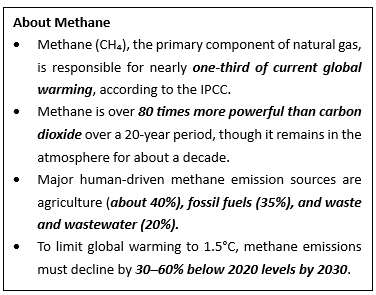
- MARS is a satellite-based methane monitoring system launched by UNEP’s International Methane Emissions Observatory in 2023.
- It uses data from more than 35 satellites to detect major methane emission sources (“super-emitters”) across the world.
- The system sends alerts to governments and industries so that methane leaks can be rapidly controlled.
- MARS also tracks whether emissions have been reduced after mitigation measures are implemented.
- Earlier, MARS focused mainly on oil and gas facilities under the Oil and Gas Methane Partnership 2.0 (OGMP 2.0).
- The system has now been expanded to include coal mines and waste facilities, including landfills.
- Since its launch, MARS has helped detect and mitigate 41 methane super-emitter sources across 11 countries, with estimated emissions of 1.2 million tonnes of methane.
ANEEL Fuel for Thorium-based Reactors
Context: US-based nuclear fuel company Clean Core Thorium Energy (CCTE) has successfully completed high-burnup irradiation testing of its patented thorium-based ANEEL fuel at the Advanced Test Reactor of Idaho National Laboratory.
More on the News
- The fuel achieved a burnup level of more than 60 GWd/MTU, a significant milestone in advanced nuclear fuel development.
- Burnup refers to the amount of energy extracted from nuclear fuel; higher burnup indicates improved fuel utilisation and lower spent fuel generation.
- The reported burnup level is more than eight times the typical discharge burnup of conventional PHWR and CANDU reactor fuels.
- The development is particularly relevant for countries like India, which possess large thorium reserves and are exploring thorium-based nuclear energy pathways.
About the ANEEL Thorium Fuel
- ANEEL (Advanced Nuclear Energy for Enriched Life) is a patented thorium-based nuclear fuel developed by Clean Core Thorium Energy (CCTE) for use in Pressurised Heavy Water Reactors (PHWRs) and CANDU-type reactors.
- The fuel has been named in honour of Anil Kakodkar, former Chairman of the Atomic Energy Commission of India and one of India’s leading nuclear scientists, recognising his contributions to India’s thorium-based nuclear energy programme.
- ANEEL fuel combines thorium with High-Assay Low-Enriched Uranium (HALEU), aiming to improve fuel efficiency, reactor performance, and long-term sustainability.
Significance
- Advancement in Thorium-based Nuclear Technology: The successful testing strengthens the prospects of thorium-based fuel cycles, which are considered safer and more sustainable alternatives to conventional uranium fuel systems.
- Improved Fuel Efficiency and Reduced Waste: Higher burnup levels can significantly improve fuel efficiency, reduce the quantity of spent nuclear fuel, and enhance overall reactor economics.
- Relevance for India’s Nuclear Programme: India possesses one of the world’s largest thorium reserves and has long pursued a three-stage nuclear programme aimed at utilising thorium-based reactors for long-term energy security.
NSE Launches Electronic Gold Receipts to Formalise Gold Market
Context: The National Stock Exchange of India (NSE) has launched Electronic Gold Receipts (EGRs) as a new trading segment to modernise and formalise India’s gold market.
More on the News
- As part of the launch, NSE successfully demonstrated the dematerialisation of a 1,000-gram gold bar into an EGR, showcasing the conversion of physical gold into a tradable electronic instrument.
- The initiative seeks to integrate India’s traditionally informal gold ecosystem with regulated financial markets through a transparent and technology-driven framework.
About Electronic Gold Receipts (EGRs)
- EGRs are dematerialised securities that represent ownership of physical gold, which is stored in SEBI-accredited vaults and held electronically through depositories.
- Each EGR is fully backed by physical gold and can be traded on the exchange, integrating gold into the formal financial system.
- Investors can also convert EGRs into physical gold through a prescribed redemption mechanism, ensuring linkage between digital and physical ownership.
Significance
- Formalisation and Transparency: EGRs are expected to bring greater transparency, traceability, and standardisation to India’s gold market, which has historically been fragmented and largely informal.
- Efficient Price Discovery and Liquidity: Exchange-based trading of EGRs can improve price discovery, enhance liquidity, and reduce inefficiencies associated with physical gold transactions.
- Investor Convenience and Safety: EGRs eliminate concerns related to storage, purity verification, theft, and handling of physical gold while enabling secure electronic ownership.
- Integration with Financial Markets: The initiative can deepen India’s financial markets by transforming gold into a more accessible and regulated financial asset for retail and institutional investors.
Two Indian Journalists Win Prestigious Pulitzer Prize
Context: Two Indian journalists, Anand RK and Suparna Sharma, have won the prestigious Pulitzer Prize 2026 for their work highlighting digital surveillance and cyber fraud.
About the Award-Winning Work
- They won the award in the Illustrated Reporting and Commentary category, and shared the award with journalist Natalie Obiko Pearson for the Bloomberg project titled “trAPPed”.
- “trAPPed” is an illustrated investigative project published by Bloomberg that explores the phenomenon of “digital arrest” scams, in which victims are manipulated and psychologically controlled through digital means.
- The project narrates the case of an Indian neurologist allegedly trapped by cybercriminals through prolonged digital coercion conducted via her phone.
- The work combines investigative reporting with immersive illustrations and visual narratives to explain the functioning of cyber fraud networks and digital surveillance systems.
- The Pulitzer Board described the project as a compelling account of the dangers posed by emerging digital threats and online scams.
About the Pulitzer Prize
- The Pulitzer Prize is one of the world’s most prestigious honours in journalism, literature, music, and public service.
- It was established in 1917 through the will of Joseph Pulitzer and is administered by Columbia University in the United States.
- The awards recognise excellence in categories such as investigative reporting, international reporting, commentary, photography, fiction, and history.