
SYLLABUS
GS-3: Indian Economy and issues relating to Planning, Mobilization of Resources, Growth, Development and Employment.
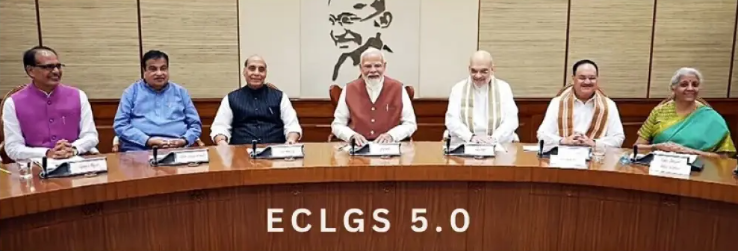
Context: The Union Cabinet has approved the Emergency Credit Line Guarantee Scheme (ECLGS) 5.0 to mitigate the economic impact of ongoing geopolitical tensions and disruptions in West Asia.
More on the News
• The scheme aims to provide emergency liquidity support to businesses facing rising input costs, supply-chain disruptions, and weakening demand conditions due to the West Asia conflict.
• ECLGS 5.0 reflects the government’s continued use of targeted credit guarantees as a counter-cyclical policy tool to safeguard economic activity during external shocks.
Key Highlights of ECLGS 5.0
• The scheme has been approved with a government guarantee support of about ₹18,100 crore, which is expected to facilitate additional credit flow of nearly ₹2.55 lakh crore.
• Around ₹5,000 crore has been specifically earmarked for the aviation sector, which has been significantly affected by higher fuel costs and disruptions linked to the West Asia crisis.
• Under the scheme, National Credit Guarantee Trustee Company Limited (NCGTC) will offer credit guarantee coverage to Member Lending Institutions (MLIs).
• MSMEs will receive 100% guarantee coverage, while non-MSMEs and the airline sector will get 90% coverage on additional loans extended to eligible borrowers.
• Eligible businesses can avail additional credit of up to 20% of peak working capital used in the fourth quarter of FY26 (Q4 FY26), subject to a ceiling of ₹100 crore.
• For Airlines, support can go up to 100% of peak working capital utilisation, with a cap of ₹1,500 crore per borrower.
• Loan tenure is set at five years for MSMEs and non-MSMEs, including a one-year moratorium. For airlines, the tenure is seven years with a two-year moratorium.
• Loans sanctioned under the scheme will remain available till 31 March 2027.
About ECLGS
• The Emergency Credit Line Guarantee Scheme was originally launched in 2020 under the Aatmanirbhar Bharat package to support businesses affected by the COVID-19 pandemic.
• The scheme provides collateral-free, government-guaranteed loans to eligible borrowers through banks and financial institutions.
• It is implemented through the National Credit Guarantee Trustee Company Limited (NCGTC), which provides guarantee coverage to lending institutions.
• Earlier phases of ECLGS played a major role in sustaining MSMEs and vulnerable sectors during the pandemic period:
- More than 1 crore guarantees were issued under previous phases.
- Total guarantees sanctioned exceeded ₹3.5 lakh crore.
• ECLGS 5.0 expands the scope of the framework from pandemic-related support to addressing external geopolitical and economic disruptions.
Significance for the Economy
• Support to MSMEs and Employment: MSMEs constitute a major source of employment, exports, and manufacturing activity, and the scheme is expected to help firms maintain operations, preserve jobs, and sustain supply chains during economic uncertainty.
• Stabilising Credit Flow in the Economy: By reducing the credit risk faced by banks through sovereign guarantees, ECLGS 5.0 encourages continued lending and prevents excessive tightening of financial conditions during periods of global instability.
• Protection Against External Economic Shocks: The scheme acts as a financial buffer against spillover effects of geopolitical disruptions, particularly rising energy prices, shipping disruptions, and trade uncertainties linked to the West Asia conflict.
• Support to the Aviation and Services Sector: Dedicated assistance to airlines is expected to help maintain operational continuity, preserve connectivity, and reduce stress in sectors linked to tourism, logistics, and trade.
• Enhancing Economic Resilience: Timely liquidity support can prevent temporary stress from turning into widespread insolvency, thereby supporting broader macroeconomic stability and economic recovery.
Challenges and Concerns
• Increase in Fiscal and Contingent Liabilities: Extensive sovereign guarantees may increase the government’s fiscal exposure if a significant proportion of the guaranteed loans eventually become stressed or non-performing.
• Risk of Moral Hazard: High levels of guarantee coverage can sometimes weaken credit discipline by encouraging excessive risk-taking among borrowers as well as lenders.
• Possibility of Future NPAs: If global economic conditions worsen or recovery remains uneven, banks may face a rise in non-performing assets despite the temporary liquidity support provided under the scheme.
• Implementation and Targeting Issues: The effectiveness of ECLGS 5.0 will depend on timely disbursal of loans, active participation by banks, and proper identification of genuinely stressed but viable enterprises.