
SYLLABUS
GS-3: Science and Technology- Developments and their Applications and Effects in Everyday Life. Achievements of Indians in Science & Technology.
What Has the Aditya-L1 Study Found?
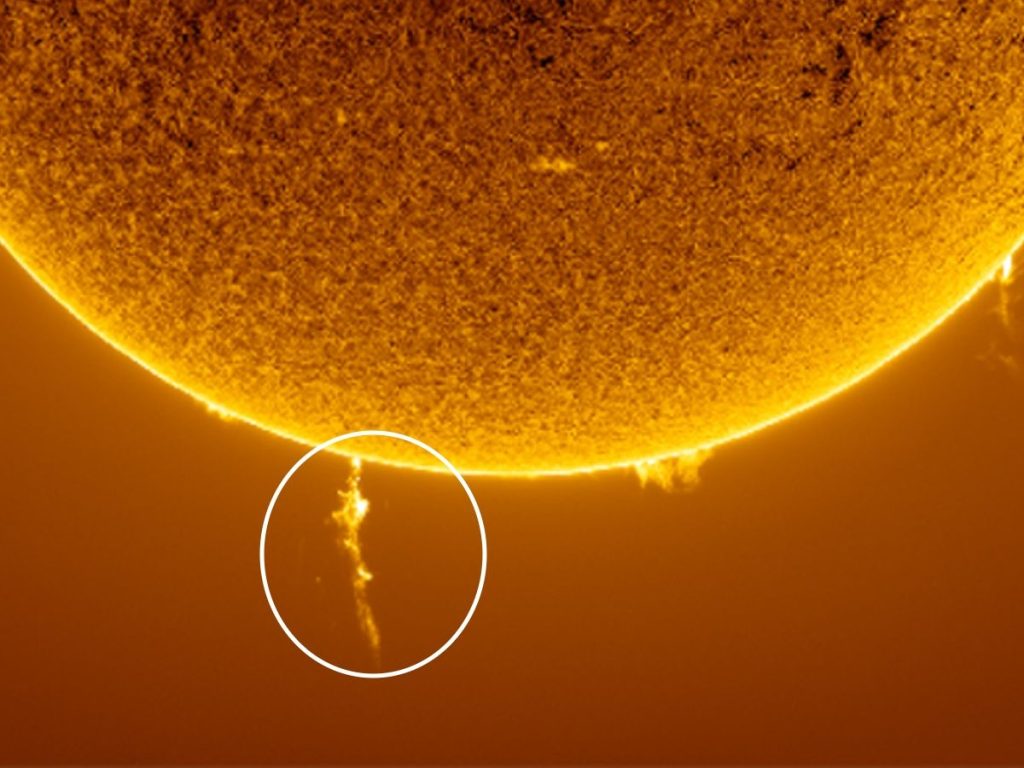
- Pre-flare transient events: Researchers detected numerous small, short-lived transient brightenings in active regions during the hours preceding major solar flares.
- Localised precursor activity: These events clustered around the same locations where the major flares subsequently occurred, indicating a spatial association with flare development.
- Magnetic-energy release: Some transient events showed corresponding X-ray signatures, suggesting that they involved small-scale releases of magnetic energy.
- Possible flare build-up: The findings suggest that repeated small-scale energy releases may progressively destabilise magnetic fields in an active region, eventually contributing to a major flare.
- Research collaboration: The study was led by researchers from the Manipal Centre for Natural Sciences (MCNS) and Manipal Academy of Higher Education (MAHE), along with scientists from ISRO/Department of Space and other academic institutions. It was published in the Monthly Notices of the Royal Astronomical Society (MNRAS).
About Aditya-L1
- India’s first dedicated solar observatory: Aditya-L1 is India’s first space-based observatory-class mission dedicated to the comprehensive study of the Sun. It was launched aboard PSLV-C57 on 2 September 2023.
- L1 vantage point: The spacecraft operates in a halo orbit around the Sun–Earth L1 point, approximately 1.5 million km from Earth.
- Key advantage: Its location enables a continuous, uninterrupted view of the Sun, without occultation or eclipse, while allowing observation of solar radiation and magnetic disturbances before they are influenced by Earth’s atmosphere and magnetic field.
- Seven payloads: Aditya-L1 carries seven indigenously developed payloads—five developed by ISRO and two by Indian academic institutions in collaboration with ISRO.
- Mission focus: It studies different layers and phenomena of the Sun, including the photosphere, chromosphere and corona, as well as solar flares, CMEs, solar wind and other processes relevant to space-weather research.
How Did Aditya-L1 Detect These Early Signs?
- SUIT: The Solar Ultraviolet Imaging Telescope observes the Sun through 11 near-ultraviolet (NUV) filters, covering layers from the upper photosphere to the chromosphere.
- SoLEXS & HEL1OS: The Solar Low Energy X-ray Spectrometer (SoLEXS) and High Energy L1 Orbiting X-ray Spectrometer (HEL1OS) measure X-ray emissions associated with energetic processes in the solar corona.
- Multi-wavelength observations: Combining NUV and X-ray observations enabled scientists to examine how activity in the lower solar atmosphere is linked to energy release in the corona during the build-up to a flare.
- Why space-based NUV observations matter: Much of the NUV spectrum is difficult to observe from the ground because Earth’s atmosphere absorbs ultraviolet radiation, making space-based observations particularly valuable.
Understanding Solar Flares & Space Weather
- Solar flares: Sudden and intense bursts of electromagnetic radiation from the Sun, associated with the release of stored magnetic energy.
- Active regions: Flares occur primarily in magnetically active regions where complex magnetic fields can accumulate and release large amounts of energy.
- Flare classification: Based on X-ray intensity, solar flares are classified as A, B, C, M and X, with X-class flares being the most intense.
- Space weather: Solar activity can disturb the near-Earth environment, affecting radio communication, navigation systems and satellites, besides increasing radiation risks for astronauts and spacecraft.
- Coronal Mass Ejections: Solar flares may occur alongside CMEs, which can cause significant disturbances in the near-Earth space environment when directed towards Earth.
Significance of the Findings
- Potential for earlier warnings: Identifying recurring pre-flare signatures could help shift solar-flare forecasting towards recognising warning signs before a major eruption.
- Better space-weather preparedness: More reliable flare forecasts could provide additional time to protect satellites, communication and navigation systems, astronauts and other critical technologies.
- Insight into flare initiation: The observations strengthen the possibility that repeated small-scale energy releases contribute to the progressive destabilisation of magnetic fields before major flares.
- Strengthens India’s solar-science capability: The study demonstrates the scientific value of Aditya-L1’s multi-wavelength observations and contributes to India’s capabilities in solar physics and space-weather research.