SYLLABUS
GS-3: Conservation, environmental pollution and degradation, environmental impact assessment.
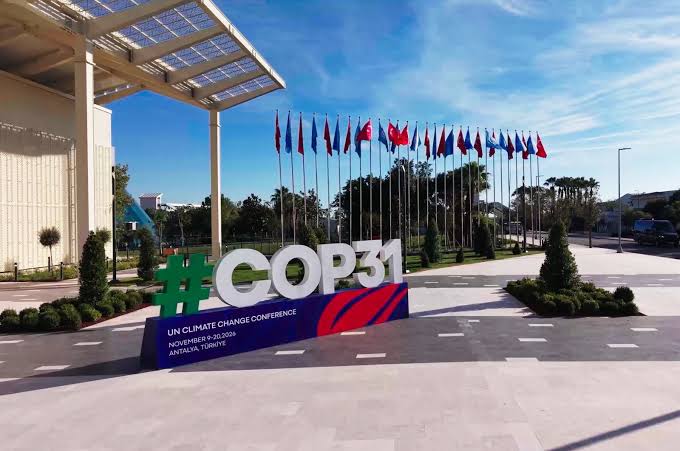
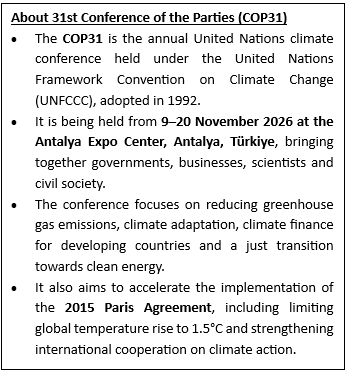
Context: At COP31 in Antalya, Türkiye, India called for a two-tier, Party-guided Just Transition Mechanism to ensure finance, technology transfer and capacity-building for developing countries while respecting their national transition pathways.
More on the News
- India called for shifting the global just transition agenda from dialogue and experience-sharing towards practical, country-driven implementation.
- India emphasised a whole-of-economy and whole-of-society approach, covering employment, social protection, climate adaptation, poverty eradication, energy access and sustainable development.
- It stressed that developed countries must provide adequate finance, technology transfer and capacity-building to support developing countries.
What is a Two-Tier, Party-Guided Just Transition Mechanism?
- Meaning: It is a proposed international mechanism under the Paris Agreement to strengthen international cooperation and support countries in achieving equitable and inclusive transitions towards low-carbon economies.
- Two-Tier Approach: It envisages two complementary functions:
- Dialogue and Experience-Sharing: The UAE Just Transition Work Programme will continue to provide a platform for dialogue and sharing experiences among countries.
- Practical Implementation Support: The proposed Just Transition Mechanism will facilitate technical assistance, capacity-building and international cooperation to translate discussions into action.
- Party-Guided Approach: Countries (Parties to the Paris Agreement) will guide the mechanism according to their national priorities, development needs and specific circumstances.
- Key Principles:
- Respect national sovereignty and diverse national circumstances.
- Build on existing initiatives and avoid duplication.
- Ensure adequate access to finance, technology and capacity-building.
- Avoid imposing uniform sectoral pathways or creating new obligations.
- Protect workers, local communities and vulnerable groups from adverse impacts of the transition.
Why Does India Want a Two-Tier Mechanism?
- Different Development Priorities: Countries have different economic structures, energy needs and development levels; therefore, each must determine its own transition pathway.
- Protecting Employment and Livelihoods: India’s coal mines and thermal power plants support approximately 1.5 million formal and informal workers, making livelihood protection essential during the energy transition.
- Addressing Regional Economic Inequalities: More than 150 districts depend significantly on fossil-fuel supply chains, which directly or indirectly support livelihoods for nearly one-third of India’s population.
- Ensuring Financial and Technological Support: Developing countries need predictable climate finance, technology transfer and capacity-building, with developed countries sharing the financial responsibilities.
- Integrating Climate Action with Social Protection: The transition must address employment, social security, poverty eradication, adaptation and affordable energy access alongside renewable energy expansion.
- Avoiding Additional Obligations: The mechanism should support country-driven transitions without imposing uniform sectoral pathways, additional obligations or external conditions.