
SYLLABUS
GS-3: Indian Economy and issues relating to planning, mobilization of resources, growth, development and employment.
Context: The Union Cabinet has approved the Mobile Phone Manufacturing Scheme (MPMS) with a budgetary outlay of ₹62,500 crore to strengthen India’s mobile phone manufacturing ecosystem and enhance its global competitiveness.
About the Mobile Phone Manufacturing Scheme (MPMS)
• It is a Central Sector Scheme with a budgetary outlay of ₹62,500 crore.
• The scheme will be implemented for five years, from FY 2026–27 to FY 2030–31.
• It aims to:
- Scale up mobile phone production.
- Deepen domestic value addition.
- Strengthen supply chain resilience.
- Enhance global competitiveness in electronics manufacturing.
- Build globally competitive Indian mobile phone brands.
- Promote technological sovereignty through indigenous design, research & development (R&D), and patent creation.
• The scheme provides:
- 2.25%–5% incentive on eligible sales of mobile phones manufactured in India.
- Up to 1.5% additional incentive for domestic sourcing of key components and sub-assemblies.
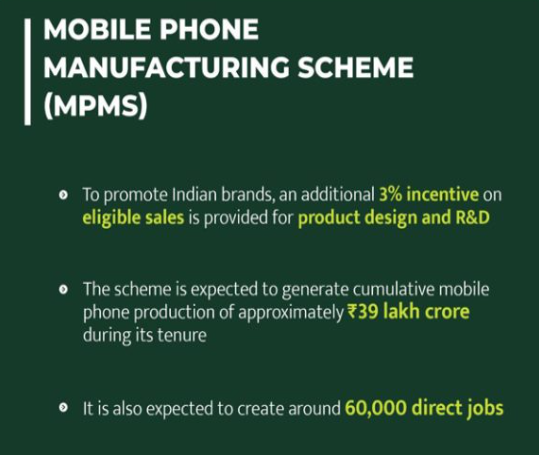
- 3% additional incentive on eligible sales for Indian brands undertaking product design and R&D.
• During its tenure, the scheme is expected to:
- Cumulative mobile phone production of about ₹39 lakh crore.
- Significant increase in mobile phone exports.
- Creation of around 60,000 direct jobs.
• The scheme succeeds the Production Linked Incentive Scheme for Large Scale Electronics Manufacturing (PLI-LSEM), whose tenure ended on 31 March 2026.
- It aims to build on its achievements by promoting higher domestic value addition and a stronger component ecosystem.
India’s Status in Mobile Manufacturing
• India is the world’s second-largest mobile phone manufacturer by volume.
• 99.2% of mobile phones used in India are manufactured domestically.
• Mobile phone manufacturing has become the anchor of India’s electronics manufacturing ecosystem.
• Under the Make in India initiative:
- Electronics manufacturing has grown seven-fold since FY 2014–15.
- Electronics exports have increased eleven-fold during the same period.
• Smartphones became India’s largest export product category in 2025, surpassing traditional exports such as diesel fuel and cut diamonds.
• According to MeitY:
- Mobile phone production increased from ₹18,900 crore (FY 2014–15) to ₹6.27 lakh crore (FY 2025–26).
- Mobile phone exports increased from ₹1,566 crore to ₹2.60 lakh crore during the same period.
• Mobile phones have risen from being India’s 153rd largest export item in FY 2014–15 to the largest export product in FY 2025–26.
Significance
• Strengthens Manufacturing Ecosystem: The scheme promotes a shift from mobile phone assembly to higher domestic value addition by strengthening the local manufacturing ecosystem.
• Enhances Supply Chain Resilience: It encourages domestic sourcing of key components and sub-assemblies, reducing import dependence and building resilient supply chains.
• Promotes Investment & Innovation: The scheme provides long-term policy certainty to attract fresh investments while encouraging indigenous design, R&D and patent creation.
• Supports Indian Brands: It enables Indian mobile phone brands and Original Design Manufacturers (ODMs) to move beyond contract manufacturing and develop globally competitive products.
• Strengthens Global Competitiveness: The scheme enhances India’s integration into Global Value Chains (GVCs) by building advanced manufacturing capabilities, engineering expertise and supplier networks.
• Boosts Economy & Employment: It is expected to increase exports, generate employment, and contribute to overall economic growth.