

SYLLABUS
GS-3: Indian Economy and issues relating to planning, mobilization of resources, growth, development and employment. Effects of liberalization on the economy, changes in industrial policy and their effects on industrial growth
Context: Parliament has passed the Micro, Small and Medium Enterprises Development (Amendment) Bill, 2026 to amend the MSME Development Act, 2006, to strengthen the legal framework governing the MSME sector by improving ease of doing business, dispute resolution and payment mechanisms.
Key Highlights of the Bill
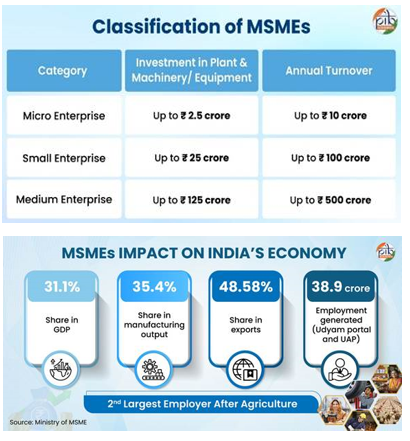
- Alignment with the Changing MSME Landscape: Incorporates MSME classification based on the twin criteria of investment in plant and machinery/equipment and turnover into the Act, while providing statutory recognition to the free, digital and voluntary Udyam Registration Portal.
- Online Dispute Resolution: Provides an Online Dispute Resolution (ODR) mechanism to ensure timely and cost-effective resolution of disputes faced by Micro and Small Enterprises.
- Time-bound Dispute Resolution: Mandates completion of mediation within 90 days, reference to arbitration within 30 days after mediation and arbitral award within 90 days from completion of pleadings.
- Recovery of Dues: Provides that mediated settlement agreements and arbitral awards can be recovered as arrears of land revenue through the District Collector, Deputy Commissioner or other notified authority.
- Enforcement of Arbitral Awards: Empowers courts to release at least 50% of the awarded amount to the supplier if the challenge against the award remains pending for more than six months.
- Mandatory Invoice Settlement through TReDS: Requires every Central Public Sector Enterprise (CPSE) to route invoice settlements for procurement from MSMEs through the Trade Receivables Discounting System (TReDS) and enables States to extend the mechanism to their Public Sector Enterprises.
- Strengthening MSE Facilitation Councils: Rationalises the composition of Micro and Small Enterprises Facilitation Councils (MSEFCs) and empowers State Governments to establish multiple Councils and frame rules for their functioning.
- Ease of Doing Business: Replaces conviction-based penalties with a graded civil penalty framework, promoting decriminalisation and a trust-based regulatory environment.
Significance of the Bill
- Addresses Delayed Payments: Introduces time-bound dispute resolution, Online Dispute Resolution and mandatory TReDS routing to improve timely payments to MSMEs.
- Strengthens Legal Framework: Strengthens recoveries of dues, enforcement of arbitral awards and institutional mechanisms governing the MSME sector.
- Promotes Ease of Doing Business: Decriminalises specified offences by replacing conviction-based fines with graded civil penalties and compliance-oriented regulation.
- Supports Formalisation and Digitalisation: Provides statutory backing to the Udyam Registration Portal and expands digital dispute resolution mechanisms.
- Supports Viksit Bharat @2047: Promotes formalisation, enterprise scaling, compliance and employment-intensive economic growth.
Criticism of the Bill
- Procedural Focus: The amendments largely strengthen procedures while concerns remain regarding the large volume of outstanding dues faced by MSMEs.
- Need for Greater Financial Support: Members sought stronger cash-flow support and better access to finance for MSMEs.
- Need for Additional Policy Support: Suggestions were made for Production Linked Incentive (PLI) support, better infrastructure assistance and relief during natural calamities.
- Need for Structural Reforms: Some members stressed the need for broader reforms rather than only procedural improvements.
Way Forward
- Effective Implementation: Ensure timely implementation of Online Dispute Resolution, TReDS and the amended dispute resolution timelines.
- Strengthen Institutional Capacity: Establish additional MSE Facilitation Councils with adequate infrastructure and trained manpower for faster disposal of disputes.
- Expand Digital Ecosystem: Promote wider adoption of digital registration, invoice settlement and technology-enabled governance mechanisms.
- Support MSME Growth: Continue strengthening access to finance, technology, markets and entrepreneurship to build globally competitive MSMEs under Viksit Bharat @2047.