SYLLABUS
GS-3: Achievements of Indians in science & technology; indigenization of technology and developing new technology; Awareness in the fields of IT, Space.
Context:A new study published in Geophysical Research Letters has found that Mercury’s contraction may be up to 30% greater than previously estimated.
More on the News:
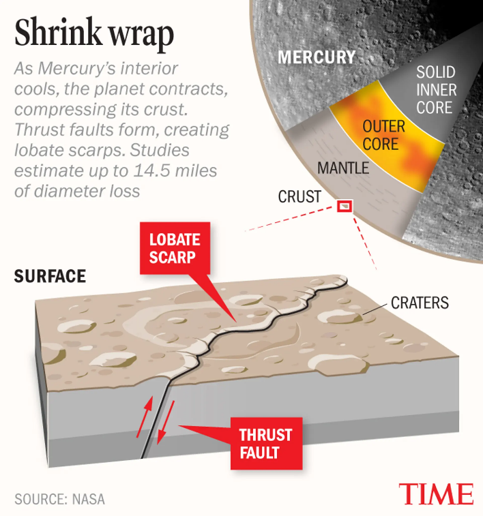
- Researchers estimate that Mercury may have lost up to 14.5 miles (23 km) in diameter since its formation around 4.5 billion years ago—significantly more than earlier estimates
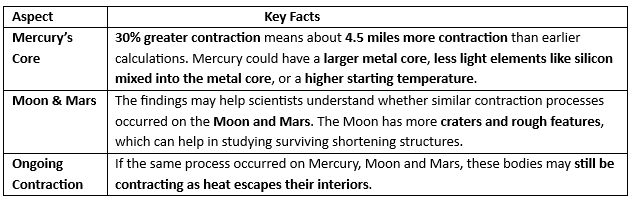
- The finding provides clues about the formation, cooling and internal composition of Mercury and may also help scientists understand other rocky worlds such as the Moon and Mars.
Mercury: A Shrinking Planet
- Smallest Planet: Mercury is the smallest planet in the Solar System, with a diameter of about 3,023 miles.It is one of the four terrestrial (rocky) planets, along with Venus, Earth and Mars.
- Formation: Mercury formed about 4.5 billion years ago from the accumulation of dust, gas, rocks and asteroids left over from the formation of the Sun. This process generated enormous amounts of heat inside the young planet.
- No Moons or Rings: Mercury has no natural satellites (moons) and no planetary ring system.
- Extreme Temperatures: Despite being closest to the Sun, Mercury has no thick atmosphere to trap heat. As a result, temperatures can reach around 430°C (800°F) during the day and fall to −180°C (−290°F) at night.
- Massive Iron Core: Unlike Earth, Mercury is dominated by its interior. Its massive iron core accounts for roughly 85% of the planet’s total radius.
- No Shifting Tectonic Plates: Mercury does not have shifting tectonic plates like Earth. It has a single, continuous rocky crust wrapped around its giant core.
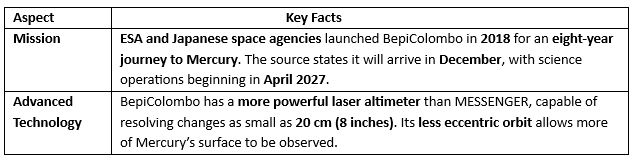
- Space Missions: NASA’s MESSENGER became the first spacecraft to orbit Mercury. BepiColombo, a joint ESA–JAXA mission, is studying Mercury and is expected to enter orbit in 2026.
How Did Scientists Measure Mercury’s Shrinking?
- MESSENGER Data: Scientists used data from NASA’s Mercury MESSENGER spacecraft, which launched in August 2004, reached Mercury in March 2011, completed 4,105 orbits, and ended its mission by crashing into Mercury on 30 April 2015.
- It carried seven scientific instruments, including a Mercury Laser Altimeter and a dual imaging system.
- Mapping Surface Features: MESSENGER’s instruments were used to identify shortening structures—surface distortions such as wrinkles, ridges and lobate scarps.
- These features form when a planet contracts, so their number and extent provide evidence of planetary shrinkage.
- Challenge of Surface Roughness: Mercury’s ancient shortening structures have been partly obscured by asteroid impacts, craters and scattered debris.
- MESSENGER’s laser altimeter could provide detailed 3D data only when the spacecraft was relatively close to Mercury, limiting planet-wide three-dimensional mapping.
- Stereophotogrammetry: A team led by Gaku Nishiyama of the German Aerospace Center Institute of Space Research combined two-dimensional MESSENGER images taken from different viewing angles using stereophotogrammetric techniques.
- This created detailed three-dimensional terrain maps of Mercury’s surface.
What Can Mercury’s Shrinking Teach Us?
BepiColombo: The Next Closer Look