
SYLLABUS
GS-2: Government policies and interventions for development in various sectors and issues arising out of their design and implementation.
GS-3: Indian Economy and issues relating to planning, mobilization of resources, growth, development and employment.
Context: A report prepared by LibTech India highlighted a sharp decline in employment generation and earnings under the Mahatma Gandhi National Rural Employment Guarantee Scheme (MGNREGS) during 2025–26, the final operational year before its replacement by the VB-GRAM G Act.
Key Findings of the Report
• Registered households under MGNREGS increased by 3.2%, from 14.98 crore in 2024–25 to 15.46 crore in 2025–26, indicating continued demand for rural employment.
• Despite higher registration, employment declined sharply:
- 44 lakh fewer households received work.
- 67 lakh fewer workers were employed, marking a 9.1% decline.
• Total person-days generated fell by 21.5%, from 268.44 crore to 210.73 crore.
• Average person-days per household dropped from 50.18 to 42.92.
• Households completing the guaranteed 100 days of work declined by 40.5%, from 0.37 crore to 0.22 crore.
• Wage expenditure fell from ₹67,835 crore in 2024–25 to ₹56,265 crore in 2025–26, despite an increase in average daily wages from ₹252.7 to ₹267.
• LibTech estimated an average income loss of ₹1,221 per MGNREGS household due to reduced employment opportunities.
• If employment levels had remained unchanged from 2024–25, workers could have earned an additional ₹15,409 crore.
• Tamil Nadu recorded the sharpest decline in person-days (42.8%), followed by Haryana, Himachal Pradesh, and Telangana.
• Jharkhand registered the highest increase in person-days at 12.9%, followed by Jammu and Kashmir and Odisha.
• The report attributed the decline partly to stagnant budget allocations and technological interventions such as:
- Aadhaar-Based Payment System (ABPS)
- National Mobile Monitoring System (NMMS) attendance app
- Mandatory eKYC verification
• Around 45.4% of all workers and 9.5% of active workers had not completed eKYC by May 2026, affecting access to employment and wage payments.
• Activists also criticised the transition to the Viksit Bharat–Guarantee for Rozgar and Ajeevika Mission (Gramin) Act 2025 for being introduced without adequate public consultation.
About the MGNREGS
• The Mahatma Gandhi National Rural Employment Guarantee Scheme was launched in 2005 under the UPA government through the Mahatma Gandhi National Rural Employment Guarantee Act (MGNREGA).
• It is a rights-based rural employment programme that guarantees up to 100 days of wage employment annually to every rural household willing to undertake unskilled manual work.
• The scheme aims to enhance livelihood security, reduce rural distress, and create durable rural assets.
• It is implemented by the Ministry of Rural Development through Gram Panchayats.
About the VB-G RAM G Act, 2025
• In 2025, the government replaced MGNREGA with the Viksit Bharat-Guarantee for Rozgar and Ajeevika Mission (Gramin) Act, commonly known as the VB-G RAM G Act, 2025.
• The Act seeks to align rural employment generation with the vision of Viksit Bharat 2047 through an infrastructure-focused and technology-driven framework.
Key Features of the VB-G RAM G Act, 2025
• Guarantees 125 days of wage employment annually per rural household.
• Integrates employment generation with rural infrastructure development.
• Focuses on four priority sectors:
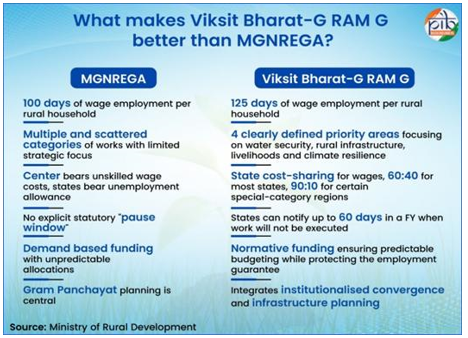
- Water security works
- Core rural infrastructure
- Livelihood-related infrastructure
- Climate resilience and extreme weather mitigation works
• Introduces decentralised Viksit Gram Panchayat Plans integrated with PM Gati Shakti.
• Emphasises digital governance through biometric attendance, GPS-based monitoring, AI-driven oversight, and social audits.
• Shifts the programme from a fully central scheme to a centrally sponsored model with Centre–State cost sharing.