
SYLLABUS
GS-2: Achievements of Indians in Science & Technology; Indigenization of Technology and Developing New Technology; Awareness in the fields of IT, Space.
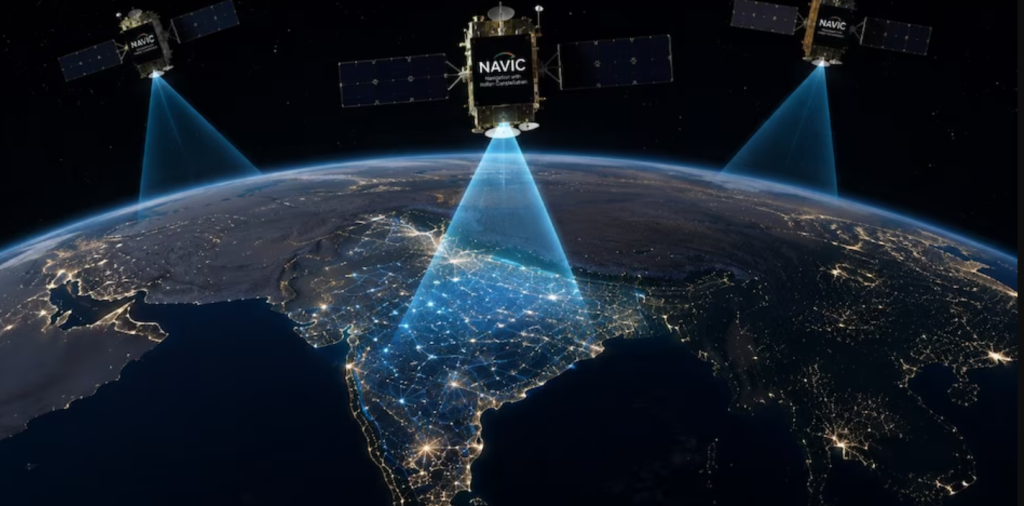
Context: The Government has informed Parliament that ISRO’s Navigation with Indian Constellation (NavIC) currently lacks the minimum number of satellites required to provide standalone Position, Navigation and Timing (PNT) services, with only three satellites presently broadcasting navigation signals.
Why Can NavIC No Longer Provide Standalone Navigation?
• Present Status
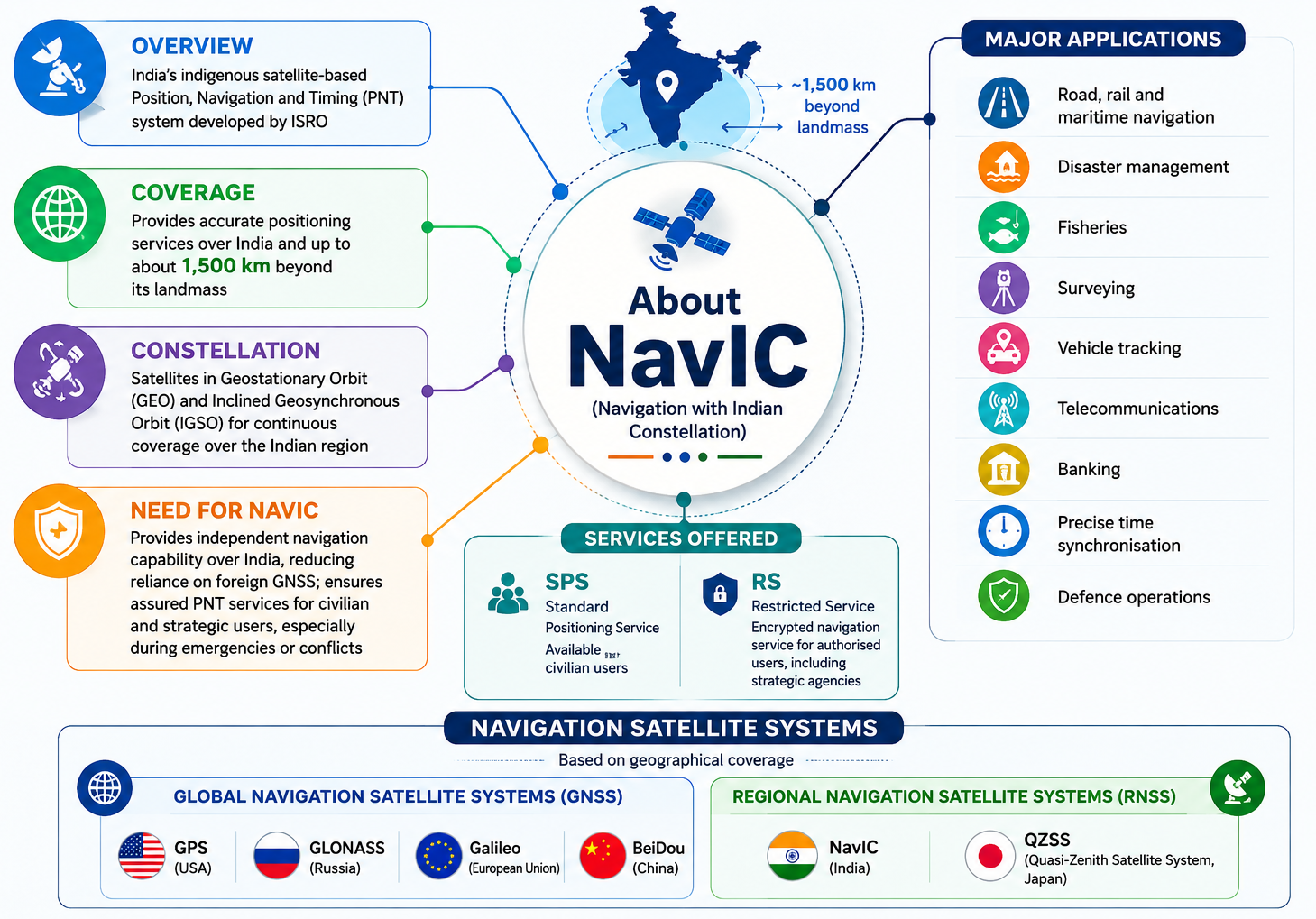
- Of the 11 NavIC satellites launched, eight remain functional. However, only three currently broadcast navigation signals, while the remaining five support one-way messaging, leaving the constellation below the minimum four satellites required for standalone PNT services.
- Timing services continue to remain operational, ensuring uninterrupted support for applications requiring precise time synchronisation.
• Reasons
- Ageing First-Generation Satellites: Several first-generation IRNSS satellites have exceeded their design life or suffered degradation of critical onboard systems, particularly atomic clocks.
- Failure of IRNSS-1F: The latest setback occurred after IRNSS-1F lost its remaining functional atomic clock, rendering it incapable of providing navigation services.
- Delay in Satellite Replacement: Although ISRO has initiated deployment of second-generation Navigation Satellite (NVS) satellites, NVS-02 could not be placed in its intended orbit due to a propulsion anomaly, delaying restoration of the full constellation.
• Standalone vs Multi-Constellation Navigation
- While NavIC currently cannot provide independent navigation services, the impact on most civilian users remains limited because modern receivers generally operate on multi-constellation GNSS, combining signals from systems such as GPS, Galileo, GLONASS and NavIC.
Why Does NavIC’s Standalone Capability Matter?
• Strategic Sovereignty: Ensures assured navigation and timing services independent of foreign GNSS, particularly during conflicts, emergencies or denial of external services.
• Critical National Infrastructure: Supports applications such as real-time train tracking, fishing vessel communication, vehicle tracking, disaster response, dissemination of Indian Standard Time (IST) and future integration with sectors such as aviation and intelligent transportation systems.
• Reliable Indigenous PNT Services: Ensures uninterrupted navigation and timing support for critical civilian, commercial and strategic sectors.
• Technological Self-Reliance: Strengthens India’s indigenous space-based navigation ecosystem and advances the vision of Atmanirbhar Bharat in strategic technologies.
Way Ahead
• Accelerate Constellation Replenishment: Expedite the deployment of NVS-03, followed by NVS-04 and NVS-05, to restore NavIC’s standalone navigation capability.
• Strengthen Indigenous Technologies: Enhance the reliability of indigenous atomic clocks, satellite payloads and onboard redundancy to improve long-term operational resilience.
• Build a Resilient PNT Ecosystem: Continue leveraging multi-constellation GNSS interoperability while restoring an independent and resilient NavIC constellation.
• Expand Civilian Adoption: Promote L1-band-enabled NavIC receivers and wider integration of NavIC-compatible chipsets across smartphones, vehicles, drones and other critical infrastructure.