
SYLLABUS
GS-3: Conservation, environmental pollution and degradation, environmental impact assessment
Context: A new modelling study published in the journal Environmental Research: Climate projects that India’s forests could significantly increase their carbon storage capacity by 2100 under current greenhouse gas emission trends.
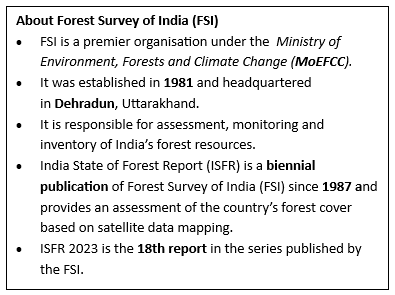
- The study, conducted by researchers from multiple Indian institutes, provides scenario based projections that differ from the official estimates of the Forest Survey of India.
Key Findings of Study
- Sharp Rise in Carbon Storage:The study estimates that vegetation carbon biomass in India’s forests may increase by 35% under a low emission scenario, 62% under a medium emission pathway, and up to 97% under a high emission fossil fuel intensive scenario.
- All scenarios show similar trends until around 2030, after which they diverge sharply. The steepest increase in forest carbon is expected after 2050.
- Key Drivers of Forest Carbon Increase
- Role of Precipitation: Higher rainfall across most regions improves soil moisture and supports enhanced tree growth and biomass accumulation.
- Role of Carbon Dioxide Fertilisation: Increasing atmospheric carbon dioxide enhances photosynthesis and improves water use efficiency in vegetation.
- Time Lag in Ecosystem Response: Rainfall effects on vegetation appear with a delay of about 2 years in low and medium emission scenarios and about 4 years in high emission scenarios due to slow ecological response and biomass buildup.
- Regional Variation in Carbon Storage Potential
- High Growth Regions: The highest increase in vegetation carbon, exceeding 60% under high emission scenarios, is projected in desert and semi arid regions such as Rajasthan, Gujarat, western Madhya Pradesh and adjoining dry interiors.
- Moderate Growth Regions: Moderate increases are expected in the Trans Himalayan region, the Gangetic plains and the Deccan Peninsula.
- Low Growth Regions: Relatively lower increases are projected in the Western Ghats and the Himalayas due to ecological saturation and climatic constraints despite their ecological significance.
- Comparison with Forest Survey of India Data
- Historical Carbon Stock Trends: According to the Forest Survey of India, India’s forest carbon stock has increased from 6.94 billion tonnes in 2013 to 7.29 billion tonnes in 2023.
- Future Projection: It is projected to reach 8.65 billion tonnes by 2030 based on field measurements and remote sensing data that reflect observed forest conditions.
Limitations of the Study
- The study does not fully account for deforestation, land use change, forest fires and pest outbreaks that can reduce carbon storage in reality.
- It does not include soil nutrient limitations, which are critical for long term forest growth and carbon sequestration.
- The projections are based on climate and vegetation models and require further validation using field based ecological data.
Climate Commitments and Policy Relevance
- India’s updated Nationally Determined Contribution (NDC) for 2031 to 2035 sets a target of creating an additional forest carbon sink of 3.5 to 4 billion tonnes of carbon dioxide equivalent by 2035.
- Forests and Bioeconomy: Forests play a crucial role in carbon sequestration, climate mitigation, livelihood support for forest-dependent communities, sustainable bioeconomy, and forest-based resources.
- Need for Region-Specific Planning: One-size-fits-all ineffective; ecological and climatic diversity; climate-sensitive, region-specific policies; future risk adaptation.