
SYLLABUS
GS-3:Indigenization of Technology and Developing New Technology; Security Challenges.
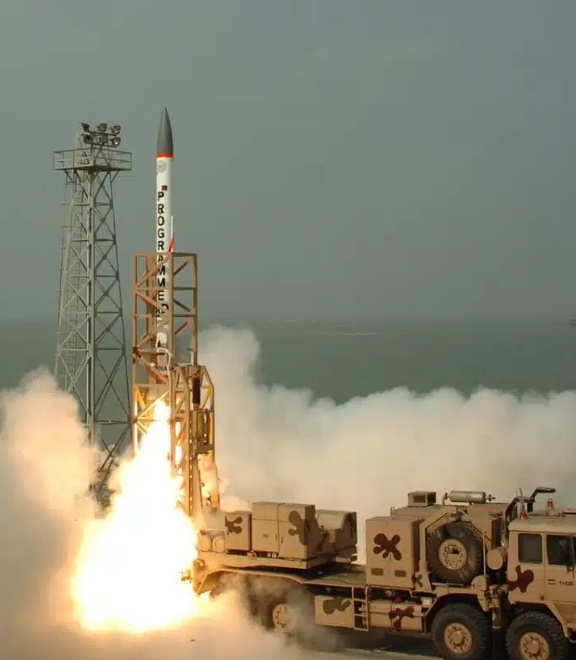
Context: India recently demonstrated its advanced Ballistic Missile Defence (BMD) capability through a series of successful interceptor tests, marking the completion of Phase-II of the indigenous BMD programme.
More on the News
- DRDO successfully conducted three consecutive flight tests recently, demonstrating India’s multi-layered BMD capability against different classes of ballistic missile threats.
- The tests validated both exo-atmospheric and endo-atmospheric interception capabilities and showcased the effectiveness of the AD-1 and AD-2 interceptor systems developed under Phase-II.
- The demonstrations included interception scenarios involving long-range ballistic missiles, medium-range ballistic missiles, and anti-ship ballistic missile-type threats.
- With the successful completion of Phase-II, India joins a select group of countries possessing advanced multi-layered ballistic missile defence capabilities.
Understanding India’s Ballistic Missile Defence Programme
- Evolution of India’s BMD Programme
- The BMD programme was initiated by DRDO in 1999, following the Kargil conflict and in response to the growing ballistic missile capabilities in India’s neighbourhood.
- Over the years, the programme has evolved from defending against short- and medium-range ballistic missiles to addressing longer-range and more sophisticated missile threats.
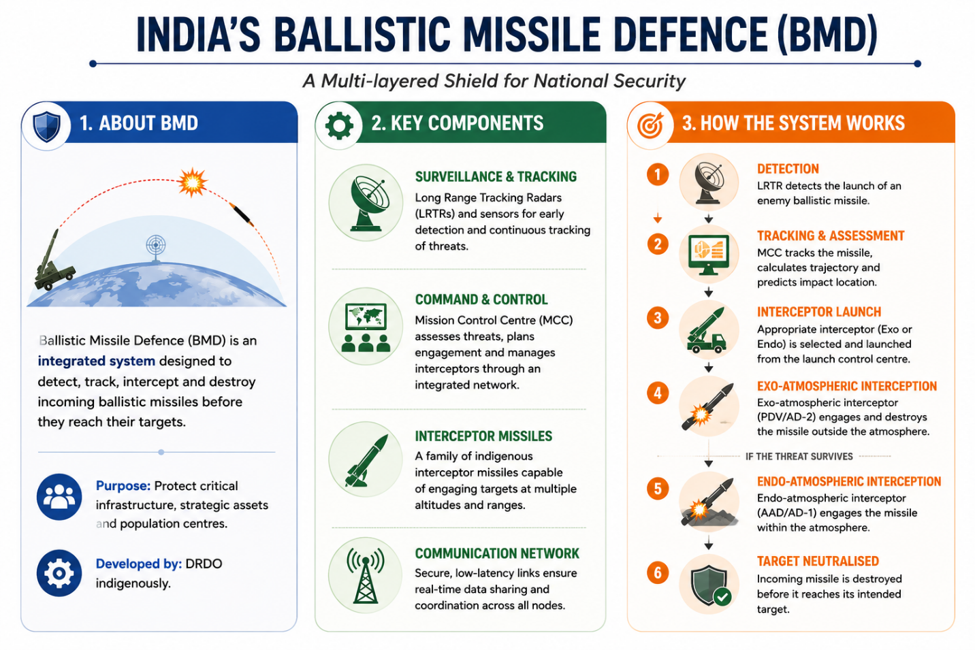
- Two-Tier Defence Architecture: India’s BMD system is operationally based on a two-tier interception architecture.
- Exo-atmospheric Interception: Interception of incoming ballistic missiles outside the Earth’s atmosphere during the mid-course phase of flight.
- Endo-atmospheric Interception: Interception within the Earth’s atmosphere during the terminal phase, providing an additional layer of defence if the outer layer fails.
Three-Phase Development Roadmap
- Phase-I
- Designed to counter ballistic missiles with ranges of up to approximately 2,000 km.
- Key interceptor systems include:
- PAD/PDV (Prithvi Air Defence/Prithvi Defence Vehicle) for exo-atmospheric interception.
- AAD (Advanced Air Defence) for endo-atmospheric interception.
- Phase-II
- Designed to counter longer-range and more advanced ballistic missile threats, including threats in the Intermediate-Range Ballistic Missile (IRBM) and ICBM-class categories.
- Built around the AD-1 and AD-2 interceptor systems. AD-1 is intended for interception of long-range ballistic missile threats, while AD-2 is designed for higher-end ballistic missile threats, including missiles in the ICBM class.
- The recent successful demonstrations mark the completion of this phase.
- Emerging Phase-III
- DRDO is developing next-generation interceptor systems such as AD-AH (Anti-Hypersonic) and AD-AM (Anti-Missile) to counter hypersonic and other advanced missile threats.
- These systems remain under development.
Significance of the BMD Programme
- Strengthening National Security: The BMD system provides a protective shield against ballistic missile attacks, enhancing the security of critical infrastructure, strategic assets and major population centres.
- Enhancing Nuclear Deterrence: By reducing the effectiveness of an adversary’s missile strike, the system strengthens India’s overall deterrence posture and strategic resilience.
- Countering Evolving Missile Threats: The programme improves India’s capability to respond to increasingly sophisticated ballistic missile threats in its strategic neighbourhood.
- Advancing Technological Self-Reliance: Indigenous development of advanced interceptors, radars and command-and-control systems reflects significant progress towards defence self-reliance under Aatmanirbhar Bharat.
- Strengthening Strategic Autonomy: Indigenous BMD capabilities reduce dependence on foreign missile-defence technologies and enhance India’s ability to independently secure its strategic interests.