
SYLLABUS
GS-3: Infrastructure: Energy, Ports, Roads, Airports, Railways, etc.; Effects of liberalization on the economy.
Context: With the recent commissioning of the final 326-km sections of the Western Dedicated Freight Corridor (WDFC), India has completed its 2,843-km Dedicated Freight Corridor (DFC) network, strengthening the country’s freight and logistics infrastructure.
Understanding Dedicated Freight Corridors
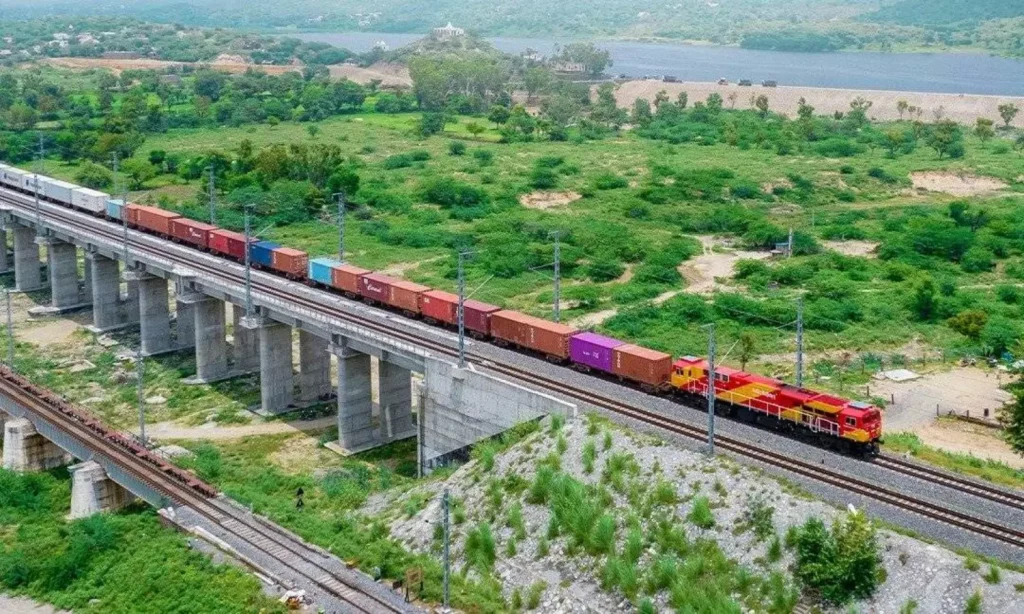
- Dedicated Freight Corridors (DFCs) are railway routes designed primarily for freight, separating goods traffic from passenger services on conventional railway lines.
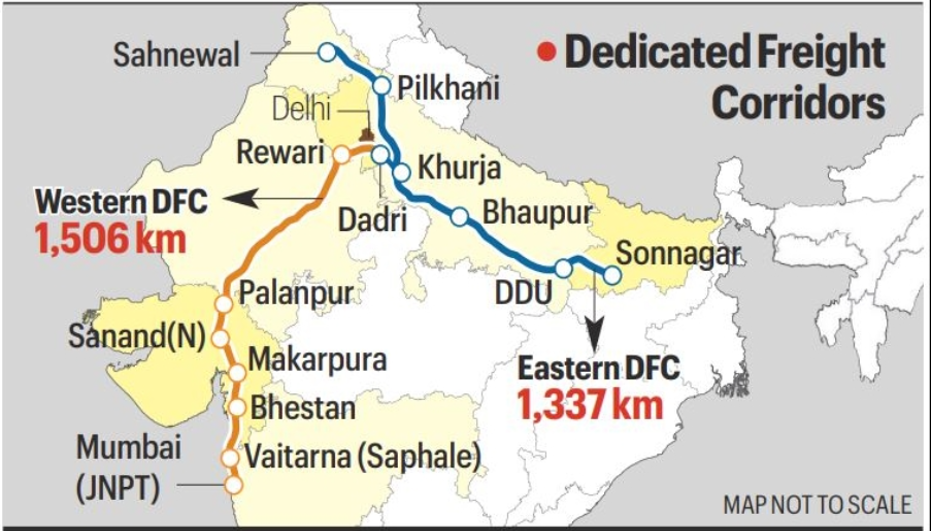
- India presently has two operational corridors:
- Eastern DFC (EDFC): 1,337 km, from Ludhiana/Sahnewal to Sonnagar, primarily carrying coal and mineral traffic.
- Western DFC (WDFC): 1,506 km, from Dadri to JNPT, primarily connecting western ports with northern consumption and production centres.
- DFCs are designed for higher axle loads, longer/heavier trains and electrified operations, enabling faster and higher-volume freight movement.
- The WDFC also facilitates double-stack container operations, improving cargo-carrying capacity per train.
- The separation of freight from passenger traffic also releases capacity on conventional railway routes for additional passenger and freight services.
India’s DFC Network: Key Achievements and Impact
- 2,843-km network operational: The completed EDFC–WDFC network is currently handling about 443 freight trains a day on average.
- Higher speed: Average freight-train speeds on DFCs are over 50 km/h—roughly twice the average on non-DFC routes, substantially reducing transit time.
- Higher freight capacity: The Railways recorded its highest-ever freight loading of 1,670 million tonnes in 2025–26, while DFCs support longer, heavier and double-stack trains.
- Decongestion of passenger routes: Moving freight to dedicated tracks frees paths on conventional routes, enabling additional passenger/coaching services and improving utilisation of the existing railway network.
- Port–hinterland connectivity: WDFC links JNPT, Mumbai, Pipavav, Mundra and Kandla with northern ICDs, while EDFC strengthens the movement of coal and minerals from eastern India.
- Lower logistics burden: Faster transit, higher throughput and more predictable movement can reduce freight costs and improve the competitiveness of Indian manufacturing and exports.
Significance for India’s Logistics and Economy
- Shift towards rail freight: Rail currently carries around 27% of India’s freight, while the National Rail Plan envisages raising this to 45% by 2030, making higher-capacity corridors crucial for achieving the modal-shift objective.
- Passenger mobility: By removing freight bottlenecks from mixed-use routes, DFCs create additional capacity for passenger trains, potentially improving frequency and reliability.
- Industrial competitiveness: Faster movement of containers, coal, minerals, fertilisers, foodgrains, steel and cement can reduce inventory and transportation burdens for industry.
- Port-led growth: Faster port–hinterland movement strengthens India’s export logistics by reducing the time taken to move containers between ports and inland production/consumption centres.
- Railway finances: Freight generates over 65% of Indian Railways’ total earnings and cross-subsidises passenger services; expanding efficient freight capacity therefore has implications for the financial sustainability of passenger operations.
Way Ahead
- Expand the DFC grid: The government has proposed a Dankuni–Surat East–West DFC, with its Detailed Project Report (DPR) under preparation, which could extend dedicated freight connectivity across India’s eastern, central and western industrial belts.
- Improve last-mile connectivity: Integrate DFCs with ports, ICDs, industrial clusters, logistics parks and production centres so that gains on the trunk route translate into end-to-end logistics efficiency.
- Increase rail’s freight share: Achieving the 45% rail-freight target by 2030 will require competitive freight rates, reliable transit, efficient terminals and greater movement of containerised, agricultural and other non-bulk cargo.
- Strengthen multimodality: Integrating DFCs with roads, ports, inland waterways, MMLPs and digital freight systems under PM Gati Shakti can reduce overall logistics costs rather than merely reducing rail transit time.
- Maximise existing capacity: Better signalling, terminal turnaround and longer/heavier trains can help extract greater throughput from the completed network as freight demand expands.