
SYLLABUS
GS-3: Science and Technology- Developments and their Applications and Effects in Everyday Life; Indigenization of Technology and Developing New Technology.
Context: HAL and France’s Safran Helicopter Engines have signed a final contract to jointly develop the ‘Aravalli’, marking the first instance of a high-power helicopter engine being designed and developed in India.
More on the News
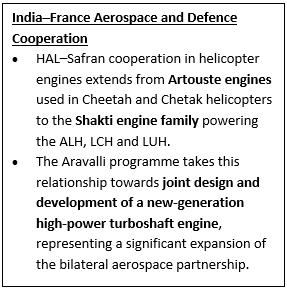
• HAL and Safran have signed the contract through their 50:50 joint venture, SAFHAL Helicopter Engines Pvt. Ltd., for the Aravalli programme.
• The agreement covers the joint design, development, manufacture, supply and lifecycle support of the new-generation helicopter engine.
• The programme builds on the long-standing HAL–Safran partnership in helicopter-engine technology and takes the cooperation towards joint development of a new high-power propulsion system.
• The Aravalli programme is expected to strengthen India’s indigenous aerospace-propulsion capabilities and the wider defence-industrial ecosystem.
Understanding the Aravalli Engine Programme
• High-Power Turboshaft Engine: Aravalli is a new-generation 3,500–4,000 shaft horsepower (shp) turboshaft engine, incorporating advanced propulsion technologies and designed for demanding operating environments.
• Intended Platforms: The engine has been selected for HAL’s 13-tonne Indian Multi-Role Helicopter (IMRH) and its 12.5-tonne naval variant, Deck-Based Multi-Role Helicopter (DBMRH), being developed for the Indian Navy.
• SAFHAL and Manufacturing: The programme is being undertaken through SAFHAL, a 50:50 HAL–Safran joint venture, with the engine to be manufactured at Tumakuru, Karnataka.
• Technology Access: The programme will provide HAL access to critical engine technologies, including the high-pressure compressor, power turbine, fuel and oil systems, accessory gearbox and engine external systems, while Indian engineers will work alongside Safran engineers during development.
• Development Timeline: Design and development of the Aravalli engine is expected to be completed by 2032–33.
Significance for India’s Defence and Aerospace Ecosystem
• From Licensed Production to Co-development: Aravalli marks a shift from earlier HAL–Safran cooperation centred on licensed production/co-production and existing engine technologies towards joint design and development of a high-power engine, enabling deeper capability-building in critical propulsion technologies.
• Aero-Engine Self-Reliance: Developing a high-power helicopter engine in India strengthens capabilities in a strategically critical and technologically complex propulsion segment, reducing dependence on foreign engine technologies over time.
• Technology Absorption: Access to critical technologies, intellectual property in HAL-led design areas and participation of Indian engineers can strengthen domestic capabilities in engine design, testing, certification and lifecycle support.
• Indigenous Rotorcraft Capability: The Aravalli will provide propulsion for the IMRH and DBMRH, supporting India’s efforts to develop indigenous medium-lift military helicopters and reduce dependence on imported platforms.
• Aerospace Industrial Ecosystem: Domestic manufacturing can generate capabilities across precision engineering, advanced manufacturing, component supply chains and MRO, creating a broader ecosystem for future aerospace programmes.
Challenges in Indigenous Aero-Engine Development
• Technological Complexity: High-power turboshaft engines require advanced capabilities in compressors, turbines, combustion, thermal management, materials and precision manufacturing.
• Testing and Certification: Extensive testing and certification will be essential to establish reliability, safety, durability and performance under diverse operating conditions.
• Technology Absorption: The long-term value of the partnership will depend on translating technology access and joint engineering into sustained Indian design and development capabilities.
• Programme Execution: Sustained funding, skilled manpower, testing infrastructure and domestic supply-chain capacity will be critical to meeting the 2032–33 development target.
Way Forward
• Build Indigenous Design Capability: Use the Aravalli programme to progressively expand Indian expertise in core engine architecture, design and development.
• Deepen Domestic Manufacturing: Localise critical components, advanced materials and precision-manufacturing capabilities to build a robust indigenous propulsion supply chain.
• Strengthen Testing and MRO: Expand domestic testing, certification, maintenance, repair and overhaul (MRO) capabilities across the engine lifecycle.
• Leverage Future Platforms: Build on the technological base created by Aravalli for future high-power military and potential civil rotorcraft applications, wherever technically and commercially viable.