
SYLLABUS:
GS-3- Conservation, environmental pollution and degradation, environmental impact assessment.
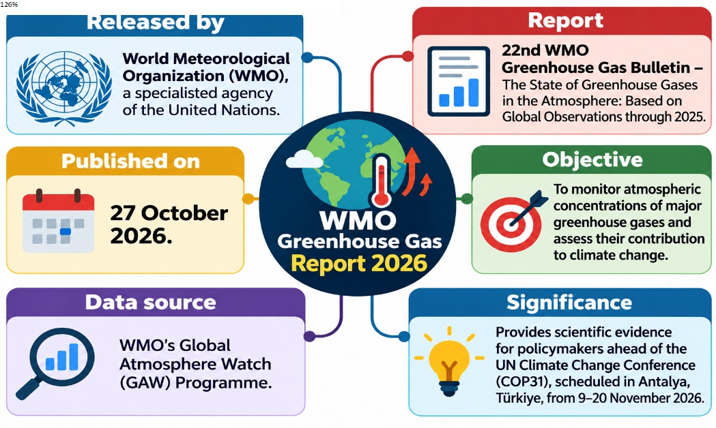
Context: According to the 22nd edition of the WMO Greenhouse Gas Bulletin, atmospheric concentrations of major greenhouse gases reached unprecedented levels in 2025, increasing the risk of long-term global warming and extreme climate events.
Key Findings of the Report
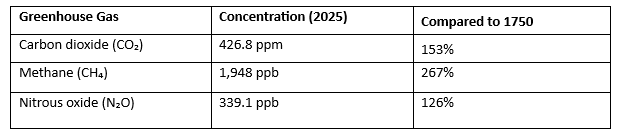
- Record Concentrations of Major Greenhouse Gases: Globally averaged atmospheric concentrations of the three major long-lived greenhouse gases reached unprecedented levels in 2025.
- CO₂ accounts for approximately 66% of radiative forcing from long-lived greenhouse gases, followed by methane (16%) and nitrous oxide (6%).
- The past 11 years have been the warmest on record.
- Rising Carbon Dioxide Concentrations: Atmospheric CO₂ increased from 377.5 ppm in 2004 to 426.8 ppm in 2025.
- Its annual growth rate has tripled, from around 0.8 ppm in the 1960s to 2.4 ppm during 2011–2020.
- CO₂ increased by 2.8 ppm between 2024 and 2025, lower than the record rise of 3.6 ppm in 2023–2024, but slightly above the 10-year average of 2.63 ppm.
- During 2015–2024, approximately 50% of human-caused CO₂ emissions accumulated in the atmosphere, while oceans absorbed 29% and land absorbed 21%.
- The NOAA Annual Greenhouse Gas Index shows that radiative forcing from long-lived greenhouse gases increased by 56% between 1990 and 2025, with CO₂ accounting for around 81% of this increase.
- The slower CO₂ growth in 2025 was partly linked to the recovery of land carbon sinks and reduced fire emissions. However, continued fossil fuel use is expected to increase concentrations further.
- Methane and Nitrous Oxide: Around 65% of methane emissions are anthropogenic, mainly from livestock, rice cultivation, fossil fuel exploitation, landfills and biomass burning.
- The remaining 35% comes from natural sources, including wetlands and termites.
- Methane increased by 6 ppb in 2025, lower than the 8 ppb rise in 2024 and the 10-year average annual increase of 10.2 ppb.
- Around 35% of nitrous oxide emissions are anthropogenic, mainly from agricultural fertilisers and industrial activities. Human-induced emissions increased by 30% over four decades, reaching 7.3 teragrams of nitrogen per year.
- Emerging Concerns:
- Sulphur hexafluoride (SF₆) is used mainly as an electrical insulator in high-voltage equipment. Its atmospheric concentration increased by 249% between 1995 and 2025, reaching 12.24 ppt.
- It has a global warming potential around 24,300 times that of CO₂ over 100 years and can remain in the atmosphere for up to 3,200 years.
- Hydrogen (H₂) is not directly a greenhouse gas but can indirectly contribute to warming by affecting atmospheric chemistry and extending methane’s lifetime.
- Its atmospheric concentration increased from 532 ppb in 2010 to 560 ppb in 2024. The WMO has highlighted the need to minimise hydrogen leakage.
- Sulphur hexafluoride (SF₆) is used mainly as an electrical insulator in high-voltage equipment. Its atmospheric concentration increased by 249% between 1995 and 2025, reaching 12.24 ppt.
Recommendations and Way Forward
- Strengthen atmospheric monitoring: Improve global greenhouse gas observations through the WMO’s Global Atmosphere Watch programme.
- Reduce CO₂ emissions: Accelerate the transition away from fossil fuels and strengthen natural carbon sinks.
- Control methane and nitrous oxide: Reduce emissions from agriculture, livestock, waste management and fertiliser use.
- Limit SF₆ emissions: Promote alternatives with lower global warming potential in electrical equipment.
- Minimise hydrogen leakage: Strengthen leak prevention across hydrogen production, pipelines, storage facilities and fuel cells.