
SYLLABUS
GS-3: Conservation, environmental pollution and degradation, environmental impact assessment.
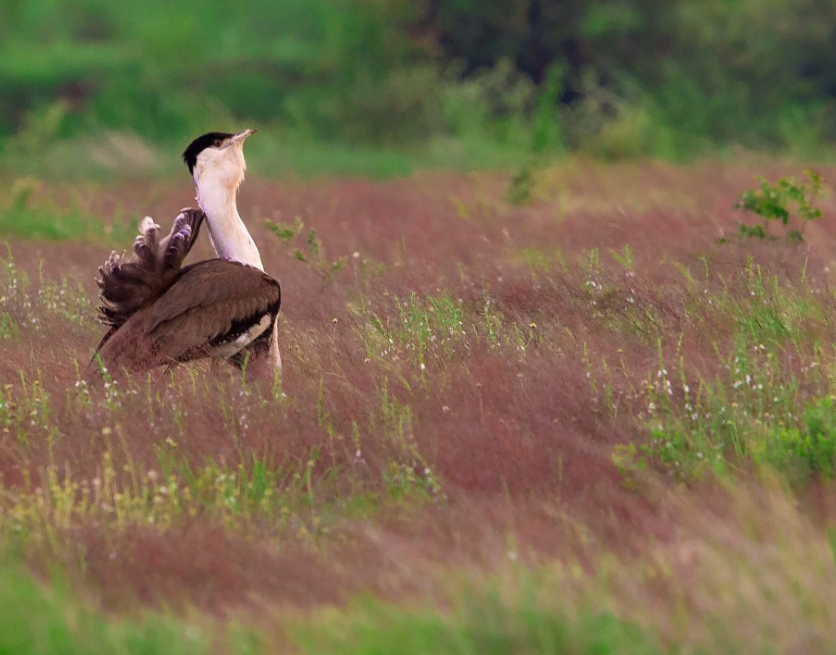
Context: In a major conservation milestone, two captive-bred male Great Indian Bustards (GIBs) were released into the wild at Sam in the Desert National Park, Jaisalmer, Rajasthan, marking the beginning of the species’ rewilding process.
More on the News
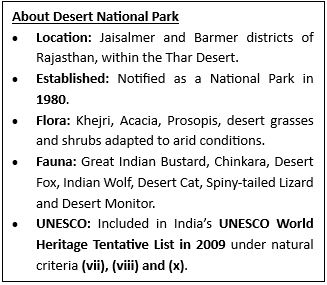
• The release of 2 GIBs marks an important shift in India’s conservation strategy—from building a viable captive-bred population to reintroducing the birds into their natural habitat.
• A total of 11 captive-bred GIBs have been earmarked for release. 2 have been released in the first phase, while the remaining 9 will be released in subsequent phases, based on the birds’ adaptation, behaviour and survival.
• The first release will serve as a pilot exercise. Scientists will monitor the birds through telemetry and other methods to understand their movement, habitat use and adaptation.
• These findings will help refine the protocol for future releases.
Major Threats
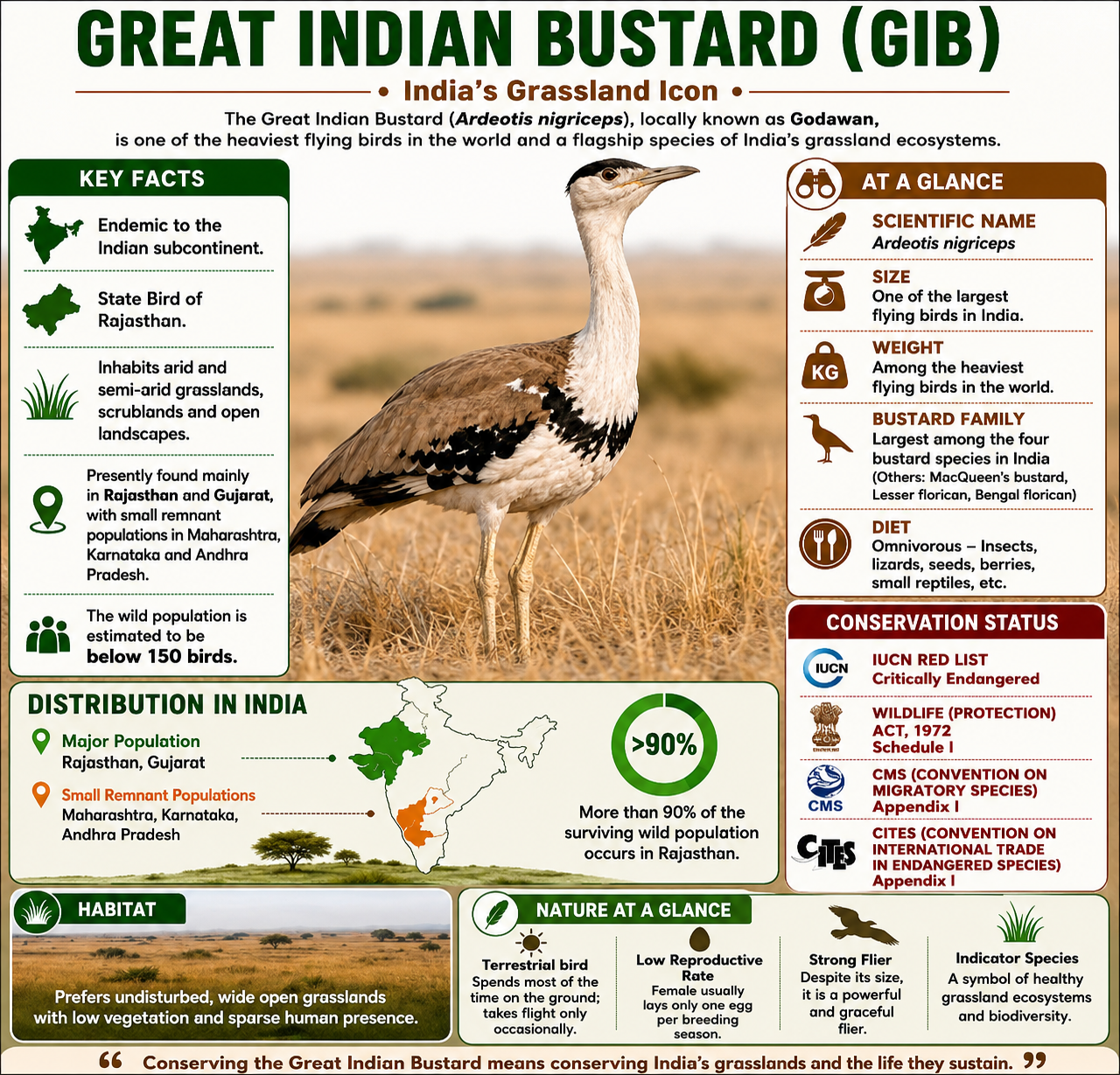
• Loss and fragmentation of grassland habitat.
• Conversion of natural grasslands for other land uses.
• Disturbance during the breeding season.
• Historical hunting and poaching.
• Infrastructure and other human-induced disturbances.
• Extremely slow reproductive rate and other life-history characteristics that make population recovery difficult.
Conservation Efforts for GIB
• Project GIB: Envisioned in 2011 and formally launched in 2016, Project GIB is a long-term recovery programme implemented by MoEFCC, Rajasthan Forest Department and WII.
- It is supported by National CAMPA and the International Fund for Houbara Conservation, with focus on captive breeding, habitat management, threat mitigation and reintroduction.
• Conservation Breeding & Rewilding: The conservation-breeding facilities at Sam and Ramdevra, Jaisalmer, now house 97 GIBs, of which 11 are earmarked for release. Two have already been released into the wild, marking the transition from captive population building to rewilding.
• ‘Jumpstart’ Approach: Under the ‘jumpstart’ technique, captive-laid eggs are placed in wild GIB nests for natural incubation.
- The method has produced 6 chicks in Rajasthan and 2 in Gujarat and was expanded through an inter-state initiative in 2026.
• Habitat Restoration & Scientific Management: Around 200 sq. km of fenced grassland enclosures have been established in the Desert National Park.
- WII’s long-term telemetry studies help identify breeding habitats and guide habitat management and future reintroduction.
• Supreme Court Intervention: The Supreme Court’s 2024 judgment called for a science-based approach to protect GIBs from power-line collisions.
- It also recognised wider threats such as habitat loss, fragmentation and low reproductive rate, with an Expert Committee guiding conservation measures.