
SYLLABUS
GS-3: Conservation, environmental pollution and degradation, environmental impact assessment; Inclusive Growth and issues arising from it.
Context: The Circularity Gap Report 2026, released by Circle Economy, a non-profit organisation in collaboration with Deloitte Netherlands, highlights that economies worldwide fundamentally depend on materials, yet a significant portion of their value is lost at each stage of production, use, and disposal.
About Circularity Gap Report 2026
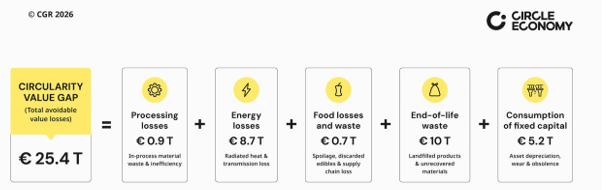
- Each year, an estimated €25.4 trillion in economic value is lost due to resource inefficiencies, premature product disposal, and under utilised assets.
- Compared with a global GDP of €82.6 trillion, the scale of material-related losses is immense, implying that for every €3 of economic value created globally, around €1 is lost due to linear material use.
- The report introduces the concept of the Value Gap, which measures avoidable economic losses tied to linear material use systems.
- This gap reflects not only financial inefficiencies but also hidden environmental and social costs, such as pollution, resource depletion, and negative health impacts.
- Understanding this gap helps identify where interventions can reduce waste and improve long-term value retention across economies.
Key Findings of the Report
- Pathways of Value Loss: Value loss can be understood through five key pathways across production, use, and disposal stages:
- Processing losses (€904.2 billion): Inefficiencies during manufacturing stages
- Energy losses (€8.7 trillion): Wasted energy throughout extraction and use
- Food losses and waste (€650.7 billion): Edible food that exits the supply chain without being consumed, including losses during storage, transport, retail, and final consumption
- End-of-life waste (€10.0 trillion): Discarded products whose value is not recovered
- Consumption of fixed capital (€5.2 trillion): Deterioration of buildings, infrastructure, and machinery
- Mechanisms Driving Value Loss: These losses are driven by four main mechanisms:
- Poor management of materials and products (€6.2 trillion): About 24% of total value loss
- Internalised shadow costs (€7.5 trillion): About 30% of total value loss, reflecting environmental damage
- Premature obsolescence (€6.5 trillion): About 26% of total value loss
- Deterioration of long-lived assets (€5.2 trillion): About 20% of total value loss
- Value Loss Across the Value Chain: Looking at the value chain, losses are spread across all stages:
- Upstream activities: €5.3 trillion, mainly from energy inefficiencies
- Use phase: €10.1 trillion, due to energy waste and asset deterioration
- Downstream stage: €10.0 trillion, largely from discarded products
- Implications for Economy and Sustainability
- Economic Implications: The magnitude of €25.4 trillion in annual losses reflects significant inefficiencies in global production and consumption systems, indicating large untapped potential for value recovery.
- Environmental and Social Implications:The Value Gap includes hidden costs such as pollution, resource depletion, and health impacts, highlighting the broader sustainability challenges associated with linear material use.
Way Forward
- Role of Businesses:
- Build a holistic business case for circular value creation: Systematically identify and quantify value losses to uncover circular opportunities that can deliver financial, strategic, and risk-related benefits.
- Innovate and scale circular business models: Engage in innovative circular business models based on their market readiness across technology, finance, and regulation.
- Role of Financiers:
- Integrate resource-use maximisation into decision-making: Factor repairability, durability, and recoverability into investment and lending assessments.
- Assess exposure to resource-related risks: Evaluate vulnerabilities in supply chains and asset lifetimes.
- Role of Policymakers:
- Support target-setting: Setting goals and science-based targets could help optimise resource extraction and consumption and guide businesses and societies toward sustainable practices.
- Consider economic instruments: Recognise how taxes and incentives can reduce value loss, making circular practices more profitable and discouraging resource-intensive behaviour.
Conclusion
The €25.4 trillion Value Gap reflects inherent inefficiencies of linear growth models, highlighting broader sustainability challenges; the Circularity Gap Report 2026 underscores the need to shift from extraction-driven growth to value retention, regeneration, and a more resilient, efficient, and sustainable global economy.
Source:
Downtoearth
Dashboard
Gdrc