
SYLLABUS
GS-2: Functions and responsibilities of the Union and the States, issues and challenges pertaining to the federal structure, devolution of powers and finances up to local levels and challenges therein.
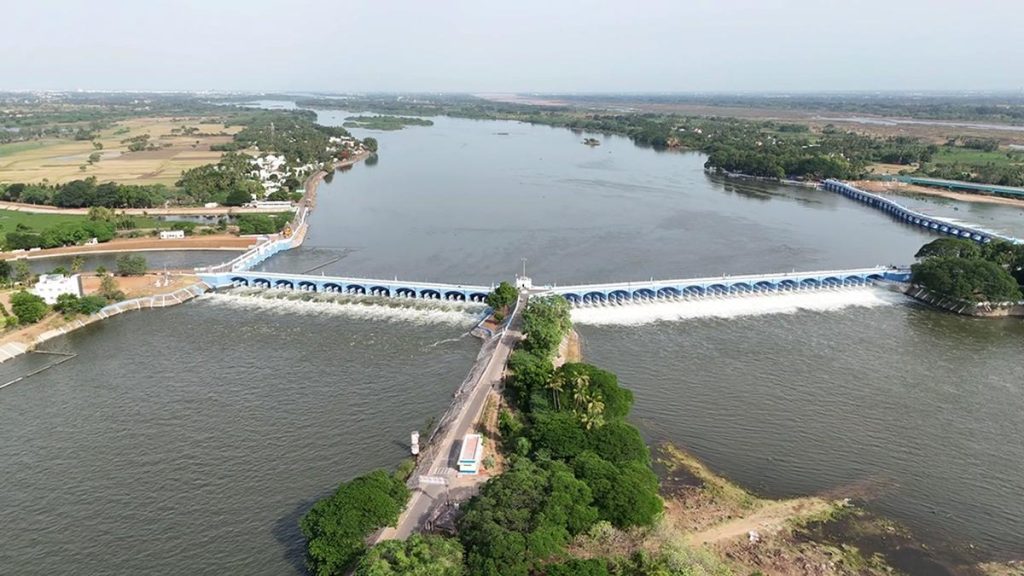
Context: Karnataka has approached the Supreme Court seeking a temporary injunction against Tamil Nadu and the Union government to halt the Cauvery (Kattalai)–South Vellar–Vaigai–Gundar Link Project, alleging unauthorised utilisation of surplus Cauvery waters originating from Karnataka.
Key concerns raised by Karnataka
- Tamil Nadu sought in-principle approval and national project status from the Centre on January 5, 2021.
- Karnataka claims that several Phase-I structures have already been completed and land acquired without the required Union clearance.
- Tamil Nadu has estimated around 8.60 TMC of surplus water at Mettur Dam, at 50% dependability, for the project.
- Karnataka fears that unilateral utilisation of surplus Cauvery waters originating from its territory could prejudice its future water-sharing rights.
- It has sought a halt to Phase-I, II and III works, demolition of completed Phase-I structures and restraint on the Centre from processing Tamil Nadu’s approval request.
- An earlier interim application was disposed of by the Supreme Court on January 20, 2025, as the Centre had not granted in-principle approval at that time.
About the Cauvery (Kattalai)–South Vellar–Vaigai–Gundar Link Project (CVG Link)
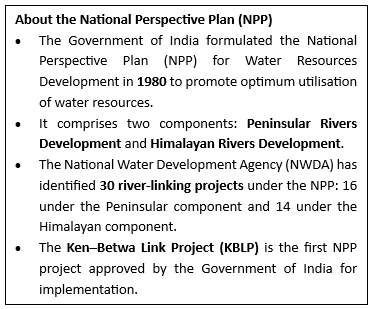
- The project is part of the National Perspective Plan (NPP), 1980, formulated by the Ministry of Irrigation (now Ministry of Jal Shakti).
- Its Peninsular Rivers Development component envisages transferring surplus water from the Mahanadi and Godavari basins to water-deficit basins of the Krishna, Pennar, Cauvery, Vaigai and Gundar rivers.
- The National Water Development Agency (NWDA) prepared the Detailed Project Report (DPR) for the Cauvery–Vaigai–Gundar link in 2020.
- Objectives:
- To divert occasional surplus floodwater from the Cauvery at Kattalai (Mayanur) towards water-deficit regions of Tamil Nadu.
- To meet drinking water requirements and support irrigation in drought-prone areas.
- To promote groundwater recharge and reduce dependence on groundwater.
- Three Phases of the Project:
- Phase I: Cauvery (Kattalai)–South Vellar (118.45 km)
- Phase II: South Vellar–Vaigai (109.695 km)
- Phase III: Vaigai–Gundar (34.045 km)
Need and Significance of the Project
- Uneven Rainfall and Water Scarcity: Tamil Nadu receives around 921 mm of average annual rainfall against the national average of 1,200 mm, with uneven monsoon distribution causing recurring water shortages, particularly in drought-prone southern districts.
- Drinking Water Security: The project aims to divert occasional surplus Cauvery floodwater to water-deficit districts, including Karur, Tiruchirappalli, Pudukkottai, Sivaganga and Ramanathapuram, to meet drinking water requirements.
- Groundwater Depletion: Recurrent droughts and excessive dependence on groundwater for drinking and irrigation have caused groundwater stress, necessitating measures to improve recharge and reduce groundwater extraction.
- Agricultural Development: The project aims to support irrigation, stabilise existing agricultural command areas and improve agricultural productivity in water-deficit regions.
- Flood Management and Regional Development: Diversion of surplus Cauvery floodwater can help reduce flooding in areas such as Tiruchirappalli and Srirangam while promoting employment and rural economic development.