

Pichwai Painting
Context: Prime Minister Narendra Modi gifted a Golden Pichwai painting from Nathdwara, Rajasthan, to US President Donald Trump during his November 2026 visit to Manila, Philippines.
About Pichwai Painting
- Pichwai means “that which hangs behind”.
- It is a traditional devotional cloth painting used as a backdrop behind the idol of Shrinathji (a form of Lord Krishna) in temples.
- Place: Nathdwara, Rajasthan.
- Origin: Originated in the 17th century. Developed through hereditary painter families and traditional guru–shishya lineages.
- Themes: Depicts Shrinathji’s daily rituals, Krishna’s divine activities, religious festivals, seasonal celebrations and stories from the Bhagavata Purana.
- Characteristics:
- Traditionally painted on hand-prepared cotton cloth.
- Uses natural mineral pigments, fine brushes and gold detailing.
- Features vibrant colours, intricate compositions and miniature-style detailing.
- Common motifs include lotuses, cows, trees, flutes and ornamental borders.
- Reflects Nathdwara’s Vaishnav devotional traditions.
- Major Paintings:
- Golden Pichwai: Known for elaborate gold detailing and rich compositions.
- Annakut Pichwai: Depicts the Annakut festival and offerings to Shrinathji.
- Sharad Purnima Pichwai: Features Sharad Purnima celebrations, often with moonlit lotus motifs.
National Gopal Ratna Award (NGRA), 2026
Context: The Department of Animal Husbandry and Dairying announced the winners of the National Gopal Ratna Award (NGRA) 2026 to recognise contributions towards the conservation and development of indigenous bovine breeds.
About the National Gopal Ratna Award
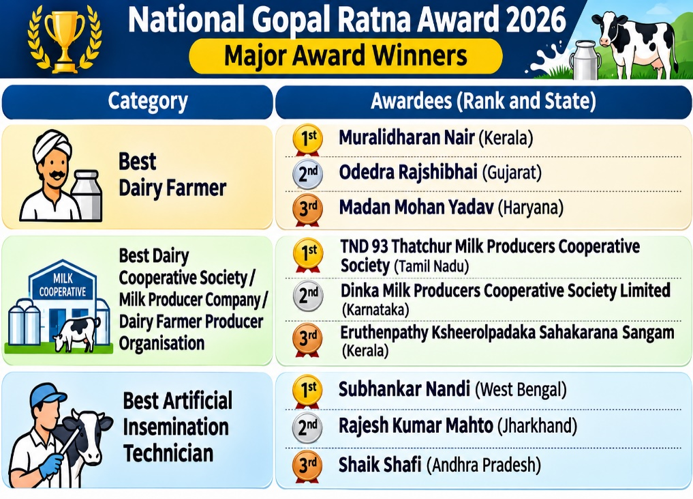
- The Department of Animal Husbandry and Dairying, under the Ministry of Fisheries, Animal Husbandry and Dairying, launched the Rashtriya Gokul Mission (RGM) in December 2014 to scientifically conserve and develop indigenous bovine breeds.
- Under RGM, the National Gopal Ratna Award has been conferred annually since 2021 to encourage stakeholders in the dairy sector.
- It recognises contributions under three categories.
- A special award for the North Eastern Region (NER) and Himalayan States encourages dairy development in these regions.
- The special awards went to Sagar Singh Rawat (Farmer), Chak Devia Dairy Cooperative Ltd (DCS) and Sudhesh Kumar (AIT).
- Awards are conferred on National Milk Day (26 November).
Fossilised Jaw of Prehistoric Elephant Discovered in Madhya Pradesh
Context: Erosion along the Narmada River has exposed a fossilised elephant jaw at Patai Ghat in Raisen district, Madhya Pradesh, preliminarily identified as belonging to the extinct Palaeoloxodon namadicus.
About Palaeoloxodon namadicus
- Nature: An extinct straight-tusked elephant species and one of the largest elephants to have ever lived.
- Geological Period: Lived during the Pleistocene Epoch (approximately 2.6 million to 11,700 years ago).
- Distribution: Primarily known from Pleistocene deposits of the Indian subcontinent, including the Narmada and Godavari valleys, the Ganga Valley and parts of West Bengal.
- Size: Estimated to have reached a shoulder height of around 4.5 metres and a body mass of 13–19 tonnes, making it one of the largest known land-dwelling proboscideans.
- Habitat and Diet: Primarily inhabited open grasslands and followed a grazing-dominated mixed diet.
- Extinction: Became extinct during the Late Pleistocene, possibly around 25,000–50,000 years ago.
Key Findings of the Discovery
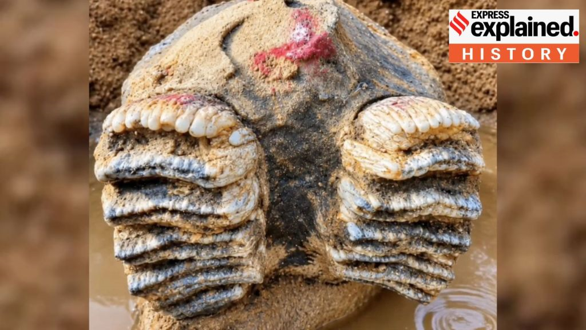
- Location: Patai Ghat, near Patai village, Deori tehsil, Raisen district, Madhya Pradesh.
- Fossil Dimensions: Approximately 75 cm long and 25 cm wide, with 7–9 parallel ridges on its molars.
- Identification: Preliminary assessment favours Palaeoloxodon namadicus over Stegodon. The animal may have been a juvenile.
- Geological Context: Found in yellowish soil associated with the Baneta Formation, indicating the Pleistocene period.
- Age: Preliminary estimates range from 4–5 lakh to 7–8 lakh years; scientific dating is awaited.
Surveillance Pricing
Context: The New York City Council passed a bill on November 12, 2026, by a vote of 44–5, to ban surveillance pricing, under which businesses use consumers’ personal data and algorithms to charge different prices for the same goods and services.
About the Surveillance pricing
- It is the practice of using personal information about consumers to determine the prices they are offered for goods and services.
- Businesses use algorithms to analyse information such as location, browsing history, previous purchases and online shopping behaviour to estimate an individual’s willingness to pay.
- As a result, two consumers purchasing the same product at the same time may be offered different prices.
Karakoram-2026
Context: China and Pakistan conducted Karakoram-2026, their first joint army-level exercise involving regular army formations, from 14–22 October 2026 at Korla, Xinjiang, China.
About Karakoram-2026
- Focus: Joint counter-terrorism operations in high-altitude areas, including UAV operations, moving-target search and firing, and long-range sniping.
- Distinctive Feature: Involved regular army formations, mixed formations and coordinated live-force exercises, marking an expansion in the scope of bilateral military cooperation.
Strategic Implications for India
- Geographical Significance: Conducted in Xinjiang, which adjoins India’s Ladakh region, making it strategically relevant to India’s northern security environment.
- Growing Military Integration: Enhances interoperability and operational coordination between the two militaries, potentially adding complexity to India’s two-front security calculations.