
SYLLABUS
GS-3: Conservation, environmental pollution and degradation.
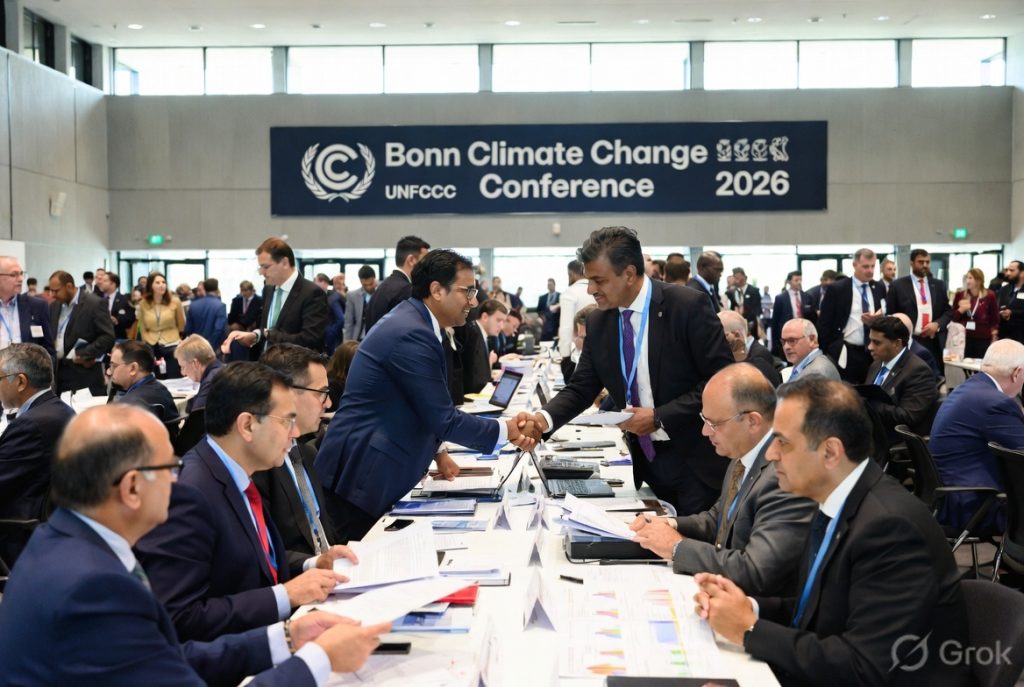
Context: Recently, the 64th Session of the Subsidiary Bodies (SB64) of the United Nations Framework Convention on Climate Change (UNFCCC) concluded in Bonn, Germany, after two weeks of negotiations ahead of COP31 to be held in Antalya, Türkiye.
Key Outcomes of the Conference
- Global Electrification Target Proposed: The COP31 Presidency proposed raising the share of electricity in global final energy consumption from about 21% to 35% by 2035.
- Electrification was identified as a key pathway for reducing emissions, improving energy security, and accelerating the clean energy transition.
- The proposal complements ongoing efforts to transition away from fossil fuels in energy systems.
- Climate Finance Remained the Central Issue: Developing countries demanded stronger implementation of developed countries’ finance obligations under Article 9.1 of the Paris Agreement.
- Concerns were raised over declining contributions to climate funds and widening adaptation finance gaps.
- Many developing countries sought a stronger and more structured climate finance agenda within the UNFCCC process.
- Adaptation Finance Deadlock: Developing countries pushed for incorporating the commitment to at least triple adaptation finance by 2035.
- Several developed countries opposed incorporating adaptation-finance commitments into the Global Goal on Adaptation (GGA) negotiations.
- No consensus emerged on several aspects of the Global Goal on Adaptation (GGA).
- Just Transition Discussions Advanced: Negotiators advanced discussions on the proposed Belém–Antalya Mechanism (BAM) for Global Just Transitions.
- Developing countries called for greater support through finance, technology transfer, and capacity building to ensure equitable transitions.
- Trade and Climate Dialogue Initiated: The first dedicated dialogue on trade and climate was held under the UNFCCC process.
- Developing countries raised concerns regarding unilateral trade measures such as the European Union’s Carbon Border Adjustment Mechanism (CBAM).
- Differences persisted over whether climate-related trade measures should be viewed as climate tools or trade barriers.
- Mitigation Work Programme Deadlock: Negotiators failed to reach agreement on the future direction of the Mitigation Work Programme (MWP).
- The issue was deferred to COP31 under Rule 16 due to the lack of consensus.
About the Bonn Climate Change Conference
- It is an annual mid-year meeting held under the United Nations Framework Convention on Climate Change (UNFCCC), an international agreement signed in 1992 that has provided a basis for global climate negotiations.
- The conference is formally known as the Sessions of the UNFCCC Subsidiary Bodies (SBs).
- Along with the annual Conference of the Parties (COP), it is the only other regular climate summit hosted by the UNFCCC.
- It is attended by:
- Members of the UNFCCC Subsidiary Bodies.
- Indigenous representatives, international organisations, scientists, and civil society representatives.
- The Bonn Conference focuses on:
- Discussing technical and scientific issues related to climate negotiations.
- Setting the agenda for COP, which usually takes place in November each year.
- Reviewing and advancing the implementation of agreements made at the previous COP.
- Two permanent Subsidiary Bodies (SBs) lead the conference:
- Subsidiary Body for Implementation (SBI): Assists UNFCCC’s governing bodies in assessing and reviewing the implementation of decisions. Facilitates technical and financial support discussions for developing countries.
- Subsidiary Body for Scientific and Technological Advice (SBSTA): Provides scientific advice on climate change issues to UNFCCC bodies. Acts as a link between scientific advisors at the Intergovernmental Panel on Climate Change (IPCC) and COP policymakers.