
SYLLABUS
GS-1: Salient features of World’s Physical Geography; Important Geophysical Phenomena. GS-3: Conservation, environmental pollution and degradation, environmental impact assessment.
Context: A recent study in Nature Communications Earth and Environment highlights that a potential collapse of the Atlantic Meridional Overturning Circulation (AMOC) could release significant oceanic carbon, particularly from the Southern Ocean, thereby amplifying global warming and pushing the climate system toward a critical tipping point.
About the Atlantic Meridional Overturning Circulation (AMOC)
- It is a major system of ocean currents and forms the Atlantic branch of the thermohaline circulation, also known as the global ocean conveyor belt.
- It transports warm surface water to the Arctic, influencing climate in northern North America and Europe, and returns cold deep water to the tropics.
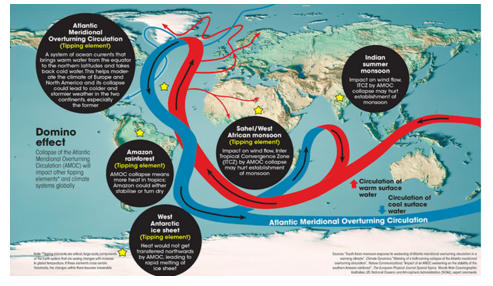
- It plays a crucial role in transporting heat, carbon, and nutrients across the world’s ocean basins.
- Process of circulation:
- Warm surface waters from the tropics move northward into the North Atlantic.In the colder northern regions, these waters lose heat, become denser, and sink into the deep ocean.The deep currents then flow southward, moving towards the tropics and the South Atlantic.
- From there, they are redistributed globally through the Antarctic Circumpolar Current, completing the conveyor-belt circulation.
Key Highlights:
- Role of AMOC in the Climate System
- Heat Distribution Mechanism: The AMOC functions as a global ocean conveyor belt, transporting warm surface water from the tropics to the North Atlantic and returning cold deep water southward. This process ensures balanced heat distribution across the planet.
- Climate Regulation Function: It moderates temperatures in regions such as Europe and North America and plays a crucial role in maintaining global climate stability.
- Carbon Cycle Contribution: The AMOC helps in the storage and redistribution of carbon within the oceans, making it essential for regulating atmospheric CO₂ levels.
- AMOC as a Climate Tipping Element
- Threshold Behaviour: AMOC is one of the 16 climate tipping elements that could undergo abrupt, irreversible changes with widespread cascading impacts.
- Irreversibility Risk: Such a collapse could be difficult to reverse, especially under ongoing global warming conditions.
- Cascading Impacts: Its disruption could trigger widespread changes across oceanic, atmospheric, and ecological systems.
- Evidence of Ongoing Weakening
- Observed Decline: Studies indicate a steady weakening of the AMOC over the past two decades.
- Western Boundary Changes: Significant reductions have been observed in the western Atlantic boundary currents, which account for a major portion of the circulation strength.
- Ocean Monitoring Data: Ocean bottom pressure measurements confirm a decline in deep-water transport, strengthening concerns about system instability.
- Causes of AMOC Weakening
- Freshwater Input from Greenland: Melting of the Greenland Ice Sheet introduces freshwater into the North Atlantic, reducing salinity and weakening density-driven sinking.
- Impact of Global Warming:Rising temperatures alter ocean stratification and reduce vertical mixing, further weakening the circulation.
- Observations show that the AMOC is already weakening, and a 2023 study in Nature Communications estimates a possible collapse between 2037 and 2109.
- Climate Impacts of AMOC Collapse
- Global Temperature Change: AMOC collapse could increase global temperatures by about 0.17–0.27°C, largely due to additional CO₂ release.
- The study estimates that an AMOC collapse could release an additional 47-83 gigatonnes of CO₂ into the atmosphere.
- Regional Climate Contrast: The impacts would be uneven, with cooling of up to 7°C in the Arctic due to reduced heat transport, and warming of up to 6°C or more in parts of Antarctica, with some regions experiencing even higher warming. This creates a sharp polar contrast.
- Global Temperature Change: AMOC collapse could increase global temperatures by about 0.17–0.27°C, largely due to additional CO₂ release.
- Ocean-Carbon Feedback Mechanism
- The collapse would also intensify feedback mechanisms such as Sea ice albedo feedback, where increased ice cover reflects more sunlight, further cooling the Northern Hemisphere.
- At the same time, rising carbon-rich deep waters in the Southern Ocean would amplify atmospheric CO₂ levels.
- The collapse would also intensify feedback mechanisms such as Sea ice albedo feedback, where increased ice cover reflects more sunlight, further cooling the Northern Hemisphere.
- Broader Implications
- Climate System Disruptions: Changes in rainfall patterns, including impacts on monsoons, could affect agriculture and water availability.
- Ecological Consequences:Marine ecosystems may be severely disrupted, affecting biodiversity and fisheries.
- Socio-Economic Risks: Food insecurity, coastal vulnerability, and climate-induced migration may increase significantly.
Conclusion
The AMOC is a vital component of the Earth’s climate system, and its observed weakening signals a potential approach towards a tipping point. The findings from recent research highlight the urgency of strengthening climate action, enhancing ocean monitoring, and incorporating tipping point risks into global policy frameworks to prevent irreversible climate consequences.
Source:
Downtoearth
oceanservice